About Eucalyptus intertexta R.T.Baker
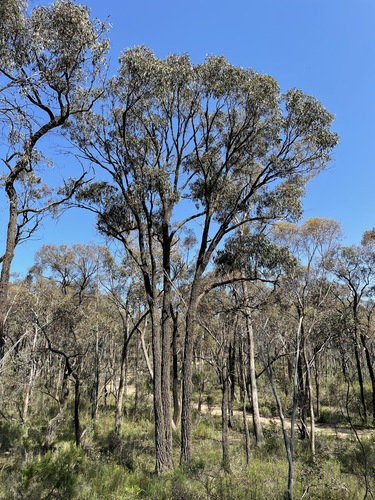
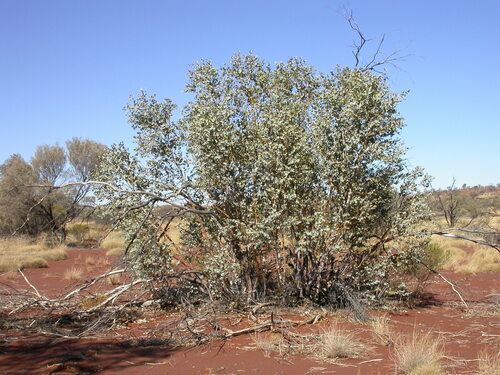
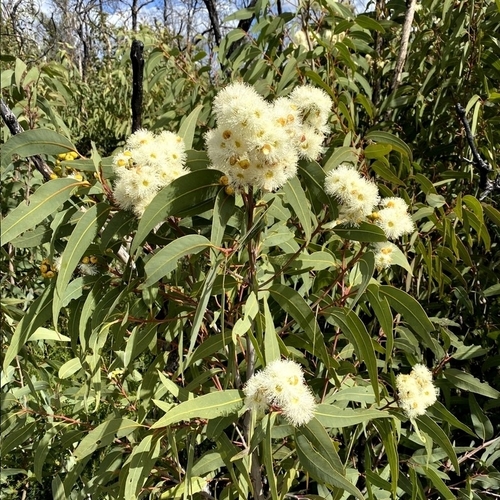
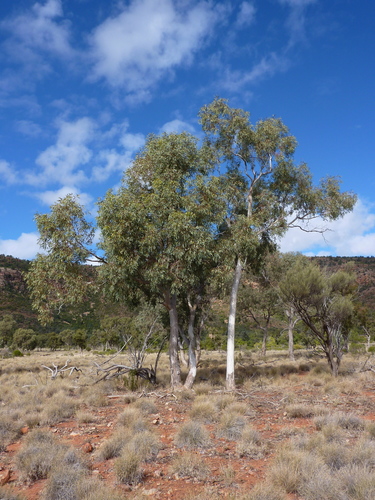
Eucalyptus intertexta, commonly known as inland red box, is most often a tree, and rarely a mallee. It typically grows to a height of 4 to 30 meters (13 to 98 feet) and forms a lignotuber. It has rough, fibrous or flaky bark at the base of the trunk, sometimes covering the full length of the trunk, with smooth white, grey, or brownish bark on sections above the rough bark. Young plants and coppice regrowth have dull greyish or glaucous, lance-shaped leaves that measure 30 to 120 mm (1.2 to 4.7 in) long and 10 to 35 mm (0.39 to 1.38 in) wide. Adult leaves are the same shade of bluish green or greyish green on both sides, are lance-shaped, and measure 50 to 160 mm (2.0 to 6.3 in) long, 8 to 25 mm (0.31 to 0.98 in) wide, growing from a petiole 5 to 15 mm (0.20 to 0.59 in) long. Flower buds are arranged at the ends of branchlets on a branching peduncle 5 to 17 mm (0.20 to 0.67 in) long. Each branch of the peduncle holds buds in groups of seven, with individual buds attached to pedicels 2 to 8 mm (0.079 to 0.315 in) long. Mature buds are oval, 4 to 8 mm (0.16 to 0.31 in) long and 2 to 4 mm (0.079 to 0.157 in) wide, with a conical operculum. Flowering occurs in most months of the year, and the flowers are white. The fruit is a woody, cup-shaped to hemispherical capsule that is 3 to 9 mm (0.12 to 0.35 in) long and 4 to 8 mm (0.16 to 0.31 in) wide, with its valves enclosed inside the capsule. Inland red box grows in woodland and open woodland. Its range covers the central deserts of Western Australia, the Northern Territory, and South Australia, extending into western New South Wales, southern Queensland, and eastern South Australia.