About Eucalyptus incrassata Labill.
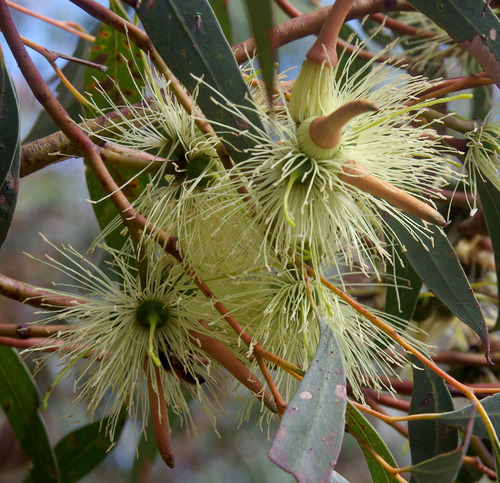
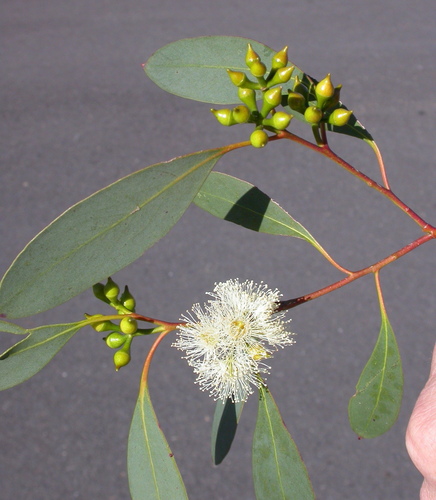
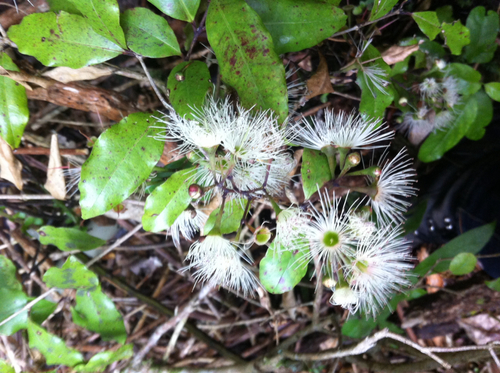
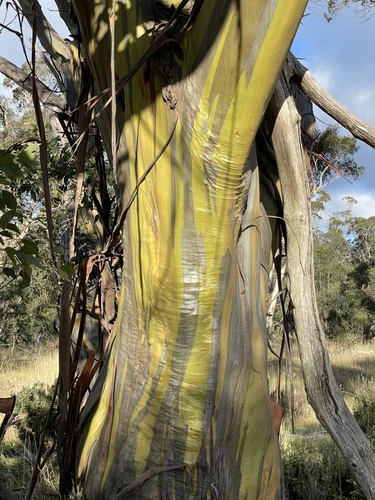
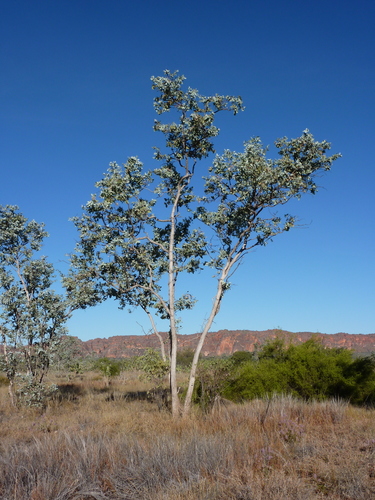
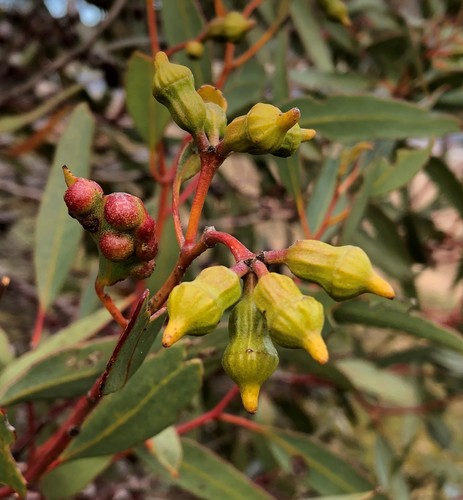
Eucalyptus incrassata Labill. is a single-stemmed or multi-stemmed mallee that typically reaches 2 to 5 meters (7 to 16 feet) in height, and may grow as tall as 10 meters (33 feet). It usually grows 4 to 7 meters (13 to 23 feet) wide, and forms a woody lignotuber. Its bark is smooth, ranging in color from pink to grey or brownish, and sometimes retains rough grey to brown ribbons of bark near the trunk base. Young plants and coppice regrowth have dull bluish-green, elliptic to egg-shaped leaves that measure 40–100 mm (1.6–3.9 in) long and 20–50 mm (0.79–1.97 in) wide. Adult leaves are arranged alternately, are the same glossy green on both sides, and are lance-shaped. They measure 50–150 mm (2.0–5.9 in) long and 10–30 mm (0.39–1.18 in) wide, growing on a petiole 8–25 mm (0.31–0.98 in) long. Flower buds are arranged in groups of seven in leaf axils, on an unbranched peduncle 10–28 mm (0.39–1.10 in) long, with individual buds attached to pedicels 1–8 mm (0.039–0.315 in) long. Mature buds are oblong to pear-shaped, 11–23 mm (0.43–0.91 in) long and 5–11 mm (0.20–0.43 in) wide, with a conical operculum. This species blooms between August and April, producing cream-white to yellow blossoms. The fruit is a woody capsule that ranges in shape from cylindrical to barrel-shaped or bell-shaped, 11–23 mm (0.43–0.91 in) long and 5–11 mm (0.20–0.43 in) wide, with valves held below the rim of the capsule. Commonly known as lerp mallee, this species is most often found on sandplains and hillsides. It is distributed across the Mid West, Wheatbelt, south coast Great Southern, and Goldfields-Esperance regions of Western Australia, growing in sandy soils. It also occurs in southern South Australia, extending into Victoria and New South Wales. It is one of the most widespread mallee species in Australia. It is part of the western mallee subgroup, which is characterized by multiple eucalypt species including Eucalyptus oleosa, E. moderata, E. eremophila, E. foecunda, E. redunca and E. uncinata. In its native habitat, the understorey is predominantly shrubby, dominated by Melaleuca and Acacia species, with occasional Triodia plants. This eucalypt attracts nectar-eating birds and insects, which use it for food and habitat. In horticulture, Eucalyptus incrassata is used as a shade tree, and mass plantings create effective screening. It is well suited for erosion control and as a windbreak, fits well in Mediterranean and bush-style gardens, and responds well to coppicing. It tolerates both drought and light frost, and can grow in ordinary or enriched soil that ranges from acidic to alkaline. It prefers a position in full sun. Seeds germinate in 2 to 6 weeks, and this species can also be grown from cuttings. The tree is susceptible to powdery mildew during wet winter months, and may also be affected by myrtle rust and dieback. It is suitable for producing large amounts of biomass, yielding 10 to 20 metric tons (11 to 22 short tons) per hectare per year. In Western Australia's wheatbelt regions, it provides additional benefits: it reduces soil salinity, provides shade for livestock, acts as a windbreak, and reduces erosion.