About Eucalyptus gunnii Hook.fil.
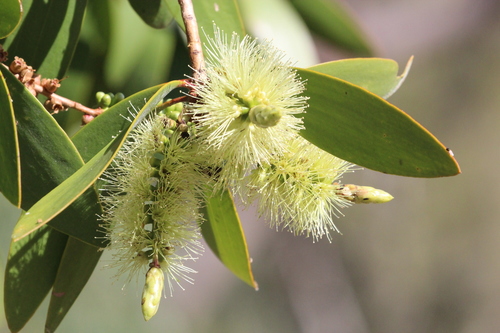
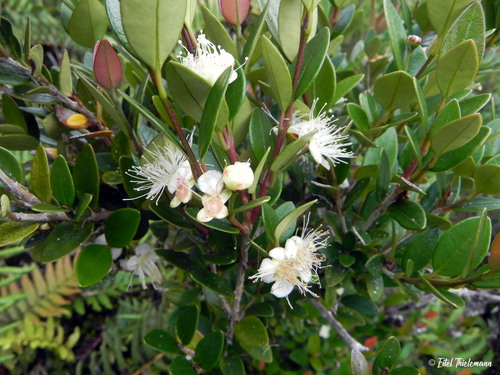
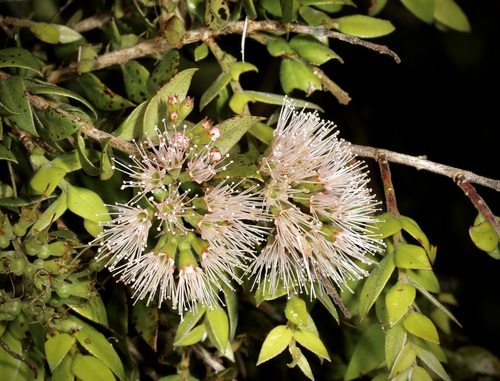
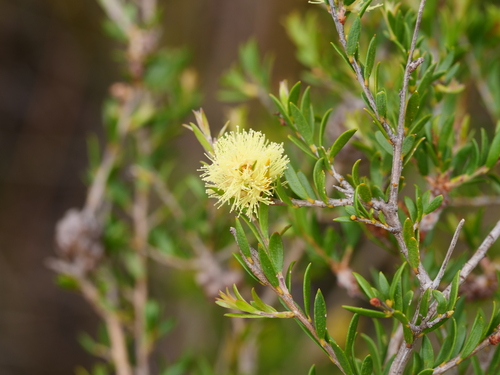
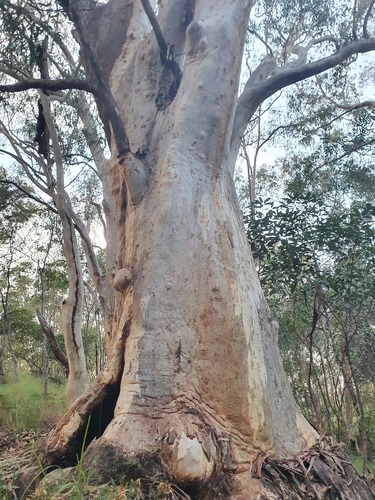
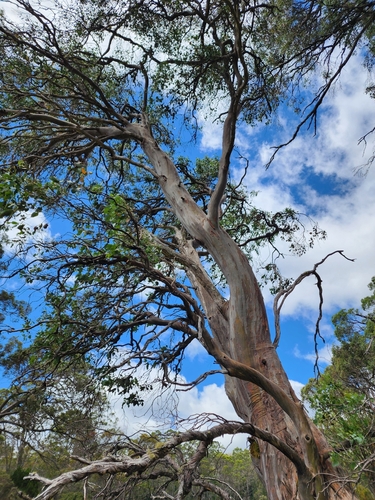
Eucalyptus gunnii Hook.fil., commonly known as cider gum, is a tree that typically reaches a maximum height of 25 m (82 ft). Its bark is usually smooth, or mottled white or grey; sometimes rough bark persists on the lowest 1 m (3 ft 3 in) of the trunk, and the species has a lignotuber. Young plants and coppice regrowth have sessile leaves arranged in opposite pairs, and juvenile stems can be round or square in cross-section. Juvenile leaves are heart-shaped to roughly round, greyish green or glaucous, 13–45 mm (0.51–1.77 in) long and 17–40 mm (0.67–1.57 in) wide. Adult leaves are arranged alternately, shaped like a lance to egg-shaped, are the same dull greyish to bluish green on both surfaces, and measure 40–90 mm (1.6–3.5 in) long and 12–35 mm (0.47–1.38 in) wide, borne on a 9–23 mm (0.35–0.91 in) long petiole. Flowers are arranged in groups of three in leaf axils, on an unbranched 3–9 mm (0.12–0.35 in) long peduncle. Individual flower buds are either sessile or on pedicels up to 4 mm (0.16 in) long. Mature buds are oval, 5–9 mm (0.20–0.35 in) long and 3–5 mm (0.12–0.20 in) wide, with a conical, rounded or flattened operculum. Flowering occurs in most months of the year, and the flowers are white. The fruit is a woody capsule shaped like a cylinder to barrel, 5–9 mm (0.20–0.35 in) long and 5–7 mm (0.20–0.28 in) wide, with valves that sit near the rim of the capsule or are enclosed within it. Cider gum is native to woodland habitats in Tasmania. It grows on the plains and slopes of the central plateaux and dolerite mountains at altitudes up to approximately 1,100 m (3,600 ft), with isolated populations located south of Hobart. It grows at higher altitudes where summers are mild, winters are cold with frequent frosts and heavy snow, and average annual rainfall is around 1,800 mm (71 in). This eucalypt species has been introduced to New Zealand and parts of the Caucasus. In horticulture, this plant has earned the Royal Horticultural Society's Award of Garden Merit. The species is known for exceptional cold tolerance for a eucalyptus, surviving temperatures down to −14 °C, and exceptionally down to −20 °C for brief periods. It is now commonly planted as an ornamental tree across the British Isles. When creased or burned, the fragrant leaves release essential oils. These oils and products made from them are used in forms including floral composition, infusion, tincture, and oil to treat a wide range of conditions including many respiratory diseases, rheumatism, migraines, and fatigue, and are also used as an antiseptic. Tasmanian Aboriginal people historically used the sap of the tree to produce a fermented beverage called way-a-linah.