About Eucalyptus grandis W.Hill ex Maiden
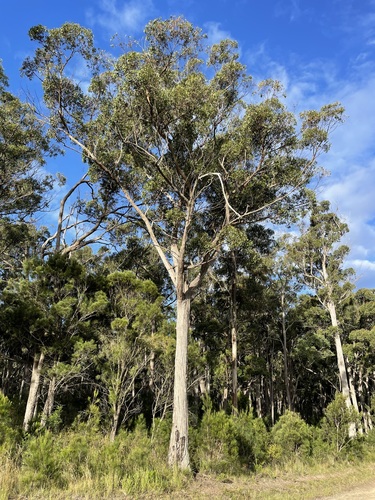
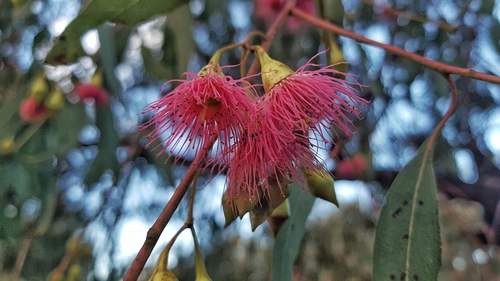
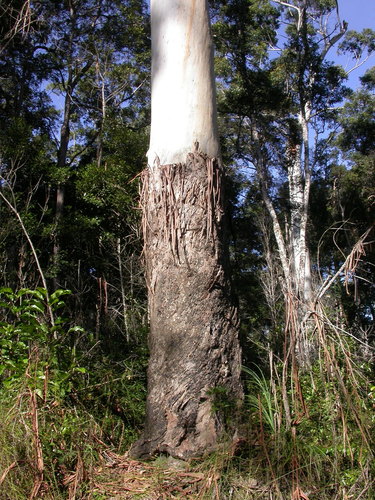
Eucalyptus grandis W.Hill ex Maiden is a straight, tall forest tree that typically grows to around 50 m (160 ft) tall, with a diameter at breast height (dbh) of 1.2 to 2 m (3.9 to 6.6 ft). The largest specimens can reach 75 m (246 ft) in height and 3 m (9.8 ft) dbh; the tallest recorded individual, known as "The Grandis" near Bulahdelah, measures 86 m (282 ft) tall with a girth of 8.5 m (28 ft). The trunk is straight for two-thirds to three-quarters of the tree’s total height. Its bark is smooth, powdery, and ranges in colour from pale grey or blue-grey to white, with a skirt of rough brownish bark covering the bottom 1–4 m (3 ft 3 in – 13 ft 1 in) of the trunk. Adult leaves are glossy dark green, stalked, shaped lanceolate to broad lanceolate, and paler on the undersides. They measure 10 to 16 cm (3.9 to 6.3 in) long and 2–3 cm (0.79–1.18 in) wide, arranged alternately along branches. Secondary veins branch from the leaf midvein at a wide angle of 61 degrees, and leaves are dotted with approximately 800 oil glands per square centimetre. Flower buds are arranged in leaf axils in groups of seven, nine or eleven, on an unbranched peduncle 10–18 mm (0.39–0.71 in) long; individual buds are either sessile or on pedicels up to 5 mm (0.20 in) long. Mature buds are oval, pear-shaped, or club-shaped, and range in colour from green to yellow or glaucous, measuring 6–9 mm (0.24–0.35 in) long and 4–5 mm (0.16–0.20 in) wide. White flowers bloom from mid autumn to late winter, between April and August. After flowering, the tree produces conical, pear-shaped, or cone-shaped fruit that is 4–10 mm (0.16–0.39 in) long and 5–8 mm (0.20–0.31 in) wide, with valves at or slightly above the rim of the fruit. The Sydney blue gum (E. saligna), which overlaps E. grandis’s range in the southern part of its distribution, is very similar in appearance, but differs in having narrower leaves, more bell-shaped gumnuts with protruding valves, and a lignotuber. The mountain blue gum (E. deanei) can be distinguished from E. grandis by its entirely smooth bark and wider adult leaves. E. grandis is naturally found in coastal areas and sub-coastal ranges from near Newcastle in New South Wales northward to Bundaberg in central Queensland, with separate disjunct populations further north near Mackay, Townsville, and Daintree in northern Queensland. It grows mainly on flat land and lower slopes, in deep, fertile alluvial loam soils, where annual rainfall ranges from 1100 to 3500 mm. It is the dominant tree of wet forest and rainforest margins, growing either in pure stands or mixed with other tree species including blackbutt (E. pilularis), tallowwood (E. microcorys), red mahogany (E. resinifera), Sydney blue gum (E. saligna), pink bloodwood (Corymbia intermedia), turpentine (Syncarpia glomulifera), brush box (Lophostemon confertus), and forest oak (Allocasuarina torulosa). E. grandis has been successfully grown in plantations in wetter areas of Sri Lanka, particularly in the Badulla and Nuwara Eliya Districts. Many climate and soil parameters in these areas are similar to those in eastern Australia, and the species grows well on plains and hills previously used for tea cultivation. Grown for its wood and ease of cultivation, it is the fastest growing eucalypt in Sri Lanka. Plantations of E. grandis have also been successful in Uruguay, where lumber from the species is exported to the United States under the trade name "Red Grandis". Extensive plantations of the species also exist in South Africa and Brazil. Commonly called flooded gum, E. grandis is an attractive, straight-trunked tree in high demand outside Australia for timber and pulp. Within Australia, plantations are located in northern New South Wales, where seedlings can put on 7 metres (23 feet) of growth in their first year. Its timber has a pinkish tinge and a straight grain, with moderate durability and strength, and is resistant to Lyctus borers. It is used in joinery, flooring, boat building, panelling, and plywood. Hybrids of E. grandis and river red gum (Eucalyptus camaldulensis) are used to combat salinity. E. grandis is a food plant for paropsine beetles of the family Chrysomelidae and Christmas beetles; Christmas beetles often defoliate E. grandis trees on Australia’s east coast. Clones of E. grandis have been selected and bred for unpalatability to the brown Christmas beetle (Anoplognathus chloropyrus) to reduce damage to plantations. Other insect pests of E. grandis include the steelblue sawfly (Perga dorsalis) and the leafblister sawfly (Phylacteophaga froggatti), both of which prefer young trees. The species is too large for most private gardens, but makes an attractive landscape tree for large parks and farms, and can be used for riverbank stabilisation. In South Africa, saligna gum (related to E. grandis) is grown extensively in plantations in areas that previously had poor forage for bees. When flowering begins each year, an extremely large number of wild bee colonies move into these plantations, where thousands are lured into hives by beekeepers. The flowers have a strong scent, and beekeepers report that bees travel at least 32 km (20 miles) to reach some of these plantations.