About Eucalyptus gracilis F.Muell.
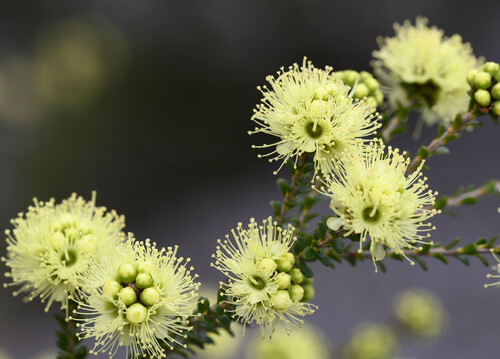
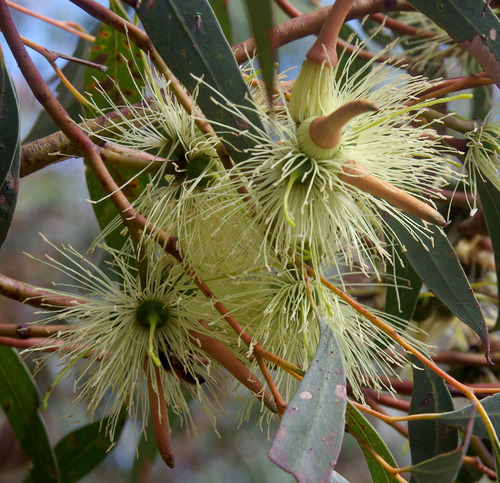
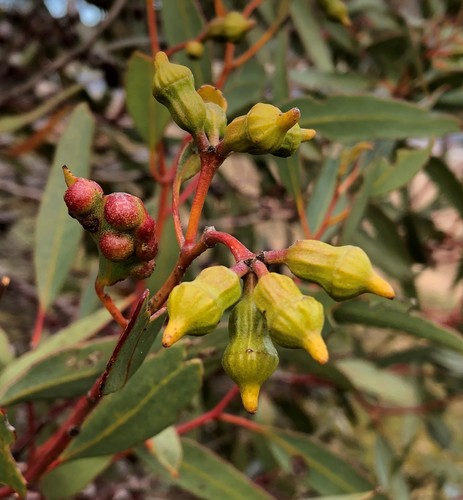
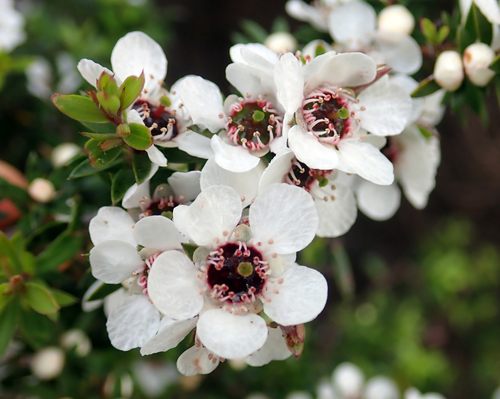
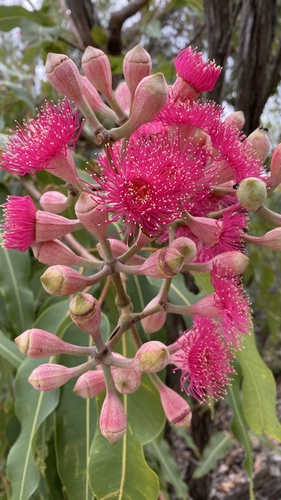
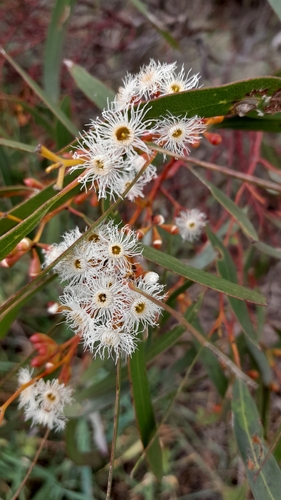
Eucalyptus gracilis F.Muell., commonly called yorrell, is an open to spreading multi-stemmed mallee or tree that typically reaches 7 meters (23 feet) in height, though it may occasionally grow as tall as 20 meters (66 feet). It has smooth white, grey, and coppery-cream bark, with the base of its stems usually covered in rough, fibrous or flaky bark. Young plants and coppice regrowth have linear to narrow lance-shaped leaves that measure 33 to 90 millimeters (1.3 to 3.5 inches) long and 9 to 18 millimeters (0.35 to 0.71 inches) wide. Adult leaves are alternately arranged, glossy green on both sides, and shaped linear to narrow lance-shaped or curved. They are 45 to 110 millimeters (1.8 to 4.3 inches) long, 4 to 17 millimeters (0.16 to 0.67 inches) wide, and grow on a petiole 5 to 15 millimeters (0.20 to 0.59 inches) long. Flower buds are arranged in groups of seven, nine or eleven on an unbranched, square cross-section peduncle 5 to 15 millimeters (0.20 to 0.59 inches) long. Individual buds sit on pedicels 2 to 5 millimeters (0.079 to 0.197 inches) long. Mature buds are club-shaped, 3 to 7 millimeters (0.12 to 0.28 inches) long and 3 to 5 millimeters (0.12 to 0.20 inches) wide, with a flattened to rounded operculum. Flowering occurs between March and October, producing creamy-white flowers. The fruit is a woody cup-shaped, cylindrical or barrel-shaped capsule 4 to 8 millimeters (0.16 to 0.31 inches) long and 3 to 7 millimeters (0.12 to 0.28 inches) wide, with enclosed valves. This species grows on sand dunes, plains, rise crests, and along creek lines in the Eremaean and South West botanical regions of Western Australia, in sandy-clay-loamy soils over limestone. It occurs across most of southern and central South Australia, where it grows in mallee shrubland in a range of soils, often over limestone. In Victoria, it is restricted to the north-west of the state, mostly found in the Big Desert and Sunset Country, extending east to Manangatang. It also grows in south western New South Wales, occurring in mallee shrubland on red aeolian sands south from Yathong and west from West Wyalong. Eucalyptus gracilis is often cultivated in open areas, wider road verges, parks, and reserves, and is used as a shelter windbreak or for erosion control. It is known to be good for honey production. Nectar-eating birds and insects use this tree for food and habitat, and yellow-tailed black cockatoos eat its seeds.