About Eucalyptus goniocalyx F.Muell.
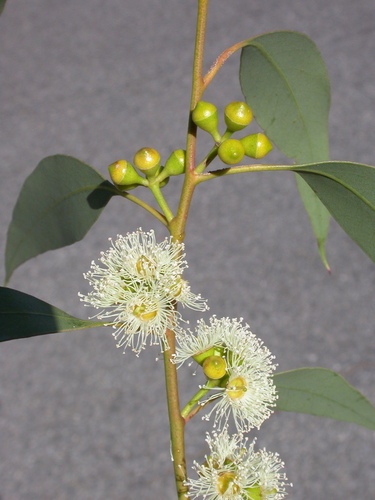
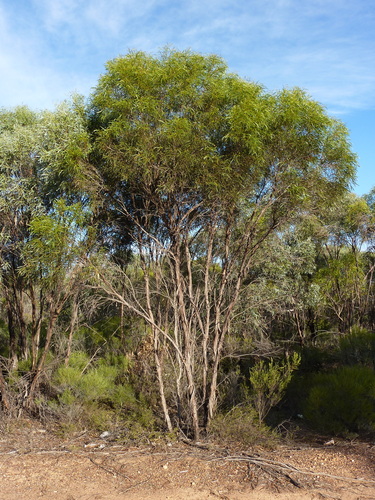
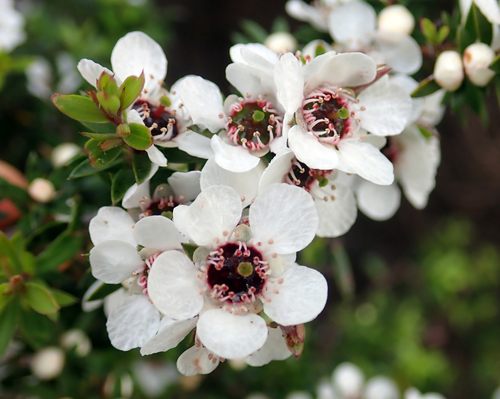
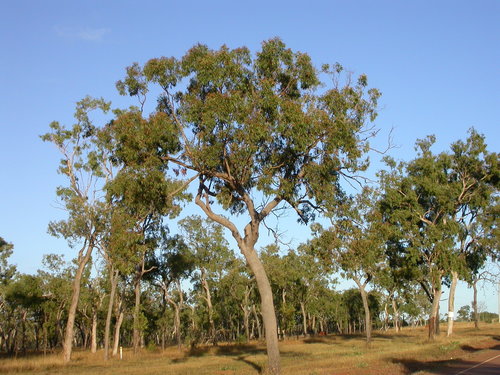
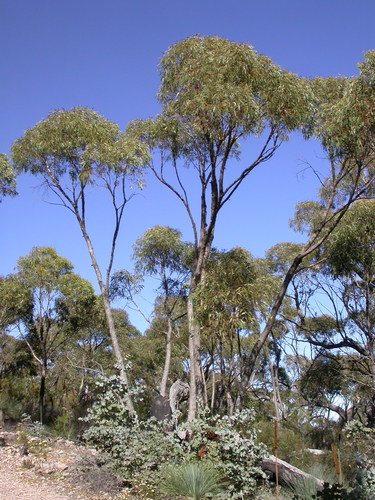
Eucalyptus goniocalyx F.Muell. is a tree that typically reaches 15 meters (49 feet) in height and forms a lignotuber. It has roughly fibrous, greyish bark, though the thickness and exact texture of this bark varies by subspecies. Young plants and coppice regrowth produce sessile, more or less round leaves, 35 to 110 millimeters (1.4 to 4.3 inches) long and 35 to 100 millimeters (1.4 to 3.9 inches) wide, arranged in opposite pairs. Adult leaves are lance-shaped to curved, 60 to 250 millimeters (2.4 to 9.8 inches) long and 13 to 40 millimeters (0.51 to 1.57 inches) wide, growing on a 10 to 40 millimeter (0.39 to 1.57 inch) petiole. Flower buds are arranged in groups of seven in leaf axils, on an unbranched peduncle 5 to 15 millimeters (0.20 to 0.59 inches) long, with individual buds usually being sessile. Mature buds are oblong to oval, 6 to 11 millimeters (0.24 to 0.43 inches) long and 4 to 7 millimeters (0.16 to 0.28 inches) wide, and have a conical to rounded operculum. Flowering occurs between March and August, and the flowers are white. The fruit is a sessile, woody capsule shaped like a cup, cylinder, or barrel, 5 to 10 millimeters (0.20 to 0.39 inches) long and 6 to 11 millimeters (0.24 to 0.43 inches) wide, with valves that are either below the rim level or slightly protruding. Regarding distribution and habitat, subspecies goniocalyx grows in woodland, usually on hilly, rocky ridges, and is widespread south of Mudgee in New South Wales and across central Victoria, with scattered populations also found in south-eastern South Australia. Subspecies exposa only occurs in the Elder Range and Wilpena Pound areas, where it grows on the summits of peaks, often alongside E. flindersii. Subspecies fallax is only known from a single occurrence in forest south of Mount Blackwood, near Greendale in central Victoria. Subspecies laxa grows in well-watered, heavy soil in Brisbane Ranges National Park, and subspecies viridissima occurs in scattered populations in Victoria, including the Grampians and Halls Gap areas.