About Eucalyptus gomphocephala A.Cunn. ex DC.
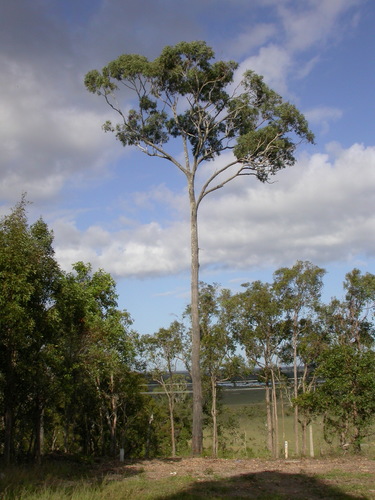
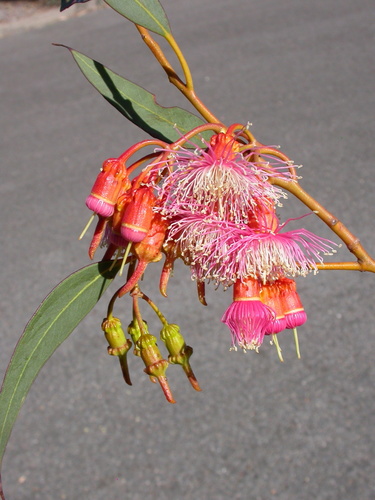
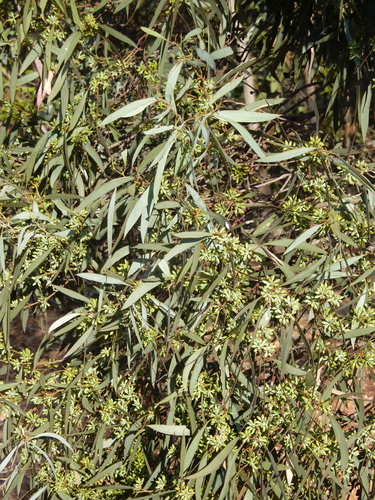
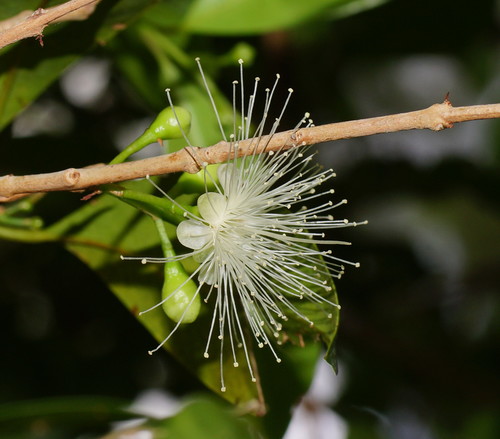
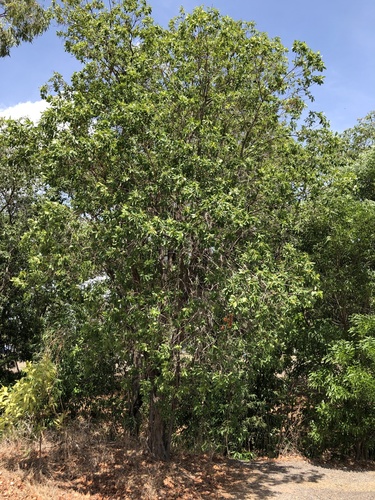
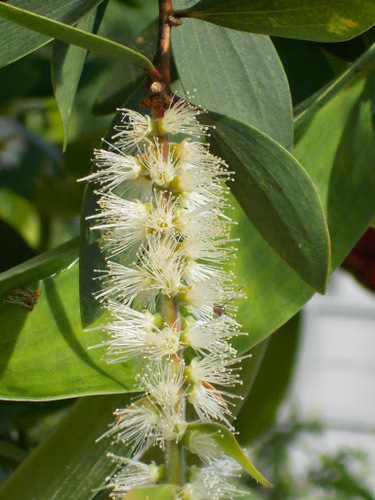
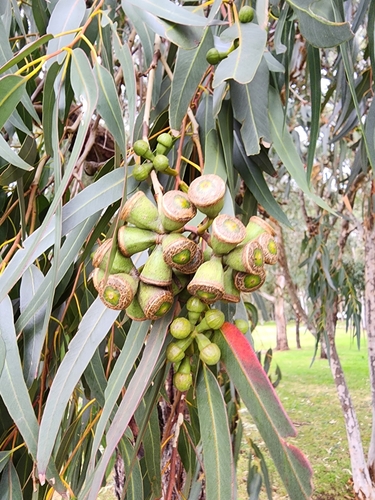
Eucalyptus gomphocephala A.Cunn. ex DC., commonly known as tuart, is a tree native to southwest Western Australia. It typically grows to a height of 10 to 40 metres (33 to 131 ft); the tallest known living tuart reaches 47 m (154 ft) and grows in Tuart Forest National Park near Ludlow, and the largest individual has a wood volume of 108 m³ (3,800 ft³). Within the species' range, taller trees usually grow at the southern end, while smaller trees grow at the northern end. The tree's crown can spread up to 25 metres (82 ft) wide. Most often, tuart grows as a tall single-stemmed tree, but may develop into a low multi-stemmed tree at the edges of stands in response to salinity and wind. This species does not form lignotubers, but does produce epicormic buds along its stem. Tuart has rough, box-like, finely fibrous grey bark over its entire trunk and main branches; this bark breaks into small flaky pieces, and becomes tessellated on large, old stems. Branchlets have a circular cross-section, and often have oil glands in their pith, though these glands can be scarce and hard to locate. Juvenile leaves are stalked, arranged oppositely for the first four to eight stem nodes before becoming alternate, green and discolorous. They are ovate (egg-shaped) to cordate (heart-shaped), 9 to 15 cm (3.5 to 5.9 in) long and 5.5 to 9.5 cm (2.2 to 3.7 in) wide. Adult leaves are stalked and alternate, oval to lanceolate or falcate (sickle-shaped), slightly discolorous to concolorous, glossy, light green and thin. Leaf blades are 90 to 180 millimetres (3.5 to 7.1 in) long, 1.5 to 3 cm (0.59 to 1.18 in) wide, and often curved. They attach to limbs or twigs via a petiole 1 to 3 cm (0.39 to 1.18 in) long. Leaf tips are pointed, and leaf bases taper toward the petiole. Tuart leaves have few oil glands, are densely reticulated (with a tight network of veins), and have side veins that branch off the midrib at an angle greater than 45 degrees. Tuart flowers between January and April; it typically has a mass flowering event every five to eight years, with smaller flowering events in intervening years. Flowers are white to cream, and bloom from mid-summer to mid-autumn. Unbranched inflorescences form in leaf axils. Each inflorescence has a 1 to 3 mm (0.039 to 0.118 in) long peduncle and holds an umbel of seven buds, which attach via pedicels 0 to 0.2 cm (0.000 to 0.079 in) long. Buds have a swollen cap that makes them resemble small ice cream cones; the cap is 8 to 10 mm (0.31 to 0.39 in) long. Buds are 1.5 to 2.4 cm (0.59 to 0.94 in) long, 0.9 to 12 cm (0.35 to 4.72 in) wide, and have a hemispherical operculum (cap) that is wider than the obconical hypanthium below it. When the outer operculum is shed, it leaves a visible scar. Stamens are irregularly flexed, and hold oblong anthers attached to the filament at their rear. Anthers open via longitudinal slits to release pollen. The style is straight and long, ending in a blunt stigma. The ovary, held in a small basal cavity (locule), has four vertical rows of ovules. Flowers grow in tight clusters of around seven, which later develop into mushroom-shaped fruits that contain small seeds. Fruits are narrow, 1.0 to 2.5 cm (0.39 to 0.98 in) long and 1.2 to 1.8 cm (0.47 to 0.71 in) wide, with a broad rim. They attach to the stem via a pedicel 0 to 0.8 cm (0.00 to 0.31 in) long. Fruits are obconic to upside-down bell-shaped, and sometimes have two longitudinal ridges extending partway up from the pedicel. They have a level disc that may be slightly raised or descending, and have three to five partially to fully protruding valves. Seeds are usually released within a year; they are 2 to 3.5 mm (0.079 to 0.138 in) long, ovoid to saucer-shaped, and grey-brown to blackish. The upper seed surface is wrinkled or marked with thin parallel streaks, and sometimes has a protruding ridge around its circumference. A hilum scar marks where the seed was once attached to the placenta. Like most eucalypt seeds, tuart seeds germinate easily, making this species one of the simplest Australian natives to grow from seed. Seed production varies considerably over time. Seeds are usually slowly released from the tree canopy, but large numbers can be shed at once after events like fire. The species' natural distribution is a narrow coastal corridor 5 to 10 kilometres (3.1 to 6.2 mi) inland on the Swan Coastal Plain, running continuously south from Yanchep to Busselton. This area was intensively cleared first for agriculture, then for urbanisation, greatly reducing the number of tuart trees and the area of tuart forest after the establishment of the Swan River Colony. Outlying patches occur north of Yanchep as far as Geraldton, and further inland where rivers intersect the species' range. E. gomphocephala has become naturalised in other parts of Western Australia. A large, scientifically and heritage valuable natural tuart stand adjacent to the Jurien Bay cemetery is listed with the Heritage Council of Western Australia as the northernmost natural tuart stand in the state, located along an historic stock route. Tuart has been introduced to parts of Europe (specifically Spain, Italy including Sicily, and France, where it was widely grown by the end of the nineteenth century), and to multiple African countries including Algeria, Morocco, Tunisia, Libya, Kenya, Tanzania, Zimbabwe, the Cape Provinces of South Africa, and the Canary Islands. It has become naturalised in parts of southern Africa. E. gomphocephala grows in sunny positions, in well-drained sandy soils often over limestone. It occurs in coastal shrubland ecosystems on deep sand, and in limited coastal woodland communities in protected areas. It is associated with the Quindalup and Spearwood sand dune systems, which both have calcareous soils. When growing in woodland or open forest, it is often found with peppermint trees (Agonis flexuosa) in the understorey. Tuart is counted as one of the six forest giants of Western Australia, alongside marri (Corymbia calophylla), karri (Eucalyptus diversicolor), red tingle (Eucalyptus jacksonii), jarrah (Eucalyptus marginata), and yarri (Eucalyptus patens). These giants are informally defined as trees significantly larger than other local species, with volumes exceeding 100 m³ (3,500 cu ft). Tuart is moderately tolerant of saline soil, salt-laden winds, drought, and frost. Individual trees can live over 400 years. 1930s experimental cultivation found the species can grow in areas with annual rainfall as low as 330 mm (13 inches). Tuart forests support rich biodiversity, with unique assemblages of plants, fungi, and animals. A 2009 survey of endophytic fungi at two tuart woodlands, sampling multiple woody species including tuart, jarrah, Acacia cochlearis, A. rostellifera, Allocasuarina fraseriana, Agonis flexuosa, Banksia grandis, and Santalum acuminatum, found around three quarters of fungal isolates belonged to the family Botryosphaeriaceae. Eighty percent of these isolates were the species Neofusicoccum australe. Four new taxa (Dothiorella moneti, Dothiorella santali, Neofusicoccum pennatisporum, and Aplosporella yalgorensis) were identified from the survey, and the species Botryosphaeria dothidea was isolated from acacia and jarrah samples. Tuart is the dominant canopy species of the ecological community known as tuart woodlands and forests, which is named for the tree. The range of this community is greatly reduced, and remaining populations are fragmented and variable in quality. A 2017 proposal recommended listing it as critically endangered on the Australian national register of threatened ecological communities, and it was listed as critically endangered in 2019 under the Environment Protection and Biodiversity Conservation Act 1999. Tuart also occurs in the already threatened Banksia Woodlands of the Swan Coastal Plain. Tuart populations persisted in place through the Last Glacial Maximum, and expanded their range 30 kilometres to the west when lower sea levels exposed more coastline. Historical phylogeography of tuart shows the moderating effect of the Southwest Australian Floristic Region's marine climate during a period of aridification and severe climate change elsewhere on the Australian continent. As a durable hardwood, tuart timber is used for scantlings, structural timber, railway carriage construction, and boat building. Its attractive colouring and grain also make it popular for furniture manufacturing. Due to over-logging, tuart is a protected tree, with legal restrictions on felling. The heartwood is pale yellow-brown, with a fine texture and a highly interlocked, close twisted grain that often curls back. Green tuart wood has a density of 1,250 kilograms per cubic metre (78 lb/cu ft), while air-dried wood has a density of 1,030 kilograms per cubic metre (64 lb/cu ft). Tuart flowers are a good source for honey production; the honey is light and creamy, and candies quickly to become hard and dry when properly matured in the hive. Tuart was noted as a high quality honey source in 1939, but was described as an undependable source thirty years later. Essential oils can be extracted from tuart leaves and fruits; leaf samples contain 0.23% essential oil by content, while fruit samples contain 0.34%. Leaf essential oil constituents are 1,8-cineole (24.2%), p-cymene (20.7%), α-pinene (14.1%), β-pinene (8.12%), γ-terpinene (6.9%), methyleugenol (6.8%), α-terpineol (4.7%), and limonene (3.8%). Fruit essential oil constituents are 1,8-cineole (46.69 %), p-cymene (8.99 %), baeckeol (8.57 %), α-pinene (5.21 %), and globulol (4.25%). All of these oils have some degree of antimicrobial activity, with leaf essential oil generally having higher activity than fruit essential oil.