About Eucalyptus globulus subsp. bicostata (Maiden, Blakely & Simmonds) J.B.Kirkp.
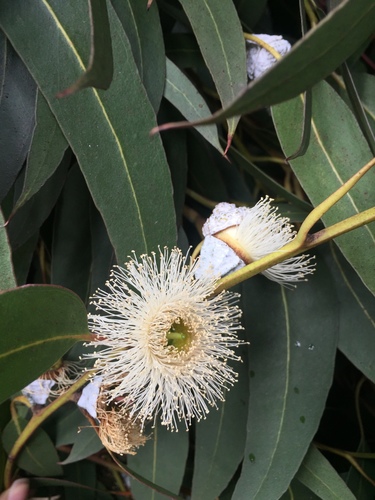
Eucalyptus globulus, commonly known as blue gum, is a tree that typically grows to 45 metres (148 feet) in height. It can sometimes be a stunted shrub, or reach up to 90 metres (300 feet) under ideal growing conditions, and it forms a lignotuber. Its bark is usually smooth, with a white to cream colour, though persistent unshed bark slabs are sometimes present at the base. Young plants, which are often several metres tall, and coppice regrowth have stems that are more or less square in cross-section, with a prominent wing on each corner. Juvenile leaves are mostly arranged in opposite pairs, are sessile and glaucous, and range from elliptic to egg-shaped, growing up to 150 mm (5.9 in) long and 105 mm (4.1 in) wide. Adult leaves are arranged alternately, are the same glossy to dark green colour on both sides, and are lance-shaped or curved. They are 150–300 mm (5.9–11.8 in) long and 17–30 mm (0.67–1.18 in) wide, and grow on a petiole 1.5–6 mm (0.059–0.236 in) long. Flower buds are arranged singly or in groups of three or seven in leaf axils, and are sometimes sessile or borne on a short thick peduncle. Individual buds are also usually sessile, though they may grow on a pedicel up to 5 mm (0.20 in) long. Mature buds are top-shaped to conical, glaucous or green, and have a flattened hemispherical, warty operculum with a central knob. Flowering time varies by subspecies and distribution, but the flowers are always white. The fruit is a woody conical or hemispherical capsule 2–3 cm in diameter, with valves close to the rim level. Blue gum grows in forests in New South Wales, Victoria and Tasmania in Australia, including some of the Bass Strait Islands. The nominate subspecies E. g. subsp. globulus occurs mainly in lowland areas of Tasmania, and is also found on some Bass Strait islands including King Island, as well as in the extreme south-west of Victoria. Eucalyptus globulus subsp. bicostata (Maiden, Blakely & Simmonds) J.B.Kirkp. grows in montane and tableland areas between the Carrai Plateau in northern New South Wales and the Pyrenees in Victoria. Subspecies E. g. subsp. maidenii occurs on near-coastal ranges of south-eastern New South Wales and eastern Victoria. Subspecies E. g. subsp. pseudoglobulus is mostly distributed in eastern Gippsland, with isolated populations further inland and in the Nadgee Nature Reserve in south-eastern New South Wales. This species has naturalised non-native populations in Ireland (where self-sown saplings typically grow 2.5 m per year when young), Spain, Portugal, other parts of southern Europe including Cyprus, Macaronesia, southern Africa, New Zealand, and the western United States (California, Hawaii).