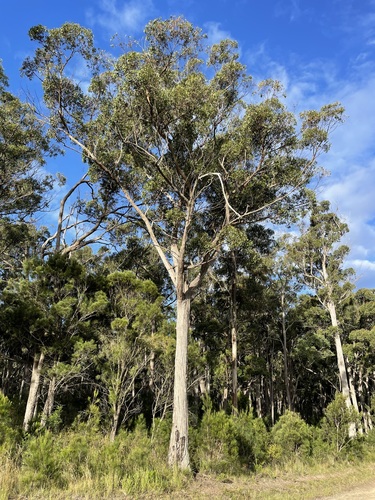
About Eucalyptus globoidea Blakely
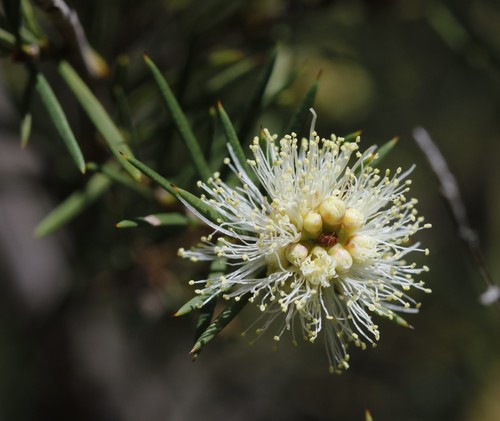
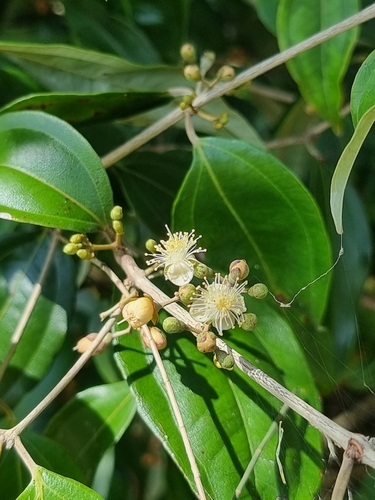
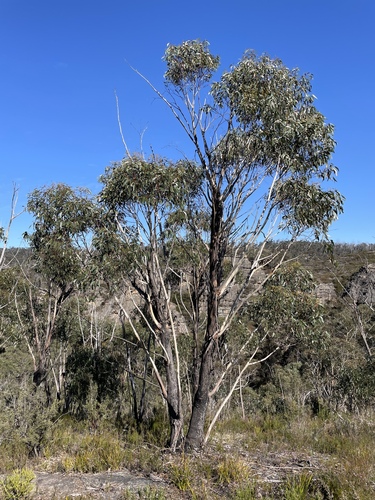
Eucalyptus globoidea, commonly known as white stringbark, is a tree that reaches a height of 30–40 metres (98–131 ft). It has rough, stringy bark that extends to its thinnest branches; the bark is grey to reddish brown and often furrowed on the trunk. Young trees have glossy green leaves that are paler on the lower surface. These juvenile leaves are egg-shaped to broadly lance-shaped, 40–100 mm (2–4 in) long, 20–45 mm (0.8–2 in) wide, and have wavy edges. Adult leaves are egg-shaped to lance-shaped, often curved, glossy green on both sides, 70–135 mm (3–5 in) long, and 12–40 mm (0.5–2 in) wide. Flowers are arranged in groups of usually 11 to 15, borne on an angular or flattened peduncle 4–10 mm (0.2–0.4 in) long. Each individual flower sits on a cylindrical pedicel up to 2 mm (0.08 in) long. Mature buds are green to yellowish, oval to spindle-shaped, 5–7 mm (0.2–0.3 in) long, and 3–4 mm (0.1–0.2 in) wide. The operculum is cone-shaped and roughly matches the length and width of the flower cup. Stamens are white, and flowering occurs from July to February, with peak flowering from September to January. The fruit is a globe-shaped to hemispherical capsule, 4–7 mm (0.2–0.3 in) long and 6–9 mm (0.2–0.4 in) wide. This species grows in forest and woodland on hills and slopes, in coastal areas and nearby tablelands. Its natural range extends from south of Woolgoolga in New South Wales to near Melbourne in Victoria. A lignan called Globoidnan A is found in Eucalyptus globoidea. This molecule has been found to inhibit the activity of HIV integrase, the enzyme responsible for inserting HIV viral RNA into the DNA of a host cell.