About Eucalyptus foecunda Schauer
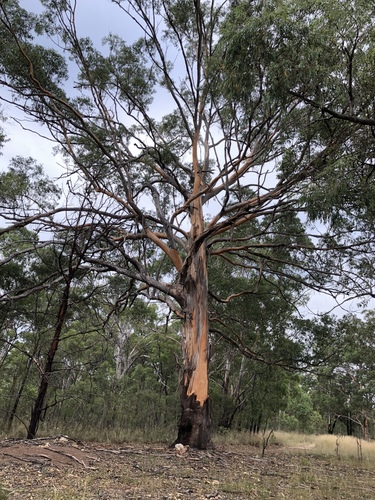
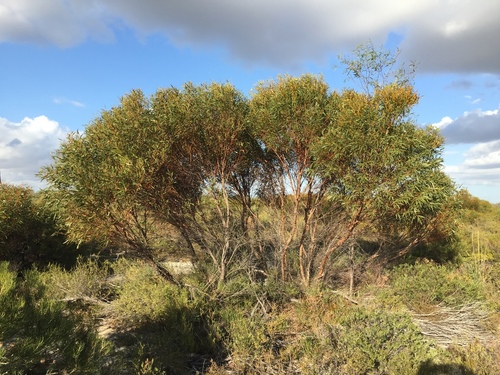
Eucalyptus foecunda Schauer is a mallee that typically grows to 3 meters (9.8 feet) tall, and occasionally reaches 5 meters (16 feet) as a tree. It forms a lignotuber. Its bark is flaky at the base, and smooth, grey to reddish-brown elsewhere. Young plants and coppice regrowth have dull green leaves ranging from elliptic to lance-shaped, that measure 40–80 mm (1.6–3.1 in) long and 2–20 mm (0.079–0.787 in) wide. Adult leaves are narrow lance-shaped to narrow oblong, glossy green on both sides, 50–95 mm (2.0–3.7 in) long and 5–13 mm (0.20–0.51 in) wide, growing on a petiole 5–17 mm (0.20–0.67 in) long. Flower buds are arranged in leaf axils in groups of nine or eleven on an unbranched peduncle 5–13 mm (0.20–0.51 in) long, with individual buds attached to pedicels 2–5 mm (0.079–0.197 in) long. Mature buds are oval to spindle-shaped, 6–10 mm (0.24–0.39 in) long and 3–4 mm (0.12–0.16 in) wide, with a conical or beaked operculum 2.5–6 mm (0.098–0.236 in) long. Flowering occurs in August, or between January and February, and produces creamy white flowers. The fruit is a woody, cup-shaped capsule that is 4–6 mm (0.16–0.24 in) long and wide. This mallee looks similar to Eucalyptus petrensis, but E. petrensis has a more persistent style on its fruit. Eucalyptus leucophylla was once classified within E. foecunda, but differs by having broader juvenile leaves, mostly smooth bark, and a shorter, more rounded operculum. This species, commonly called narrow-leaved red mallee, grows on limy sands near the coast of Western Australia, between Lancelin and Mandurah.