About Eucalyptus fibrosa F.Muell.
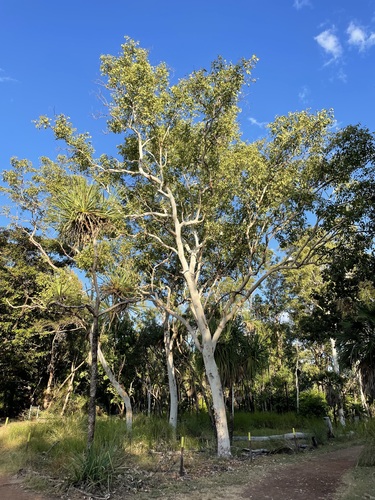
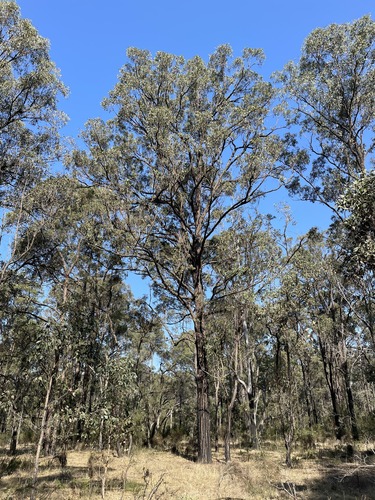
Eucalyptus fibrosa F.Muell., commonly called red ironbark, is a tree that typically grows to a height of 35 metres (115 feet) and forms a lignotuber. It has rough, grey to black, sometimes flaky ironbark that extends from the base of the trunk to its thinner branches. Young plants and coppice regrowth have leaves with petioles that are egg-shaped, more or less triangular, or round; these leaves measure 80–200 mm (3.1–7.9 in) long and 45–140 mm (1.8–5.5 in) wide, and are a slightly lighter shade of green on one side. Adult leaves are lance-shaped to egg-shaped, the same shade of green on both sides, 85–180 mm (3.3–7.1 in) long and 15–45 mm (0.59–1.77 in) wide, attached to a 13–30 mm (0.51–1.18 in) long petiole. Flower buds are arranged at the ends of branchlets in groups of seven, nine, or eleven, on a branching peduncle 9–20 mm (0.35–0.79 in) long, with individual buds attached to pedicels 2–8 mm (0.079–0.315 in) long. Mature buds are spindle-shaped, 8–17 mm (0.31–0.67 in) long and 3–5 mm (0.12–0.20 in) wide, with a conical to horn-shaped operculum. Flowering has been recorded in most months, and the flowers are white. The fruit is a woody, conical capsule that is 5–10 mm (0.20–0.39 in) long and wide, with valves close to the rim level. Several other similar ironbark species, including E. siderophloia, E. rhombica, and E. decorticans, occur in the same area, but all have smaller buds and fruit, and a much shorter operculum than Eucalyptus fibrosa. This species grows in forest on shallow, relatively infertile soil. It is widespread across coastal areas, tablelands, and nearby inland regions, ranging from near Rockhampton in Queensland to Moruya in New South Wales.