About Eucalyptus fastigata H.Deane & Maiden
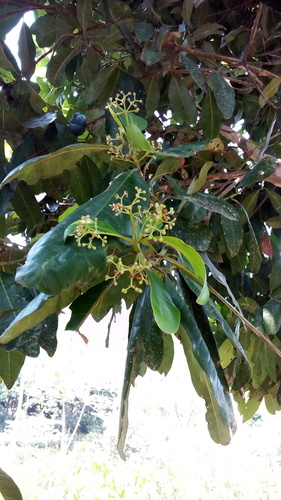
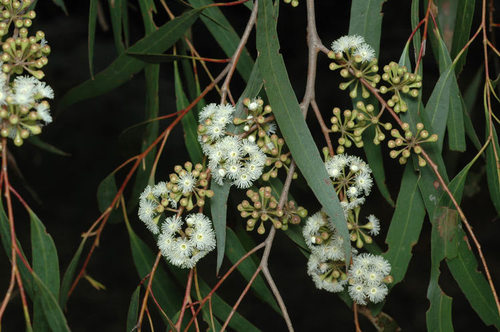
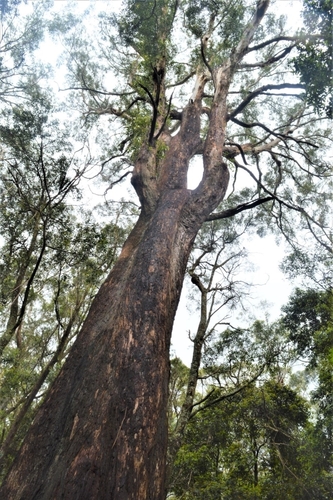
Eucalyptus fastigata is typically a tall, straight tree, growing to a height of 45–60 m (148–197 ft) and does not form a lignotuber. It has rough, fibrous or stringy bark covering its trunk and larger branches, with smooth white to brown bark on upper sections that often hangs in loose strings within the tree’s crown. Young plants and coppice regrowth have leaves that are borne on a petiole, broadly elliptical to egg-shaped, 45–120 mm (1.8–4.7 in) long and 18–50 mm (0.71–1.97 in) wide. Adult leaves are more or less equally glossy green on both sides, shaped from lance-like to curved, 70–205 mm (2.8–8.1 in) long, 15–36 mm (0.59–1.42 in) wide, and attached to a 10–17 mm (0.39–0.67 in) long petiole. Flower buds are arranged in leaf axils in groups of eleven, thirteen, fifteen or more, with these groups often paired. The whole bud cluster sits on a 4–14 mm (0.16–0.55 in) long peduncle, and individual buds attach via 1–5 mm (0.039–0.197 in) long pedicels. Mature buds are oval or club-shaped, 3–6 mm (0.12–0.24 in) long and 2–3 mm (0.079–0.118 in) wide, with a conical or rounded operculum. Flowering occurs between December and February, and the flowers are white. The fruit is a woody conical or pear-shaped capsule, 5–9 mm (0.20–0.35 in) long and 4–8 mm (0.16–0.31 in) wide, with its valves positioned approximately level with the capsule rim. Eucalyptus regnans is similar to E. fastigata, but differs in that it only has rough bark at the base of its trunk, produces smaller buds and fruit, and has a wider distribution in Victoria. This species, commonly called brown barrel, grows in tall open forest in valleys and on slopes, ranging from the Ebor district on the Northern Tablelands of New South Wales to the Errinundra Plateau in far north-eastern Victoria. It is also widely planted in New Zealand.