About Eucalyptus erythrocorys F.Muell.
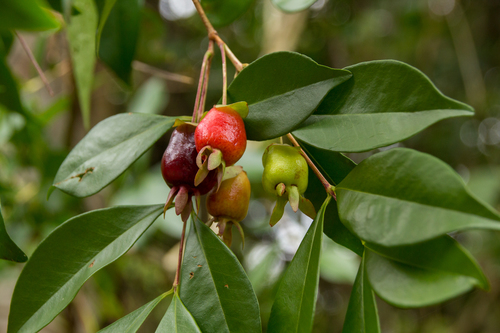
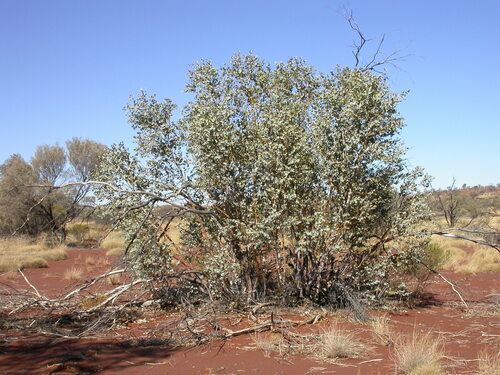
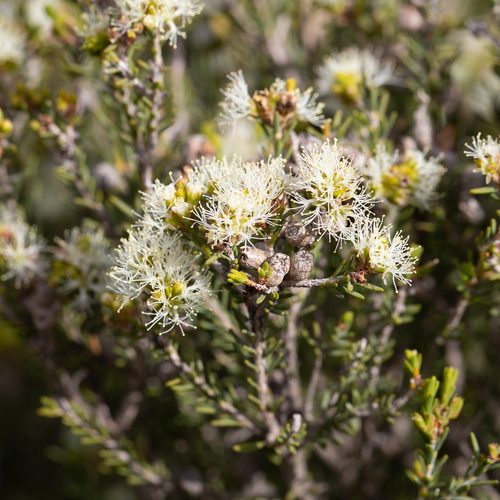
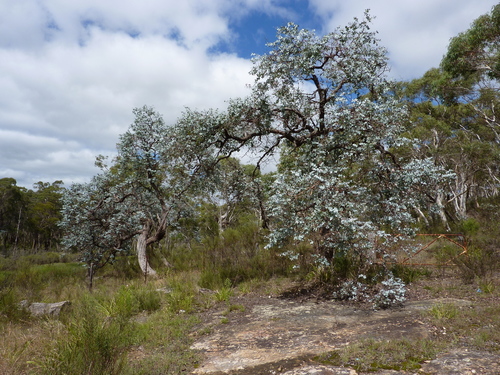
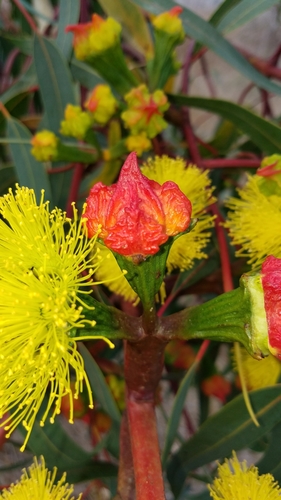
Eucalyptus erythrocorys F.Muell. is a small tree or mallee with an open spreading growth habit, typically reaching 3 to 10 metres (9.8 to 32.8 feet) in height and 3 to 6 metres (9.8 to 19.7 feet) in width. Its bark is mostly smooth and creamy-coloured, but may retain a few rough brown persistent patches on the trunk that do not shed. Smooth bark is shed in short ribbons or small polygonal flakes. Young plants and coppice regrowth have hairy stems, and leaves that range from broadly lance-shaped to egg-shaped or heart-shaped. These young leaves measure 50 to 130 millimetres (2.0 to 5.1 inches) long and 30 to 60 millimetres (1.2 to 2.4 inches) wide. Adult leaves are arranged in opposite pairs, and vary in shape from sickle-shaped to lance-shaped or curved. They measure 90 to 200 millimetres (3.5 to 7.9 inches) long, 12 to 30 millimetres (0.47 to 1.18 inches) wide, and grow on a flattened or channelled petiole 15 to 30 millimetres (0.59 to 1.18 inches) long. Adult leaves are thick, and the same glossy green colour on both sides. Flower buds grow in groups of three in leaf axils, on a peduncle 12 to 26 millimetres (0.47 to 1.02 inches) long, with individual buds attached to a 2 to 10 millimetre (0.079 to 0.394 inch) long pedicel. Mature buds are oval, 20 to 25 millimetres (0.79 to 0.98 inches) long and 20 to 26 millimetres (0.79 to 1.02 inches) wide, with a flattened, bright red, four-lobed operculum. The bright yellow to greenish flowers appear between February and April, with stamens arranged in four bundles. The fruit is a woody, broadly bell-shaped capsule 28 to 40 millimetres (1.1 to 1.6 inches) long and 30 to 55 millimetres (1.2 to 2.2 inches) wide. Sometimes fruit production is so heavy that the weight pulls the tree into a weeping habit.
This species has a limited distribution north of Perth in Western Australia. It grows on undulating limestone ridges and outcrops in sandy alkaline soils near Dongara, and also occurs north of Kalbarri National Park. It can also be found on sandy plains, particularly the Geraldton Sandplains between Shark Bay and Jurien.
Eucalyptus erythrocorys is sold commercially as seed or tube stock, and is a popular cultivated species across Australia. Its seeds germinate easily. While the plant can become untidy, it can easily be kept in shape with light pruning. Its colourful flowers attract nectar-loving birds. The trees are known to shed limbs due to the weight of their fruit. It grows reasonably quickly, is resistant to drought and smog, but can be sensitive to frost. It prefers a full sun position in well-drained soil, and can be grown in containers and in coastal locations. Its flowers are used in wreaths.