About Eucalyptus elata Denham
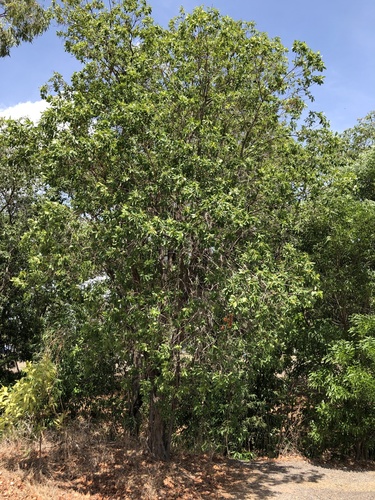
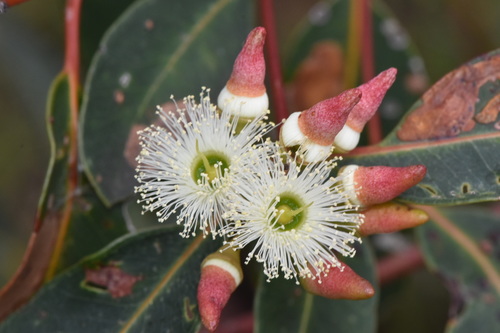
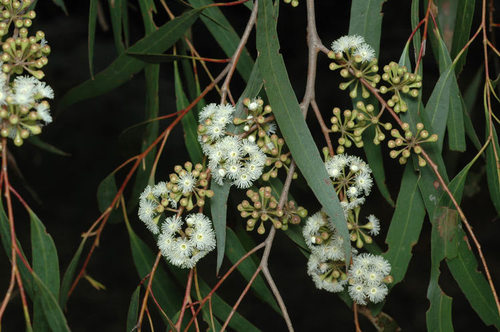
Eucalyptus elata, commonly known as river peppermint, is most often a tree that typically grows to 40 metres (130 feet) tall, and rarely forms a mallee only 6 metres (20 feet) tall. This species forms a lignotuber. It has rough, compact, dark grey bark marked with narrow longitudinal fissures on the lower part of the trunk. On the upper trunk and branches, the bark is smooth, and it sheds in long ribbons that often stay caught in the tree’s crown. The shedding leaves behind a grey, cream, or whitish bark surface. Young plants and coppice regrowth have leaves arranged in opposite pairs, with a lance-shaped to curved form. These leaves measure 33–105 mm (1.3–4.1 in) long and 6–16 mm (0.24–0.63 in) wide. Adult leaves are arranged alternately, are glossy green with the same colour on both sides, and are also lance-shaped to curved. They are 60–220 mm (2.4–8.7 in) long and 6–20 mm (0.24–0.79 in) wide, attached to a 6–20 mm (0.24–0.79 in) long petiole. Flower buds grow in groups of eleven to thirty or more in leaf axils, on an unbranched 4–12 mm (0.16–0.47 in) long peduncle. Individual buds sit on a 3–5 mm (0.12–0.20 in) long pedicel. Mature buds are club-shaped, 2–4 mm (0.079–0.157 in) long and 1.5–3 mm (0.059–0.118 in) wide, with a conical to rounded operculum. Flowering occurs between August and December, and the flowers are white. The fruit is a woody hemispherical or shortened spherical capsule 3–5 mm (0.12–0.20 in) long and 3–6 mm (0.12–0.24 in) wide, with its valves held enclosed below the capsule rim. River peppermint most commonly grows along watercourses, but can also grow on undulating terrain, rocky ridges, or scree slopes within forest. It occurs near the coast and adjacent tablelands, ranging from south of Putty in New South Wales through to eastern Victoria. In horticulture, E. elata is widely cultivated as a street tree and ornamental tree, valued for its attractive smooth upper bark, rich green foliage, and abundant flowers that grow in rounded masses.