About Eucalyptus dumosa A.Cunn. ex Oxley
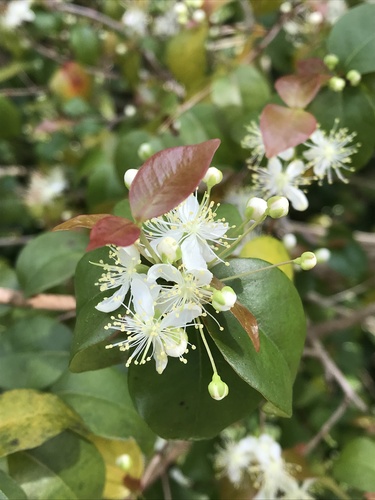
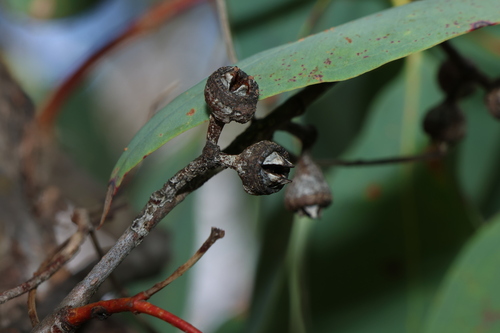
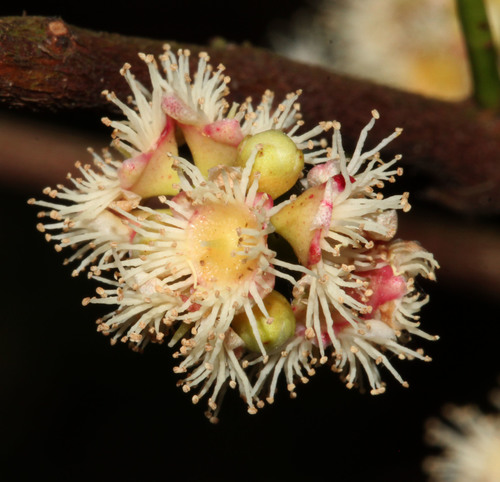
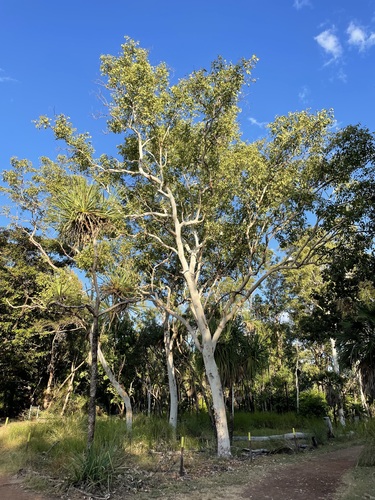
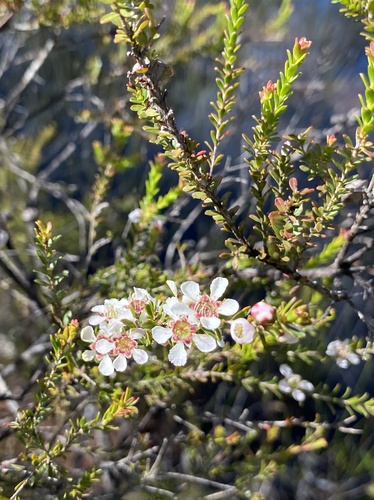
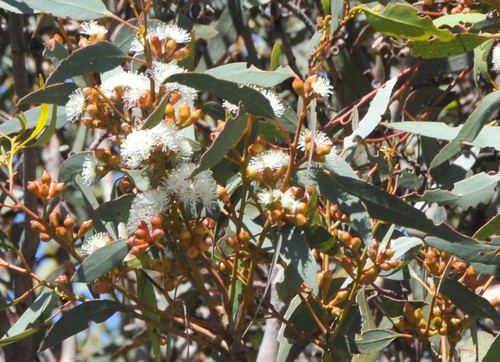
Eucalyptus dumosa A.Cunn. ex Oxley is a mallee that typically grows 4–10 m (13–33 ft) tall, occasionally reaching 12 m (39 ft), and 4–5 m (13–16 ft) wide, with an open, bushy, spreading growth habit. It usually has rough, flaky or fibrous greyish bark on the lower base of its trunk, with smooth whitish or yellow-white bark above that weathers to grey or pinkish-grey. Bark is shed in long thin ribbons. Young plants and coppice regrowth have petiolate leaves, that are egg-shaped to broadly lance-shaped, 55–140 mm (2.2–5.5 in) long and 22–70 mm (0.87–2.76 in) wide. Adult leaves are dull bluish green to greyish green on both sides, lance-shaped to curved, 48–120 mm (1.9–4.7 in) long and 8–25 mm (0.31–0.98 in) wide, growing on a petiole 8–25 mm (0.31–0.98 in) long. Flower buds are arranged in groups of seven in leaf axils, on a peduncle 5–20 mm (0.20–0.79 in) long, with individual buds growing on a pedicel 2–5 mm (0.079–0.197 in) long. Mature buds are cylindrical, green or red, 6–11 mm (0.24–0.43 in) long and 3–5 mm (0.12–0.20 in) wide, with a conical to turban-shaped, striated operculum. Flowering occurs from late summer to mid autumn, and the flowers are white. The fruit is a woody capsule that is cup-shaped to cylindrical or barrel-shaped, 4–9 mm (0.16–0.35 in) long and 5–7 mm (0.20–0.28 in) wide.
This species, commonly called white mallee, is found in the relatively dry country of South Australia, ranging from the northern Flinders Ranges and Murray Mallee east to Dubbo in central western New South Wales and Swan Hill in north western Victoria. It is one of the most widespread mallee species.
Its leaves are steam distilled as a commercial source of cineole-based eucalyptus oil. It is used as a component of mass plantings alongside other mallee species on wide roadside verges, serving as a screen, windbreak, for erosion control, or as a shade tree. Indigenous Australians use this tree as a source of food, drink, and medicines, and to make containers and implements. A sweet manna-like substance produced on its leaves is made into a drink. The bark of young roots is baked and eaten; it is sweet, with a flavor resembling malt.
The 1889 book 'The Useful Native Plants of Australia' records that common names for this species included "Bastard Box" and "Coolibah", and notes that "These Eucalypts, amongst others, yield water from their roots...", and that "a kind of manna called Lerp or Larp by the aboriginals. It is the nidus of an insect, and consists of starch-like substance, which is eaten in summer by the aborigines of the mallee country of Victoria. It somewhat resembles in appearance small shells; it is sweet, and in colour white or yellowish-white. According to Dr. Thomas Dobson, of Hobart, the insect which causes the Lerp to form is Psylla Eucalypti, now called Ctenarytaina eucalypti. It is probably formed on the leaves of other mallee eucalypts. This substance occurs on the leaves, and consists of white threads clotted together by a syrup proceeding from the insect (Psylla Eucalypti) which spins those threads. It contains, in round numbers, of water 14 parts, thread-like portion 33 parts, sugar 53 parts. The threads possess many of the characteristic properties of starch, from which, however, they are sharply distinguished by their form. When lerp is washed with water the sugar dissolves and the threads swell but slightly, but dissolve to a slight extent, so that the solution is coloured blue by iodine. The threads freed from sugar by washing consist of a substance called Lerp-amylum. Lerp-amylum is very slightly soluble in cold water, not perceptibly more so in water at 100°".
Eucalyptus dumosa is also suitable for producing large amounts of biomass, able to yield 10 to 20 metric tons (11 to 22 short tons) per hectare per year. In wheatbelt regions, it is also beneficial, as the tree reduces salinity, provides shade to livestock, acts as a windbreak, and reduces erosion.