About Eucalyptus diversicolor F.Muell.
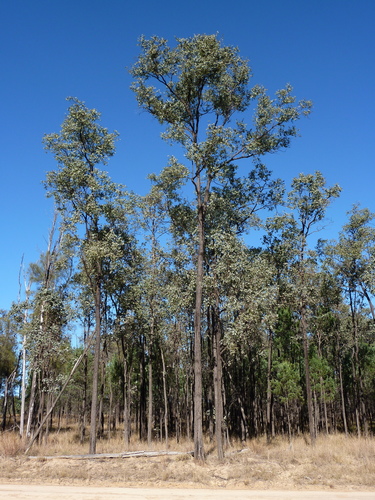
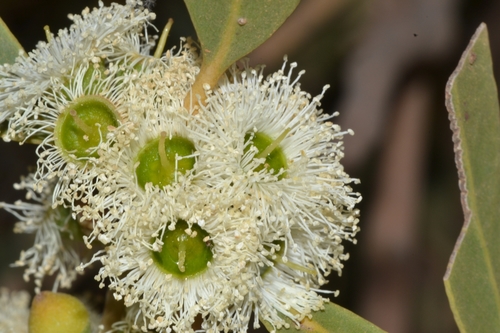
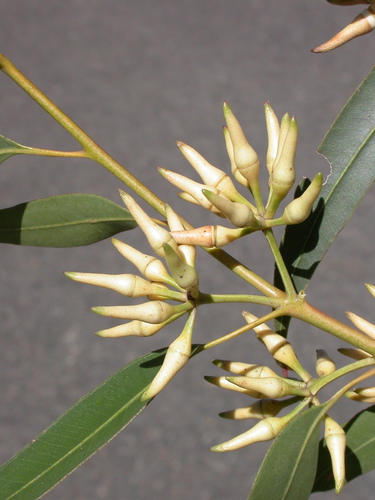
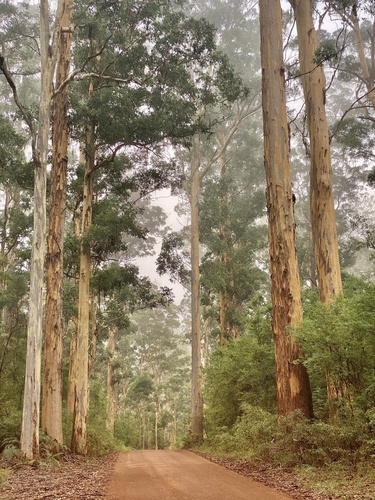
Eucalyptus diversicolor F.Muell., commonly known as karri, is the tallest tree species that grows in Western Australia, and one of the tallest tree species in the world. It is a tall forest tree that typically reaches 10–60 m (33–197 ft) in height, and can grow as tall as 90 m (300 ft). As of February 2019, the tallest known living karri stands just over 80 m (260 ft) tall. A specimen called 'The Tyrant', located south of Pemberton, is 69 m (226 ft) tall with a 11.5 m (38 ft) girth, and holds approximately 220 m3 (7,800 cu ft) of wood in its trunk, making it the largest karri by wood volume. A 72.9 m (239 ft) tall Eucalyptus diversicolor with a 5.71 m (18.7 ft) girth growing in Coimbra, Portugal, is the tallest reliably measured tree in Europe. Karri does not form a lignotuber, but does produce epicormic buds under the bark along the entire length of its stem. The bark on the trunk and branches is smooth, ranging in color from grey to cream or pale orange, and often has a mottled appearance. It is shed annually in large plates, short ribbons, or small polygonal flakes. Newly exposed bark contrasts between white and orange to yellow, and bark becomes increasingly granulated as the tree ages. Karri bark is rich in tannins. Stems and branchlets are round in cross-section, and branchlets have no oil glands in the pith. Leaves on young plants and coppice regrowth are arranged in opposite pairs, broadly egg-shaped to almost round, paler on the lower surface, 50–155 mm (2.0–6.1 in) long, 25–100 mm (0.98–3.94 in) wide, and borne on a petiole. These leaves tend to be more spreading than pendulous. Adult leaves are arranged alternately, glossy dark green on the upper surface and paler below, lance-shaped, 70–135 mm (2.8–5.3 in) long and 15–37 mm (0.59–1.46 in) wide, growing on a flattened or channelled petiole 10–20 mm (0.39–0.79 in) long. The leaves are penniveined, meaning veins arise in a feather-like pinnate arrangement from a single primary vein. They are also densely reticulated, with a closely packed network of veins across the leaf blade. A prominent vein runs very close to and nearly parallel with the leaf margin. Yellow oil glands inside the leaves are located in the center of the smallest unreticulated areas, and fine lateral veins spread at a wide angle from the midrib. Unbranched inflorescences grow in leaf axils in small clusters on a common stalk. Flower buds are arranged in groups of seven on a rounded peduncle 12–30 mm (0.47–1.18 in) long, with each individual bud attached to a 3–6 mm (0.12–0.24 in) pedicel. At maturity, the buds are oval, 11–16 mm (0.43–0.63 in) long and 5–7 mm (0.20–0.28 in) wide, with a conical operculum. Flowering has been recorded in January, April, May, August, and December, and the flowers are white. The flowers have narrow cylindrical calyx tubes that taper gradually toward the base into the pedicel. The numerous stamens form a continuous ring with inflected white filaments. The anthers at the tip of each filament are oblong and open via parallel longitudinal slits. The fruit is a woody barrel-shaped capsule 10–12 mm (0.39–0.47 in) long and 8–10 mm (0.31–0.39 in) wide, borne on a 5–6 mm (0.20–0.24 in) pedicel, with three valves positioned at or below the rim of the capsule. Seeds inside the fruit are flattened ovoid, grey in color, 1.2 to 3 mm (0.047 to 0.118 in) long, pointed at one end, with a smooth upper surface and a placental scar on the underside. This species has a haploid chromosome number of 12. Karri grows naturally only in the High Rainfall Zone of the South West Botanical Province of Western Australia, which receives 900 to 1,300 millimetres (35.4 to 51.2 in) of rain per year, mostly falling in winter. The climate across the species' native range is mildly temperate, with small variations in humidity and temperature, and frosts occur only rarely. Most karri forest is located within the Warren biogeographic region, but there are outlying populations in the Porongorup Ranges, Mount Manypeaks, Torbay, and Rocky Gully along the south coast, Karridale and Forest Grove to the north-west, and the Leeuwin-Naturaliste Ridge south of Margaret River west of the main distribution belt. The core of karri forest extends from near Nannup and Manjimup through to Denmark. The total area covered by karri forest today is less than 200,000 hectares (494,211 acres), around one fifth of its original virgin extent. The nearest other tall tree forests are approximately 3,000 kilometres (1,864 mi) to the east in Tasmania and Victoria. Eucalyptus diversicolor has been introduced to parts of Africa including Kenya, Tanzania, and the Canary Islands. The species is considered invasive in South Africa, where it causes problems in the Western Cape region and is locally called karie. It commonly invades clearings, fynbos, water courses, and roadsides, often outcompetes native species, and spreads easily via seed dispersal. Karri is counted as one of the six forest giants of Western Australia; the other five are Corymbia calophylla (marri), Eucalyptus gomphocephala (tuart), Eucalyptus jacksonii (red tingle), Eucalyptus marginata (jarrah), and Eucalyptus patens (yarri). Some karri specimens are thought to live up to 300 years. The species often grows in poor soil, and tends to flower after fire to take advantage of nutrients released by the combustion of forest litter. The soil in its native range is classified as karri loam. While low in some minor nutrients, it is valued for its depth and its suitability for growing pasture. The soil can reach several metres in depth, and is thought to form primarily from bark shed by karri trees, which accumulates at the base of the trunk to a depth of up to six metres in mature specimens. Karri supports an extensive ecosystem connected to the granite outcrops of south-western Western Australia and the many creeks and rivers formed by runoff from these outcrops. Karri trees generally dominate the deep valleys between granite outcrops that surround creeks and rivers. Dense understorey persists in karri forest areas, retaining moisture through hot summers. Associated understorey trees and shrubs include Agonis flexuosa (peppermint), Allocasuarina decussata (karri sheoak), Acacia pentadenia (karri wattle), and Chorilaena quercifolia (karri oak). A diverse community of flowers and smaller plants, totalling around 2,000 plant taxa, forms the mosaic of habitats within karri forests. Karri has a complex floral cycle; it takes four to five years from flower production to seed release. Seed production depends on many variables, including tree density, pollinator availability, soil moisture, genetics, nutrients, and fire. Karri wood has a green density of around 1,200 kilograms per cubic metre (75 lb/cu ft), and an air-dried density of about 900 kilograms per cubic metre (56 lb/cu ft). Karri heartwood is red in color and closely resembles jarrah heartwood. Historically, Australian bushmen could tell the two timbers apart by burning a wood splinter: karri leaves white ash, while jarrah leaves grey to black ash. Karri timber is suitable for construction work. It is slightly denser than jarrah, but much stronger. Karri wood is not as resistant to termites as jarrah wood. Karri has been logged since European settlement of Western Australia, with logging towns established across the species' range, and the species has been harvested to produce hardwood timbers, mostly for construction, for the 150 years since settlement. The first karri timber felled for export came from the isolated settlement around Leeuwin, which later became known as Karridale. In the 1920s, the state conservator of forests Charles Lane-Poole promoted the virtues of karri wood, noting that colonists preferred other timbers because karri's vulnerability to termites made it a poor choice for fence posts and railway sleepers. Within Western Australia, karri timber was used for wagon spokes and wooden pipes. In England, it was used for scantlings by the national railway, for telegraph arms by postal services, and was listed by Lloyds as a shipbuilding timber valued for its great strength over long lengths. Between 1937 and 1952, eight fire lookouts were built in karri forests, using the tallest karri trees to give foresters a commanding view of the landscape. The idea was first suggested in 1937 by young forester Don Stewart, who later became Conservator of Forests; the first such lookout was actually built on a large marri (Corymbia calophylla) at Alco near Nannup. Spotter planes are now used for fire detection instead, and some of the tall trees that hosted lookouts are now tourist attractions. Karri wood is a beautiful mahogany color, lighter than jarrah. It is widely used in the building industry, especially for roofs, thanks to the great length and knot-free quality of its boards. It is also used for flooring, furniture, cabinetry, and plywood. The heartwood is golden to reddish brown, often with an orange or purple tint, and tends to darken with age. It has interlocked grain with a uniform medium-coarse texture. It has a reputation for being susceptible to termites, although it is far less susceptible than pine. It is resistant to rot, and makes excellent furniture. Blocks of karri wood were used to pave some of the main streets of early Sydney, though these have long been covered by asphalt; karri wood was also sent to London for the same paving purpose. Karri honey is widely desired for its clarity, light color, and delicate flavor. In 1952, it was estimated that 25% of honey produced in Western Australia came from karri forests. Major honey flows occur every four to five years, with even larger flows around every fifteen years. Karri forests also support tourism in the region.