About Eucalyptus delegatensis F.Muell. ex R.T.Baker
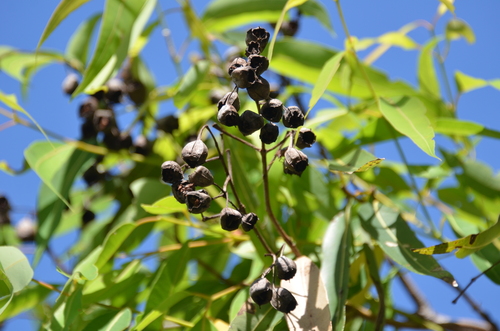
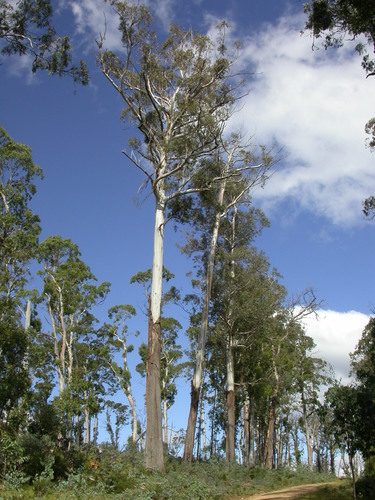
Eucalyptus delegatensis, commonly known as alpine ash, is a tree that typically grows to a height of 40 to 50 metres (130 to 160 feet), and may occasionally reach up to 90 metres (300 feet). This species forms a lignotuber. On the lower half of the trunk, the bark is rough, grey to black, and has a fibrous or stringy texture; bark on the upper trunk is smooth and ranges in color from white to greyish. Young plants and coppice regrowth have broadly lance-shaped to egg-shaped leaves that are 70–200 mm (2.8–7.9 in) long and 27–82 mm (1.1–3.2 in) wide. Adult leaves are lance-shaped to curved, the same glossy green to bluish green on both sides, 75–230 mm (3.0–9.1 in) long and 13–55 mm (0.51–2.17 in) wide, borne on a petiole 10–45 mm (0.39–1.77 in) long. Flower buds are arranged in groups of 7 to 15 in leaf axils, on an unbranched peduncle 8–20 mm (0.31–0.79 in) long, with individual buds attached to a pedicel 3–5 mm (0.12–0.20 in) long. Mature buds are oval to club-shaped, colored green to yellow or red, 4–5 mm (0.16–0.20 in) long and wide, with a conical or rounded operculum that has a small point at the tip. Flowering occurs between December and March, and the flowers are white. The fruit is a woody barrel-shaped to hemispherical capsule that is 6–11 mm (0.24–0.43 in) long and wide, with valves located near the rim of the capsule or enclosed within the fruit. Alpine ash is widespread and often dominant in grassy or wet subalpine forest, growing in deep fertile soil, often on slopes, and commonly forms pure stands. In New South Wales and the Australian Capital Territory, it is found south from the Brindabella Range. In Victoria, it occurs at altitudes between 900 and 1,500 m (3,000 and 4,900 ft) east of Mount Macedon. The subspecies Eucalyptus delegatensis subsp. tasmaniensis is endemic to Tasmania.