About Eucalyptus deglupta Blume
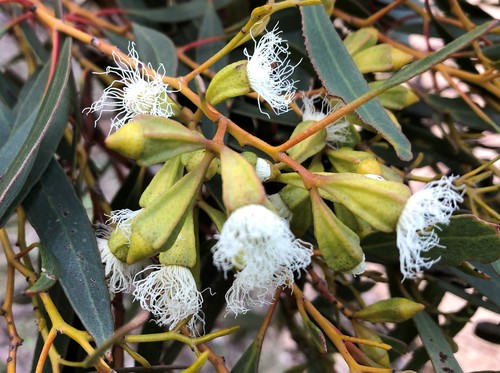
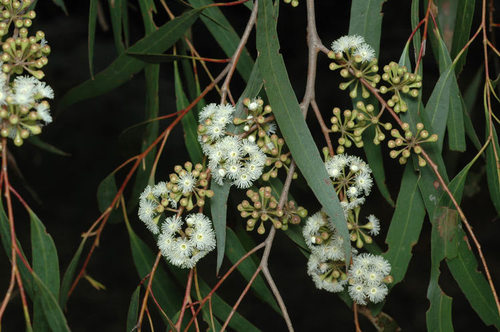
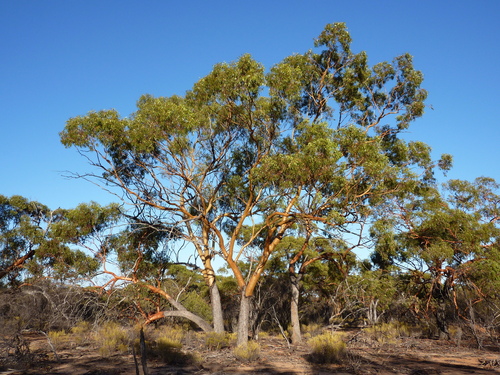
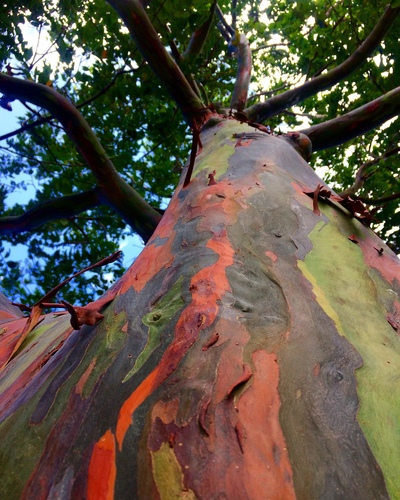
Eucalyptus deglupta Blume is a fast-growing tree that typically reaches 60–75 m (197–256 ft) in height. Its trunk can grow up to 240 cm (94 in) in diameter, with buttresses reaching up to 4 m (13 ft) high. It has smooth, orange-tinted bark that sheds in strips, revealing streaks of pale green, red, orange, grey, and purplish brown. Branchlets are roughly square in cross section, and often have narrow wings along their corners. Leaves are arranged in opposite pairs, most measuring 75–150 mm (3–6 in) long and 50–75 mm (2–3 in) wide, attached to a short petiole. Flower buds are arranged in a branching inflorescence that grows in leaf axils or at the end of branchlets. Each branch holds groups of seven buds, with individual buds attached to a pedicel about 5 mm (3⁄16 in) long. Mature buds are pale green or cream-coloured, roughly spherical, and 2–5 mm (1⁄16–3⁄16 in) in diameter, with a hemispherical operculum that has a small point at the top. Flowering time varies based on location, and the stamens that give the flowers their color are white or pale yellow. The fruit is a woody, brown, hemispherical capsule about 3–5 mm (1⁄8–3⁄16 in) long and wide, with three or four valves that extend beyond the fruit's rim. Each fruit cell contains between three and twelve tiny brown seeds, each with a small wing. This species, commonly called the rainbow eucalyptus, grows in lowland and lower montane rainforest, at altitudes from sea level up to 1,800 m (5,900 ft). It is native to Indonesia, Papua New Guinea, and the Philippines, but has been widely planted in many other countries. Wild populations of this species are severely fragmented, and the overall population is decreasing. It is estimated that the overall population has declined by 30% over the last 210 years. In 2019, the International Union for the Conservation of Nature listed E. deglupta as a vulnerable species. Eucalyptus deglupta is commonly planted as an ornamental tree in frost-free climates, including Hawaii, Southern California, Texas, and Florida. It is planted in at least three locations in coastal Los Angeles County, including Santa Monica and San Marino at the Huntington Botanical Garden. In 1988, these trees were still growing, and were relatively young at approximately 30–40 years old. It also grows at the UCLA Botanic Garden and as a Los Angeles city street tree. When grown from seed, the growing temperature should be around 20–22 °C (68–72 °F). Plants can be grown from cuttings taken from trees younger than 5 years old. Once a tree reaches 5 years of age, root inhibition prevents cuttings from developing new roots. This species thrives in rich, medium-to-wet soil in full sun, and is intolerant of frost. In botanical gardens such as Fairchild Tropical Botanic Garden in Florida, the tree displays the same intense range of bark colors seen in trees from its native range.