About Eucalyptus crenulata Blakely & Beuzev.
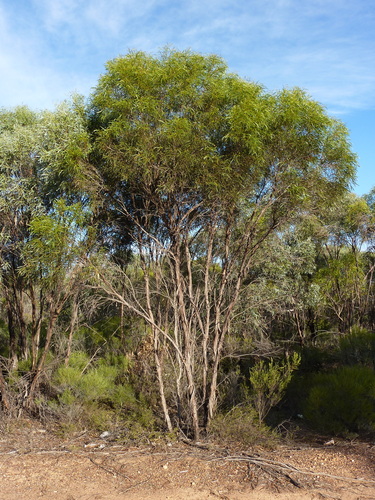
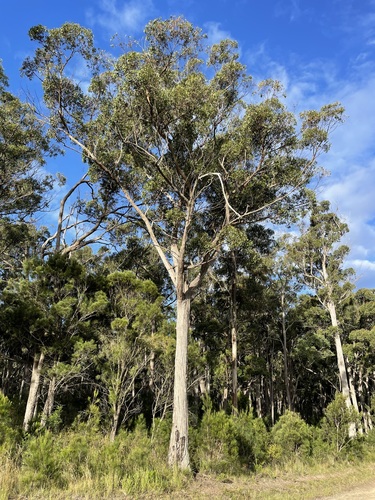
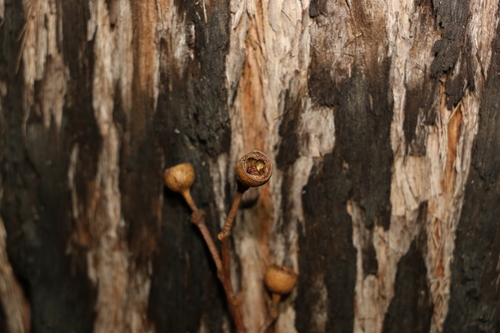
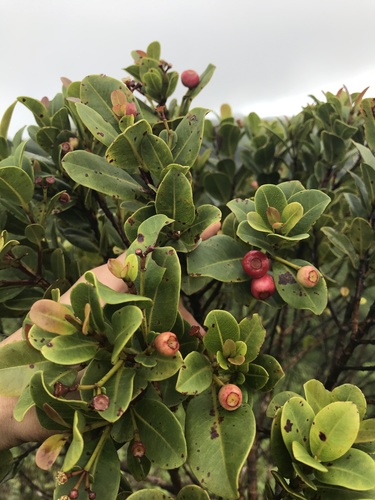
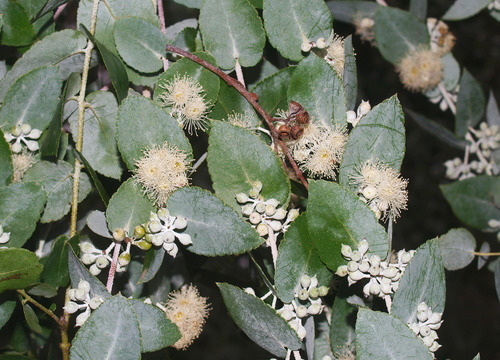
Eucalyptus crenulata, commonly known as Buxton gum, is a tree that typically reaches 10–12 meters (30–40 feet) in height and forms a lignotuber. It has hard, rough, compact bark that is grey to brown or black on the trunk, and smooth grey or yellowish bark on the branches. Leaves on young plants and coppice regrowth are egg-shaped to heart-shaped, arranged in opposite pairs, paler on the lower surface, 20–65 mm (0.79–2.6 inches) long and 15–55 mm (0.6–2 inches) wide, and do not have a petiole. Adult leaves are similar to juvenile leaves, except juvenile leaves are covered in a powdery white bloom that eventually wears away. All leaf edges have small, rounded teeth. Flower buds grow in groups of seven, nine or eleven in leaf axils, on an unbranched peduncle 1–8 mm (0.04–0.3 inches) long, with individual buds attached to a pedicel 1–4 mm (0.04–0.2 inches) long. Mature buds are oval to almost spherical, covered in a powdery bloom, 5–7 mm (0.20–0.28 inches) long and 3–4 mm (0.12–0.16 inches) wide, with a beaked operculum. Flowering takes place from September to February, and the flowers are white. The fruit is a woody, cup-shaped capsule 3–5 mm (0.12–0.20 inches) long and 4–6 mm (0.16–0.24 inches) wide, borne on a pedicel up to 3 mm (0.1 inch) long, with valves enclosed below the capsule rim. Buxton gum grows in swampy sites in the foothills of the Great Dividing Range. It is only known from two natural populations: one near the Acheron River valley close to Buxton, and the other on the Yarra River floodplain at Yering in Victoria, Australia. This species is widely cultivated, and there are far more specimens in cultivation than exist in the wild.