About Eucalyptus crebra F.Muell.
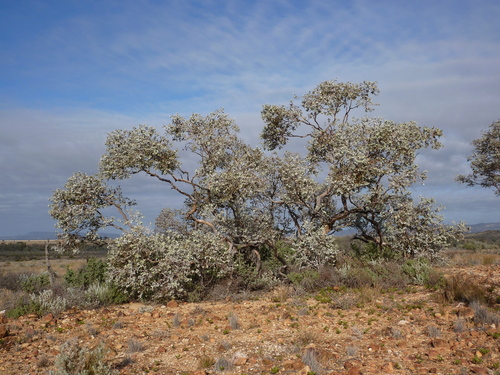
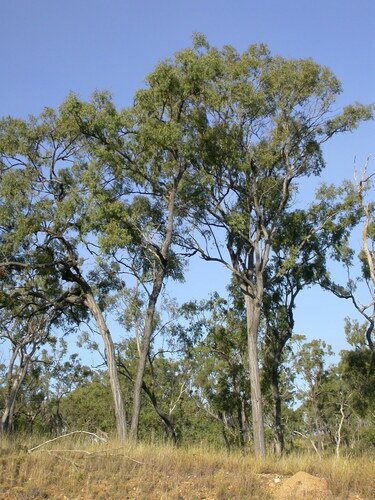
Eucalyptus crebra F.Muell. is a tree that usually grows to a height of 35 metres (115 feet), and forms a lignotuber. It has persistent, thick, rough, deeply furrowed, greyish-black "ironbark" that extends from the base of its trunk all the way to its small branches. Young plants and coppice regrowth have linear to lance-shaped or curved leaves that are 50–120 mm (2.0–4.7 in) long and 6–17 mm (0.24–0.67 in) wide. Adult leaves are linear to lance-shaped, with the same dull green to greyish colour on both sides. They measure 55–180 mm (2.2–7.1 in) long and 7–27 mm (0.28–1.06 in) wide, and grow on a petiole 7–20 mm (0.28–0.79 in) long. Flower buds are arranged in groups of seven, nine or eleven, usually on a branching inflorescence at the ends of branchlets. Each group is borne on a peduncle 2–13 mm (0.079–0.512 in) long, with individual buds attached to a pedicel 2–7 mm (0.079–0.276 in) long. Mature buds are club-shaped, spindle-shaped, or diamond-shaped to oval, 3–7 mm (0.12–0.28 in) long and 2–4 mm (0.079–0.157 in) wide, green to yellow, with a conical to rounded operculum. Flowering has been recorded in most months of the year, and the flowers are white. The fruit is a woody capsule that is cup-shaped, barrel-shaped or hemispherical, 2–7 mm (0.079–0.276 in) long and 2.5–6 mm (0.098–0.236 in) wide, borne on a pedicel 1–6 mm (0.039–0.236 in) long. This species, commonly called narrow-leaved ironbark, grows in sandy soils in woodland and forest. Its range extends from Picton, southwest of Sydney, north through New South Wales and Queensland to the area around Moreton Telegraph Station on Cape York Peninsula. The tree produces hard, strong, dark red timber that has been used for railway sleepers and construction. A plank from this tree was recorded being used in Elizabeth Farm, Australia's oldest surviving European dwelling. It is planted as a shade tree and for lining roadways, and is also available as a cultivated variety. It is useful for honey production because its flowers produce abundant nectar and pollen; honey made from this species by bees is light-coloured and has a delicate flavour.