About Eucalyptus cornuta Labill.
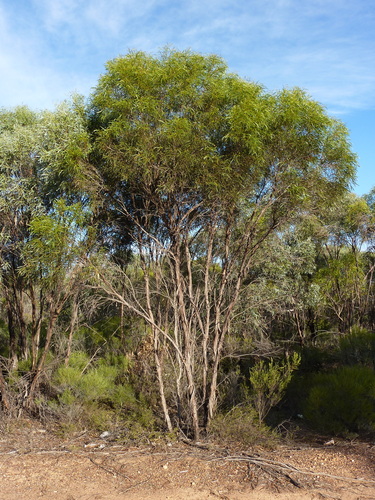
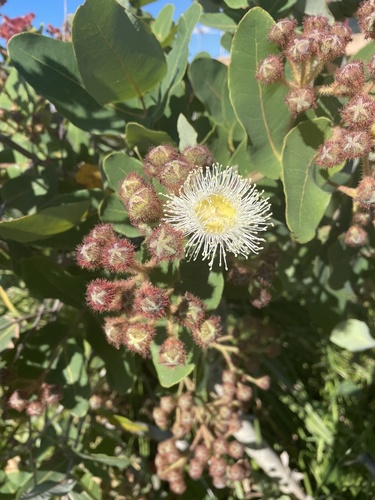
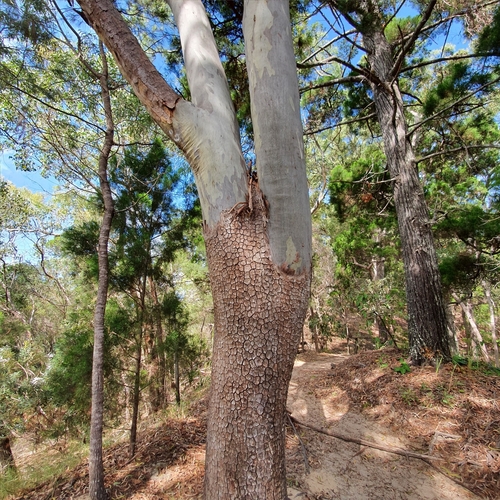
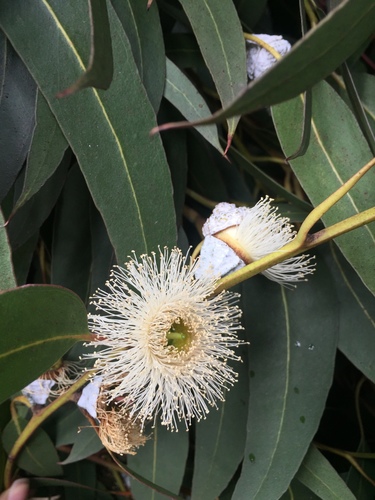
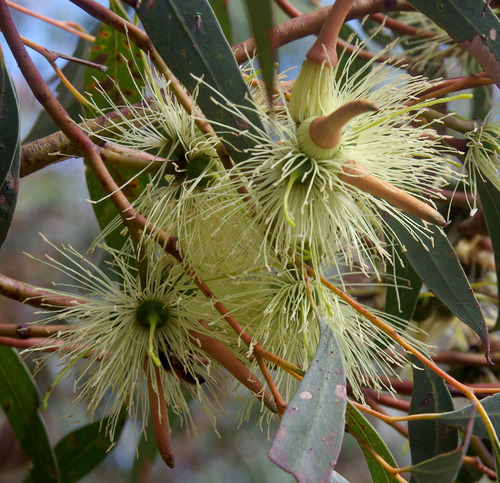
Eucalyptus cornuta Labill. (commonly known as yate) is most often a tree that typically grows to 25 metres (82 feet) tall, with a crown 8–12 metres (26–39 feet) wide. It sometimes grows as a 10-metre (33-foot) tall mallee and always forms a lignotuber. New stems can fork from the trunk or lignotuber, and older specimens may develop multiple main stems that replace the original single trunk. It has rough, fibrous, brown to almost black bark on all or part of its trunk, with smooth greyish bark on sections above the rough bark. Young plants and coppice regrowth have egg-shaped to roughly round leaves that are 40–70 mm (1.6–2.8 in) long, 20–70 mm (0.79–2.76 in) wide, and paler on the lower surface. Adult leaves are arranged alternately, glossy green and the same shade on both sides, usually lance-shaped. Most adult leaves are 60–135 mm (2.4–5.3 in) long, 10–33 mm (0.39–1.30 in) wide, and grow from a 5–20 mm (0.20–0.79 in) long petiole. Flower buds are arranged in groups of eleven or more on a rounded to flattened, unbranched peduncle that is 12–32 mm (0.47–1.26 in) long. Individual buds are usually sessile. Mature buds are elongated, 23–42 mm (0.91–1.65 in) long and 5–8 mm (0.20–0.31 in) wide, with a horn-shaped operculum that is between four and seven times as long as the floral cup. Flowering occurs between January and May, or from July to November, and the flowers are yellowish green. The fruit is a woody cylindrical to cup-shaped capsule 5–12 mm (0.20–0.47 in) long and 6–13 mm (0.24–0.51 in) wide; seeds are released through slits between the fruit's valves. This species occurs in a range extending from southeast of Busselton to Cape Arid, including the islands of the Recherche Archipelago in Western Australia. It often grows in isolated stands. In more arid regions near Esperance, it most often occurs at granite outcrops, growing in deeper, wetter soil in rock cavities or on the apron beneath the rockface. It grows in a large mallee form in coastal areas, and as tall stands in high-rainfall, fertile valley areas, particularly the inland region from Manjimup to the Porongurups. Its vigorous early growth and lignotuber allow it to produce new stems after fire, or when new growing opportunities open in the canopy or surrounding environment. Its growth habit is similar to the mallee habit of smaller eucalypts in drier regions, and comparable to that of limestone marlock (E. decipiens), which occurs to the north and east of yate's range. In favourable habitat, a single trunk can reach great height, and it is able to compete in tall forests of jarrah (Eucalyptus marginata) and marri (Corymbia calophylla) alongside any other tree species, except for the giant karri (Eucalyptus diversicolor) in karri forest. Yate is sold commercially for horticultural use as an ornamental tree, shade tree, or to provide wildlife habitat. It tolerates drought, moderate frost, a wide range of soils, and grows successfully in coastal areas. Although it can reach great height in its natural habitat, it is successfully planted as a medium or small tree for shade, windbreaks, street trees, and highway verges. It is widely known as a cultivated tree across Australia, and has also been introduced to California. Ferdinand von Mueller sent seed of this species to Lucknow, where a sapling grew 8 to 10 feet tall within a year, and unlike other tested eucalypts, tolerated tropical rain; Mueller's 1879 report also noted the species had been successfully introduced to Melbourne. This eucalypt produces one of the hardest and strongest timbers in the world, and was formerly used to make wheel spokes and shafts for horse-drawn vehicles. Most trees with commercially valuable timber were logged long ago.