About Eucalyptus coolabah Blakely & Jacobs
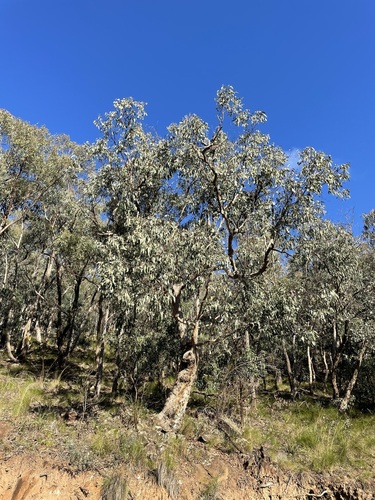
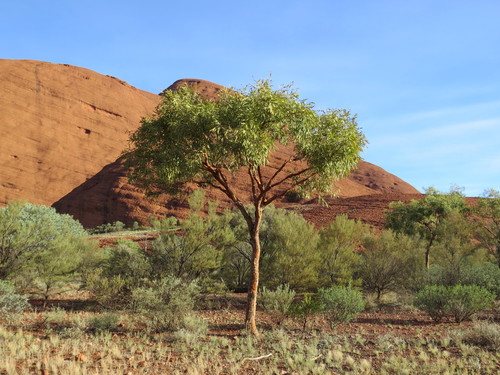
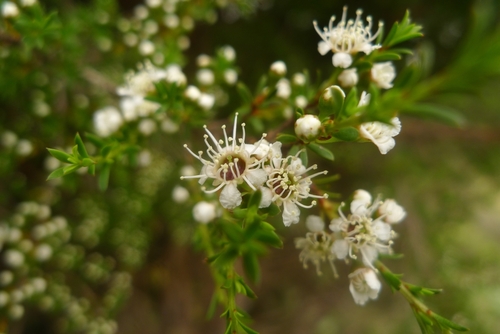
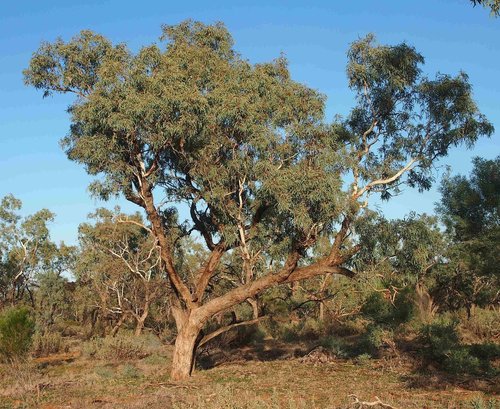
Eucalyptus coolabah Blakely & Jacobs is a tree that typically grows to 20 metres (66 feet) in height. It has hard, fibrous to flaky grey bark with whitish patches covering part or all of the trunk, and sometimes covering larger branches. The upper bark is smooth, powdery, ranges in colour from white to cream-coloured, pale grey or pink, and is shed in short ribbons. Young plants and coppice regrowth usually have stems that are more or less square in cross-section, with dull bluish, lance-shaped leaves that measure 40–130 mm (1.6–5.1 in) long and 5–30 mm (0.20–1.18 in) wide. Adult leaves are the same dull green to bluish or greyish colour on both sides, and are lance-shaped to curved. They are 80–170 mm (3.1–6.7 in) long and 10–25 mm (0.39–0.98 in) wide, growing from a petiole 8–20 mm (0.31–0.79 in) long. Flower buds are arranged on a branching inflorescence in leaf axils, with groups of seven buds on each branch. Each branch has a flattened to angular peduncle 3–10 mm (0.12–0.39 in) long, and each individual bud grows from a cylindrical pedicel 1–4 mm (0.039–0.157 in) long. Mature buds are oval, often glaucous, 3–5 mm (0.12–0.20 in) long and 2–4 mm (0.079–0.157 in) wide, with a conical operculum. Flowering has been recorded in most months of the year, and the flowers are white. The fruit is a woody conical or hemispherical capsule 2–4 mm (0.079–0.157 in) long and 3–5 mm (0.12–0.20 in) wide, growing on a pedicel 1–3 mm (0.039–0.118 in) long, with valves that protrude beyond the capsule rim. Eucalyptus coolabah is very similar to Eucalyptus microtheca, which has rough bark extending to its smallest branches, and to Eucalyptus victrix, which has smooth bark across its entire structure. This species is found in western New South Wales, central South Australia, the Kimberley region of Western Australia, western Queensland, and southern to central parts of the Northern Territory. It grows on occasionally flooded heavy-soiled plains and on the banks of intermittent streams and creeks, where flows are generally too infrequent to support river red gums (Eucalyptus camaldulensis). The wood of Eucalyptus coolabah typically has a density of 900 to 1,100 kilograms per cubic metre (56 to 69 lb/cu ft). Its heartwood is reddish brown, and much darker than its sapwood. Indigenous Australians used the wood to make spears, fire-making equipment, message sticks, coolamons (wooden dishes) and throwing sticks, and also obtained water from the rootwood.