About Eucalyptus conferruminata D.J.Carr & S.G.M.Carr
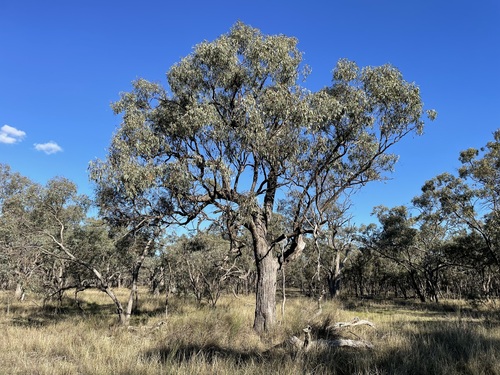
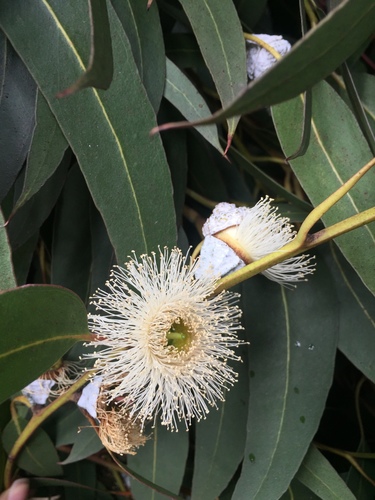
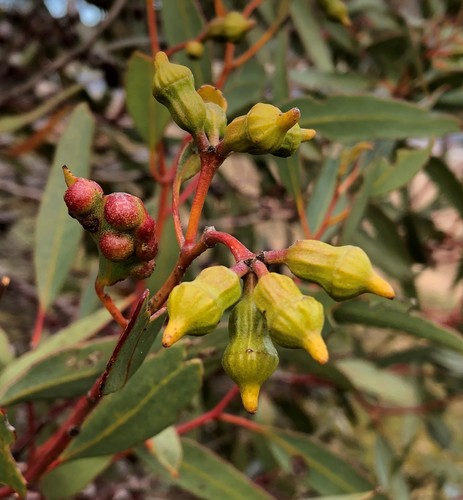
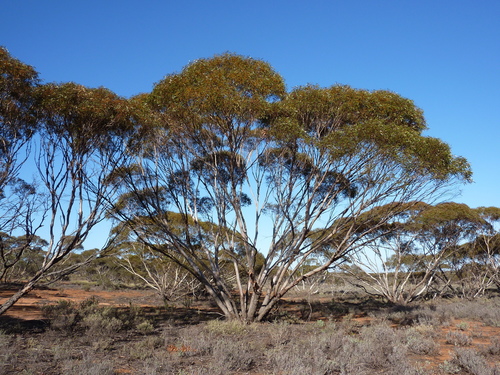
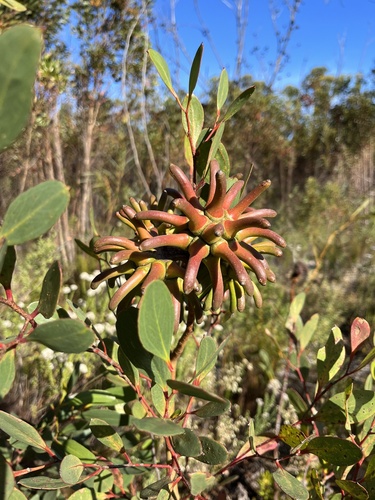
Eucalyptus conferruminata D.J.Carr & S.G.M.Carr is typically a mallee or tree that grows to a height of 2 to 8 metres (7 to 26 ft), has smooth grey and whitish bark, and forms a bushy shape. Its adult leaves are elliptical, oblong, or egg-shaped, between 40–90 mm (1.6–3.5 in) long and 10–30 mm (0.39–1.18 in) wide, and are the same glossy, light green colour on both surfaces. Flower buds grow in groups of 15 to 21 or more in leaf axils, on a broad, strap-like peduncle 30–70 mm (1.2–2.8 in) long. The buds are fused at the hypanthium, with only their upper portions being free. The combined length of the fused hypanthia and each operculum measures around 30–45 mm (1.2–1.8 in). The operculum is horn-shaped, and is about four to six times as long as the fused hypanthia. Flowers range in colour from green to yellow-green, and appear from late winter to late spring, between August and November. The fruit fuse together to form a woody mass 14–26 mm (0.55–1.02 in) wide, with three valves that extend beyond the fruit rim but remain fused at their tips. Seeds are blackish brown with a flattened-ovoid to cuboid shape, and are released through the gap between the valves. This species is native only to southern Western Australia, ranging from Two Peoples Bay east to beyond Esperance, including islands in the Archipelago of the Recherche. It always grows in coastal areas, often on large granite rocks, and is commonly found on hillsides and in gullies in sandy-loamy soils over granite or quartzite. It has become naturalised in other parts of the Southwest region of Western Australia through revegetation projects, use as windbreaks, and as a garden escapee. It has a limited distribution in Victoria, where it has become sparsely established in the Gippsland and Wimmera areas after spreading by seed from planted trees. It was once sold under the name Eucalyptus lehmannii, and has also become naturalised in California. The subspecies most commonly cultivated in coastal regions of southern Australia, including the metropolitan areas of Perth and Adelaide, is subspecies recherche. Subspecies conferruminata is endemic to the Recherche Archipelago and does not occur naturally on the Australian mainland. In horticulture, this plant is sold commercially for use as an ornamental, a wind break, or for erosion control. Once established, it tolerates drought and moderate frost, and grows in a variety of soil types including waterlogged soils.