About Eucalyptus coccifera Hook.fil.
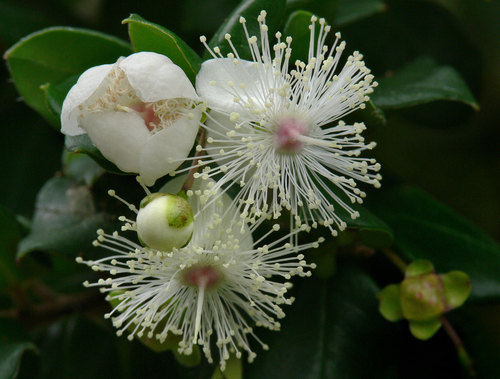
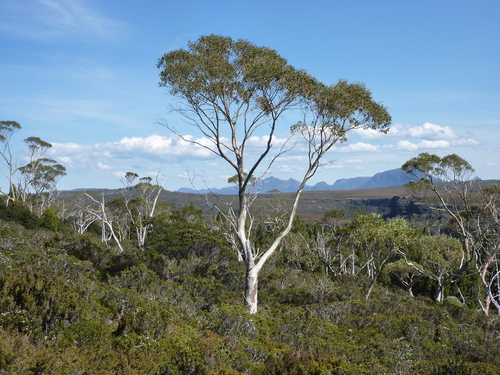
Eucalyptus coccifera Hook.fil. is most often a tree that typically reaches 15 metres (49 ft) in height, but sometimes grows as a mallee only up to 5 m (16 ft) tall. It has smooth bark that is light grey to white, marked with tan streaks. Young plants and coppice regrowth have sessile, blue-green leaves that are elliptic to heart-shaped, measuring 15–45 mm (0.59–1.77 in) long and 7–23 mm (0.28–0.91 in) wide. Adult leaves are arranged alternately along stems, are elliptic to lance-shaped, and have the same glossy green to bluish colour on both sides; they are 50–100 mm (2.0–3.9 in) long, 10–20 mm (0.39–0.79 in) wide, and grow from a petiole 8–22 mm (0.31–0.87 in) long. Flowers are produced in groups of three, seven or nine in leaf axils, growing from a 4–12 mm (0.16–0.47 in) long peduncle, with individual buds attached to a 1–7 mm (0.039–0.276 in) long pedicel. Mature buds are oval, glaucous, 5–8 mm (0.20–0.31 in) long and 4–7 mm (0.16–0.28 in) wide, with a warty, hemispherical to more or less flattened operculum. Flowering occurs between December and February, and the flowers are white, or rarely pink. The fruit is a woody capsule that is conical, hemispherical or cup-shaped, 6–12 mm (0.24–0.47 in) long and 8–13 mm (0.31–0.51 in) wide. This eucalypt is endemic to Tasmania, where it is the dominant species in many exposed, rocky, dolerite-rich sub-alpine regions of southern Tasmania and the Tasmanian Central Plateau. For most eucalyptus species, flower buds take around one year to fully develop, but development is slower for E. coccifera and other high altitude eucalypts. Insects and birds pollinate the open flowers, and fertilization can take up to 20 days after pollination occurs. Flowering of E. coccifera typically runs between November and February. After fertilization, the hard woody capsule develops. Seeds are released through valves in the capsule, which open when the capsule dries. This drying is triggered by either extreme heat and drought, or fire. Seed dispersal relies partially on wind, but mostly on gravity, so seeds usually fall within a couple of metres of the parent tree. E. coccifera can also regenerate from underground lignotubers after fire.