About Eucalyptus cladocalyx F.Muell.
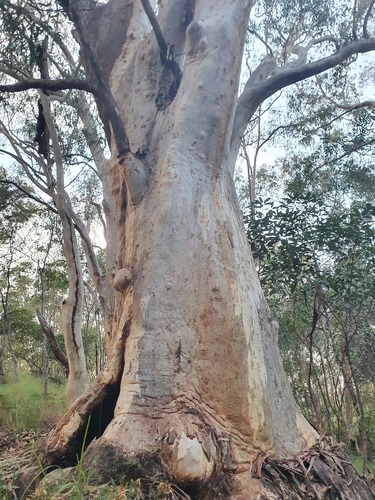
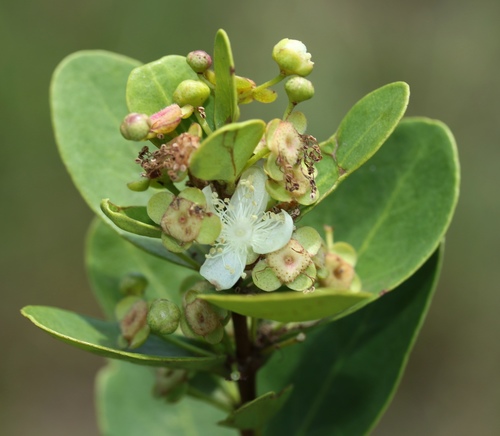
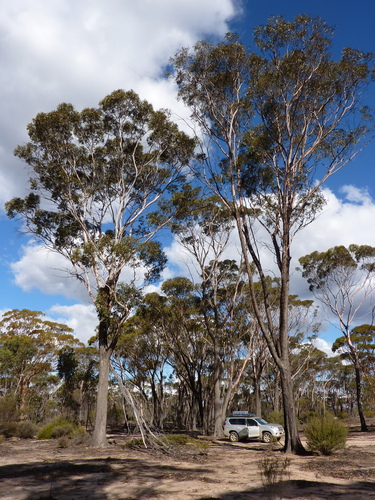
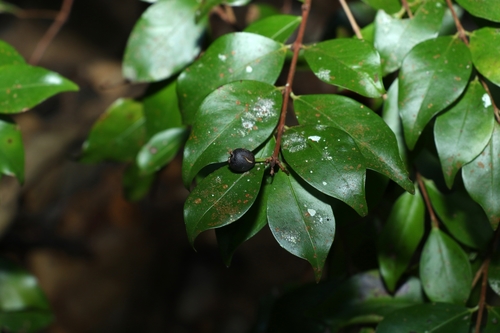
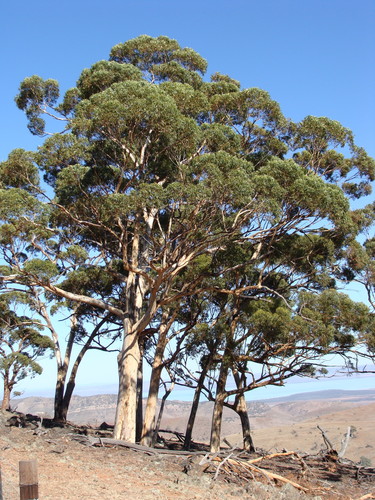
Eucalyptus cladocalyx F.Muell., commonly known as sugar gum, is most recognizable for its mottled, colourful yellow to orange bark, strongly discolourous leaves, and inflorescences that grow in clusters on leafless branchlets inside the tree crown. Old bark of this species is smooth and grey, and sheds in irregular patches to reveal fresh yellowy-brown new bark. It produces creamy-white flowers in summer, and its fruit capsules are barrel-shaped to urn-shaped. Sugar gums growing in the Flinders Ranges reach up to 35 metres (115 ft) in height, and have the classic "gum" growth habit: a straight trunk with a diameter at breast height (dbh) of 1 to 1.5 m (3 ft 3 in to 4 ft 11 in), with steep branches growing from roughly halfway up the trunk. Each main branch ends in its own small canopy. By contrast, trees growing on the Eyre Peninsula and Kangaroo Island are much shorter, typically reaching 8 to 15 m (26 and 49 ft) in height with a dbh of 0.4 m (1 ft 4 in), and often have crooked trunks. The crown has an open spreading growth habit, with a typical spread of 12 to 15 m (39 to 49 ft). Adult leaves are strongly discolorous and glossy, arranged alternately on petioles that are 0.9 to 2.7 cm (0.35 to 1.06 in) long. The leaf blade is darker green on its upper surface and paler below, with a slightly falcate to lanceolate shape. It measures 8 to 17 cm (3.1 to 6.7 in) long and 1.2 to 3.2 cm (0.47 to 1.26 in) wide, and usually tapers at the base to connect to the petiole. Leaf side-veins form an acute or wider angle and are densely reticulate. The intramarginal vein runs parallel to the leaf margin but is separated from it, and the leaves have small, obscure oil glands. Inflorescences are axillary and unbranched, forming umbels that hold 7, 9, or 11 flower buds each. Mature buds are oblong, pale green, yellow to creamy, and measure 0.8 to 1.1 cm (0.31 to 0.43 in) long and 0.4 to 0.5 cm (0.16 to 0.20 in) wide. Buds are often longitudinally striated and scarred, with a rounded operculum, inflexed stamens, and cuboid to oblong anthers. After flowering, urceolate or barrel-shaped, longitudinally ribbed fruits develop that measure 0.7 to 1.5 cm (0.28 to 0.59 in) long and 0.5 to 1 cm (0.20 to 0.39 in) wide. Fruits have a descending disc and three or four enclosed valves. The light grey to brown seeds inside the fruit are 1.5 to 3 mm (0.059 to 0.118 in) long, with a flattened-ovoid shape that may be pointed at one end. Eucalyptus cladocalyx is endemic to a few restricted areas in southern South Australia, where it occurs in three distinct populations: across southern and central-eastern Eyre Peninsula, through most of the Flinders Ranges, and on Kangaroo Island. It is thought to be a remaining component of relic forests that formed in wetter past climates. Eucalyptus cladocalyx has become naturalised outside its native range in the South West region of Western Australia, southern Victoria, and parts of south-eastern South Australia. It is also naturalised in regions outside of Australia, including northern and southern Africa, California, Hawaii, Arizona, Israel, Chile, Greece, Portugal and Spain. Three subspecies are recognised: subspecies cladocalyx is restricted to southern and eastern Eyre Peninsula, subspecies crassa to Kangaroo Island, and subspecies petila to the southern Flinders Ranges. This tree has been widely planted across southern Australia, most commonly as a farm windbreak or shelterbelt, and also for timber and firewood production. Its wood is termite-resistant, with moderate strength and durability, and is used to make furniture, flooring, posts, construction timber, and railway sleepers. It is a fast-growing species that grows best planted in full sun on clay, loamy, or sandy soils. It uses water efficiently, tolerates drought and frost, and its flowers attract bees. It also serves as a suitable breeding habitat for the Yellow-tailed Black-Cockatoo. Eucalyptus cladocalyx is well adapted to regular bushfires, and can resprout epicormically after fire. It also produces large numbers of wind-dispersed seeds that readily establish new seedlings. The hard, heavy heartwood is pale yellow-brown, with a fine uniform texture and interlocked grain. Air-dried wood has a density of around 1,105 kg/m3 (1,863 lb/cu yd) and is moderately durable. The dwarf subspecies cladocalyx is sold in the nursery trade as E. cladocalyx 'Nana'.