About Eucalyptus cinerea F.Muell. ex Benth.
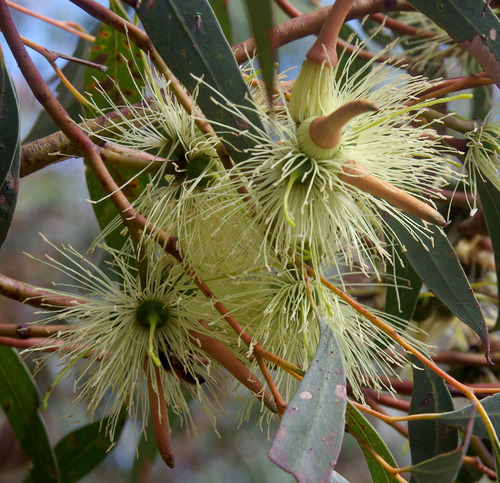
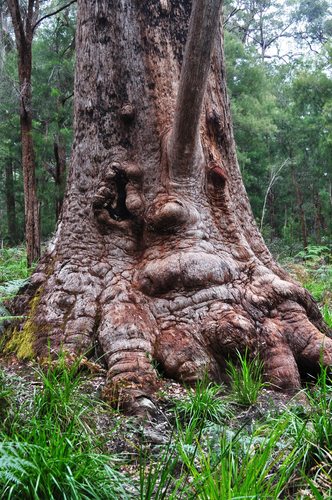
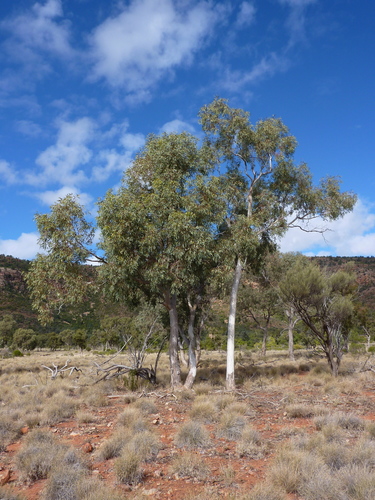
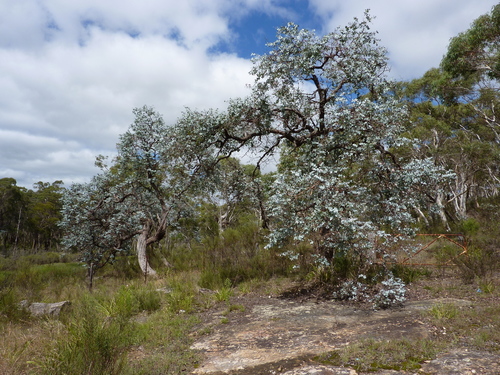
Eucalyptus cinerea F.Muell. ex Benth. is a tree that typically reaches a height of 15–30 m (49–98 ft) and forms a lignotuber. It has thick, fibrous, reddish brown to grey brown bark that is longitudinally fissured, and this bark covers the trunk all the way to its small branches. On young plants and coppice regrowth, leaves are arranged in opposite pairs, are sessile, glaucous, broadly egg-shaped to roughly round, and grow up to 80 mm (3.1 in) long and 50 mm (2.0 in) wide. Intermediate leaves are also arranged in opposite pairs, are glaucous, egg-shaped to lance-shaped, 48–90 mm (1.9–3.5 in) long and 20–45 mm (0.79–1.77 in) wide, and grow on a petiole 4–15 mm (0.16–0.59 in) long. Adult leaves are arranged alternately, are lance-shaped, 90–140 mm (3.5–5.5 in) long and 15–50 mm (0.59–1.97 in) wide, and grow on a petiole up to 11 mm (0.43 in) long. Flower buds are arranged in groups of three in leaf axils, on a peduncle 2–9 mm (0.079–0.354 in) long; individual buds are either sessile or on a pedicel up to 3 mm (0.12 in) long. Mature buds are glaucous, diamond-shaped, 6–8 mm (0.24–0.31 in) long and 3–5 mm (0.12–0.20 in) wide, with a conical operculum. Flowering takes place between May and November, and the flowers are white. The fruit is a woody, conical to bell-shaped capsule 4–7 mm (0.16–0.28 in) long and 5–9 mm (0.20–0.35 in) wide, with valves that are level with the capsule rim or extend slightly beyond it. This species, commonly called Argyle apple, is native to Australia, where it typically occurs from north of Bathurst (33° S) in central west New South Wales to the Beechworth area of Victoria (36° S). It often grows as part of grassy or sclerophyll woodland communities, in shallow, relatively infertile soils, where it is usually part of the understorey. Subspecies cinerea is found in the Australian Capital Territory and Captains Flat, New South Wales. Subspecies triplex is also found in the Australian Capital Territory and Captains Flat, New South Wales. Subspecies victoriensis is only known from hilly country near Beechworth, Victoria. The Wiradjuri people of New South Wales use the bark and timber of this species to make tools, string and rope, and shelters, and also use it for making fire. In horticulture, Eucalyptus cinerea is used as a park and street tree, and it is widely planted for this purpose in Canberra.