About Eucalyptus camphora R.T.Baker
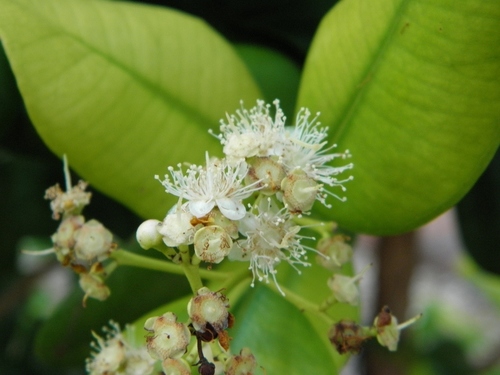
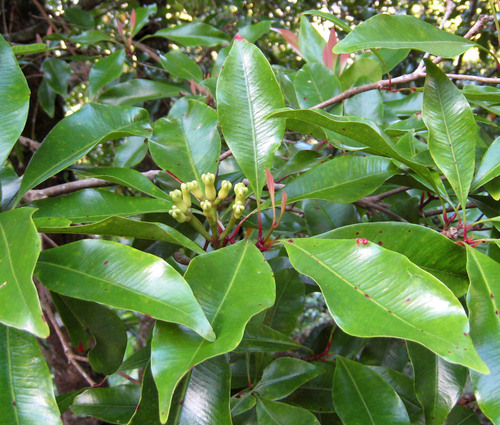
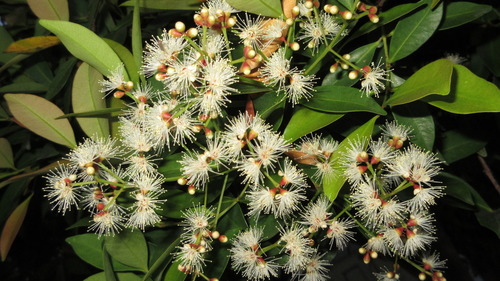
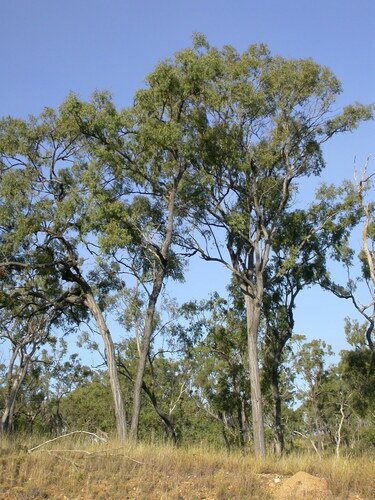
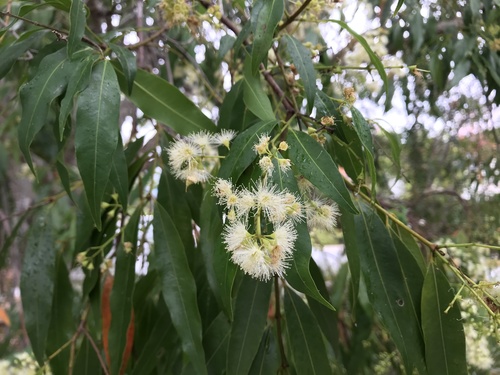
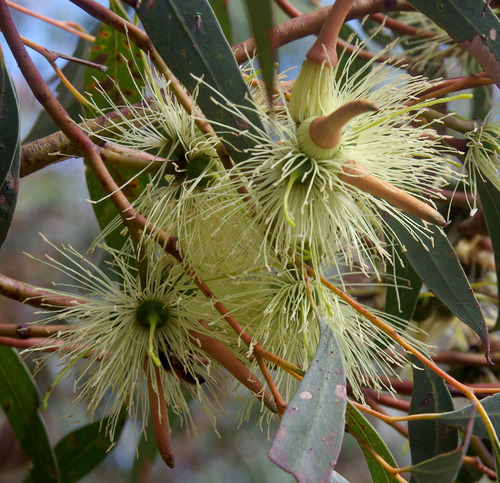
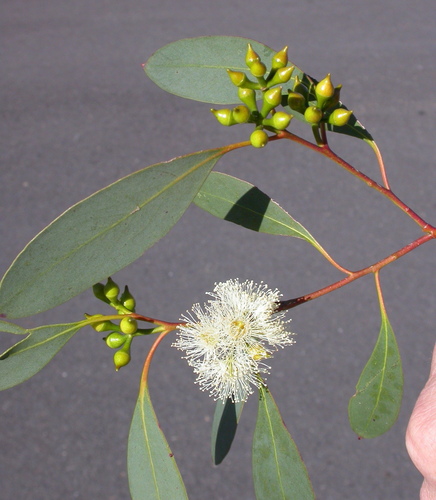
Eucalyptus camphora R.T.Baker is most often a tree that typically grows 22 to 25 meters (72 to 82 feet) tall, and sometimes forms a mallee reaching up to 10 meters (33 feet) tall. This species forms a lignotuber, and has smooth grey to brownish or almost black bark extending from the trunk to its thinnest branches. Accumulated shed bark is sometimes present at the base of the trunk. Leaves on young plants and coppice regrowth are green or bluish green, with shapes ranging from egg-shaped and elliptic to almost round. These leaves measure 30–70 mm (1.2–2.8 in) long, 15–46 mm (0.6–2 in) wide, and have a petiole. Adult leaves are broadly lance-shaped to egg-shaped, 50–150 mm (2.0–5.9 in) long and 15–60 mm (0.6–2 in) wide, borne on a petiole 5–25 mm (0.20–0.98 in) long. Flower buds are grouped in clusters of seven in leaf axils, growing on an unbranched peduncle 4–18 mm (0.2–0.7 in) long, with individual flowers attached to a pedicel 2–6 mm (0.08–0.2 in) long. Mature buds are spindle-shaped to diamond-shaped, 4–8 mm (0.2–0.3 in) long and 2.5–5 mm (0.1–0.2 in) wide, with a conical to beaked operculum. Flowering occurs mainly from January to April, and the flowers are white. The fruit that develops after flowering is a woody conical or hemispherical capsule 2–6 mm (0.079–0.236 in) long and 4–7 mm (0.16–0.28 in) wide. Eucalyptus camphora has two accepted subspecies with different distribution ranges. Subspecies camphora grows in forest, most often in marshy places and valleys. Its range extends south from Wallangarra in Queensland to near Glen Innes in New South Wales, and also occurs from near Rylstone to the Megalong Valley. Subspecies humeana grows in similar habitats, with a range spanning from Wee Jasper in New South Wales to mountainous terrain east and north of Melbourne in Victoria.