About Eucalyptus camaldulensis Denham
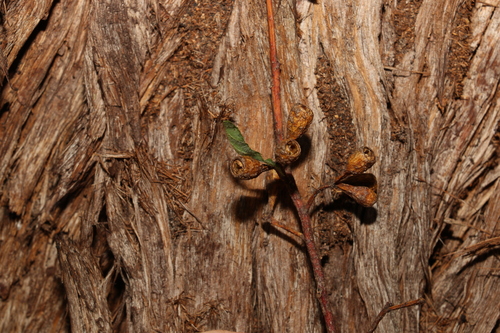
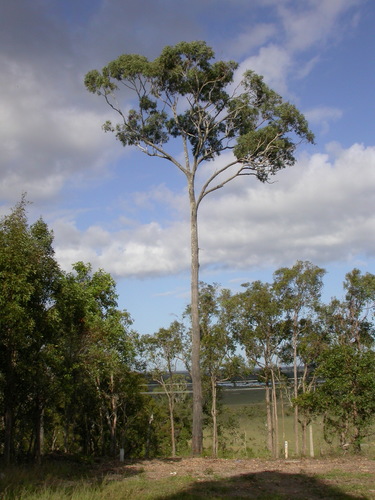
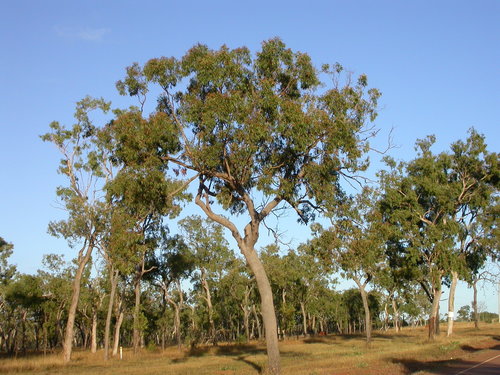
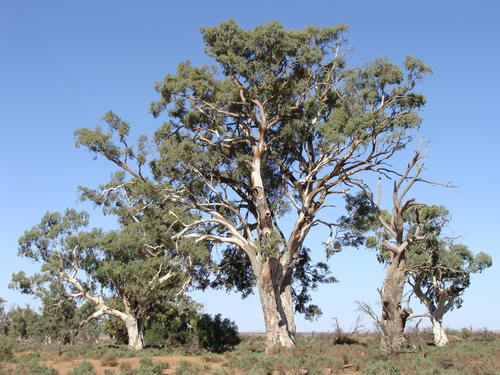
Eucalyptus camaldulensis Denham is a tree that typically reaches 20 metres (66 ft) in height, and may occasionally grow as tall as 45 metres (148 ft). It often does not develop a lignotuber. Its bark is smooth, white or cream-coloured with patches of yellow, pink or brown, and often has loose, rough slabs of bark near the base. Juvenile leaves are lance-shaped, 80–180 mm (3.1–7.1 in) long and 13–25 mm (0.51–0.98 in) wide. Adult leaves are lance-shaped to curved, the same dull green or greyish green on both surfaces, 50–300 mm (2.0–11.8 in) long, 7–32 mm (0.28–1.26 in) wide, and borne on a petiole 8–33 mm (0.31–1.30 in) long. Flower buds are arranged in groups of seven, nine or sometimes eleven, in leaf axils on a peduncle 5–28 mm (0.20–1.10 in) long, with individual flowers attached to pedicels 2–10 mm (0.079–0.394 in) long. Mature buds are oval to more or less spherical, green to creamy yellow, 6–9 mm (0.24–0.35 in) long and 4–6 mm (0.16–0.24 in) wide, with a prominently beaked operculum 3–7 mm (0.12–0.28 in) long. Flowering occurs mainly in summer, and the flowers are white; the species also has an extended flowering period that occurs throughout the year. Limbs of river red gums, and sometimes whole trees, often fall without warning, making camping or picnicking near them dangerous, especially for trees with dead limbs or trees under stress. The fruit is a woody, hemispherical capsule 2–5 mm (0.079–0.197 in) long and 4–10 mm (0.16–0.39 in) wide, borne on a pedicel 3–12 mm (0.12–0.47 in) long, with valves that are raised above the rim. Eucalyptus camaldulensis has the widest natural distribution of any eucalyptus species. It is most commonly found along waterways, and only occurs at a small number of locations away from watercourses. Subspecies acuta is common along rivers from south of Cape York Peninsula in Queensland to the north west slopes and plains of New South Wales, and is absent from coastal areas and the arid inland. Subspecies arida has the widest distribution of all the subspecies, and is found in all mainland Australian states except Victoria. It grows in arid regions, but only where there is sufficient subsoil moisture. Subspecies camaldulensis is the dominant eucalypt along the Murray-Darling river system and its tributaries. It also occurs on the Eyre and Yorke Peninsulas and Kangaroo Island in South Australia, and in some locations along the Hunter River in New South Wales. It is the only subspecies present in coastal Victoria. Subspecies minima is endemic to South Australia, where it grows in the northern Flinders Ranges and the northern Eyre Peninsula. Subspecies obtusa is endemic to tropical northern Australia, including parts of the Kimberley, the Top End and the Gulf of Carpentaria hinterland, extending east as far as the Gilbert River in Queensland. Subspecies refulgens is endemic to the Pilbara-Gascoyne-Carnarvon region, growing along rivers that flow westwards, including some tributaries of the upper Murchison River. Subspecies simulata is mainly restricted to some rivers on Cape York Peninsula, with a small number of populations found further south. In Victoria, this species hybridises with Eucalyptus ovata to form Eucalyptus ×studleyensis. Eucalyptus camaldulensis grows across a wide range of climatic conditions from tropical to temperate, but its main areas of occurrence have 5 to 20 frosts in winter and high summer temperatures. Temperatures in its range can vary from a minimum of -6°C to a maximum of 54°C, with a diurnal range of up to 21°C. This species grows along watercourse banks and their floodplains, and experiences regular flooding in its natural habitat due to its proximity to waterways. River red gum prefers soils with clay content, and the trees rely not just on rainfall but also on regular flooding that recharges subsoil water. The species' close association with water makes it a common, and sometimes the only available, habitat for other species in drier areas. During flooding season, the trees provide breeding habitat for fish, which in turn benefits aquatic birds that depend on fish as a food source during their own breeding season. Studies of river red gum management in New South Wales note that fallen branches from river red gums provide shelter for fish in rivers and streams. Snags formed when river red gums fall into rivers such as the Glenelg are an important part of river ecosystems, and serve as vital habitat and breeding sites for native fish such as river blackfish. Starting in the 1850s, most of these snags were removed from rivers as part of river improvement projects intended to remove navigation hazards, reduce damage to in-stream structures, rejuvenate or scour channels, and increase hydraulic capacity to lower flood risk. However, the Murray–Darling Basin Commission has recognised the importance of snags as aquatic habitat, and has recommended a moratorium on snag removal from the Murray River. Tree hollows begin to form in river red gums when the trees reach 120–180 years of age, creating habitat for many wildlife species, including a range of breeding and roosting animals such as bats, carpet pythons, and birds. The dense foliage of the tree also provides shade and shelter from the sun in drier areas, and the threatened superb parrot is one of the bird species that nests in river red gums. Falling leaves and insects from river red gums provide nutrients and energy for other species, which is especially important for ecosystems in low-nutrient areas. Because the species prefers floodplain and watercourse habitats, it acts as a flood mitigator that slows silt runoff. Flower buds begin as an invaginated receptacle, with the operculum (cap) protecting the developing male and female internal flower parts. The male parts of the flower are the stamen, which consists of a slender filament and an anther with two pollen sacs at the tip of the filament. The anther sacs open via longitudinal slits to release pollen. During flowering, the filaments extend to encircle the receptacle. The female parts of the flower, the ovaries, are contained within ovary chambers, which are separated from the receptacle holding the male parts by a disc. A structure called the style extends from the top of the ovaries into the receptacle, ending in the stigma. During flowering, pollen from anthers can land on the stigma, which can occasionally lead to self-pollination. However, the stigma does not become receptive until a few days after the expanding stamens detach the operculum, by which time the flower's own pollen has already been released. Fertilisation therefore occurs with pollen from other flowers on the same tree, or from flowers on a different tree. Insects, birds, and small mammals assist with pollination between flowers. After flowering, the stamens detach. The fruit is the part of the flower that remains after fertilisation; it enlarges, dries, and becomes woody. Triangular valves in the fruit open to release yellow, cuboid seeds. When seeds are shed from the tree, most fall onto the ground below the crown, with a small number carried by wind and water. Seed dispersal occurs mostly in spring and summer, while natural flooding typically occurs during winter and spring. Since the species is closely linked to waterways, it has been suggested that floodwater facilitates seed dispersion, but this theory is contested. A CSIRO experiment found that Eucalyptus camaldulensis seeds sink after only 36 hours. Additionally, because seeding and flooding do not fully coincide, it has been suggested that germination conditions such as damp soil and ample sunlight are more important for the species' survival than floodwater-mediated seed dispersal. Seeding during the flooding season prevents seed desiccation, which is the main cause of seed reproductive failure. Despite this evolutionary advantage for seeds near watercourses, only a very small proportion of the many seeds produced in an E. camaldulensis forest will grow to reproductive maturity; a gap in the forest canopy is required for germinated seeds to receive enough sunlight. Culturally, the species is an iconic part of Australia. Its leaves have appeared on Australian stamps, and it is widely recognised due to its widespread range. Seasonal recreation along waterways also takes place within the habitat of the river red gum, due to the species' fundamental association with watercourses and floodplains. In 1936, an image of The Old Gum Tree was engraved on an Australian stamp to commemorate the centenary of the founding of South Australia.