About Eucalyptus calycogona Turcz.
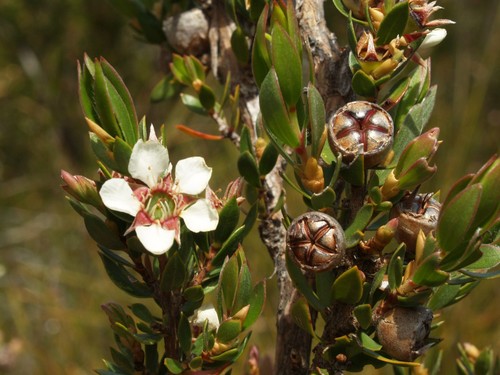
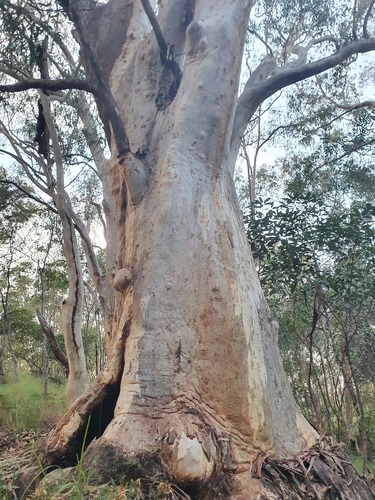
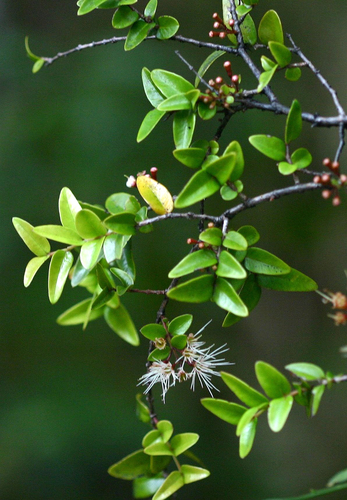
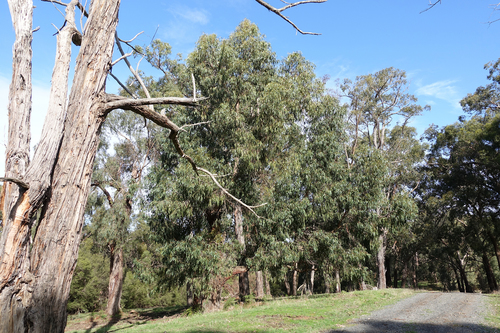
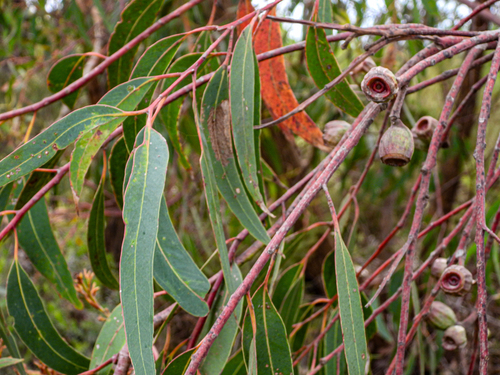
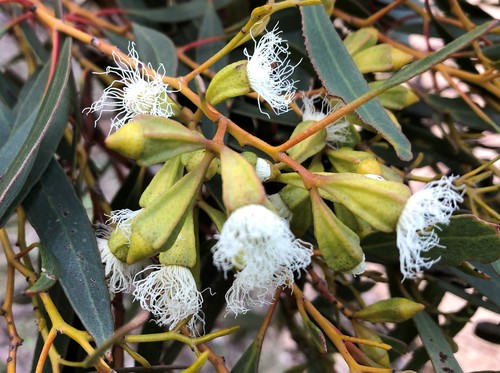
Eucalyptus calycogona, commonly known as gooseberry mallee, is typically a mallee that grows 5 to 6 metres (16 to 20 feet) tall, and rarely forms as a small tree. It develops a lignotuber, and has smooth, cream-coloured to grey or pinkish bark that is sometimes powdery, occasionally with rough bark near the base. Young plants and coppice regrowth have dull greyish green leaves arranged in opposite pairs, shaped lanceolate to oblong, measuring 18–60 mm long and 6–20 mm wide. Adult leaves are arranged alternately, are narrow lance-shaped, the same glossy green on both surfaces, 50–100 mm long and 7–20 mm wide, borne on a petiole 5–17 mm long. Flower buds are arranged in groups of seven in leaf axils, on a peduncle 5–10 mm long, with each individual bud attached to a pedicel 2–7 mm long. Mature buds are oblong, square in cross-section, 7–13 mm long and 3–5 mm wide, with four distinct ribs along their sides. Flowering takes place between May and November, and flowers are creamy white, or sometimes pink. There are two rows of stamens, and the outer ring of stamens does not produce pollen. The fruit is a woody capsule 5–15 mm long and 4–8 mm wide, barrel-shaped or urn-shaped in side view, roughly square in cross-section, with four ribs along the sides.
This species grows in mallee woodlands and shrublands across Western Australia, South Australia, Victoria, and New South Wales. Subspecies calycogona is the most widespread subspecies, occurring in all four of these states. It is especially common in Western Australia, where it grows in the southern and central wheatbelt, Great Southern, and southern Goldfields-Esperance regions, extending eastward almost to Balladonia. It also occurs on the Eyre Peninsula and south-eastern Mount Lofty Ranges in South Australia, the Big Desert area of Victoria, and the Koraleigh area in far south-western New South Wales. Subspecies trachybasis is found from the eastern side of Spencer Gulf in South Australia, westward to Boort and Kerang, and north from Edenhope in Victoria. Subspecies spaffordii is restricted to southern parts of the Eyre Peninsula in South Australia, and subspecies miracula occurs in an area south of Southern Cross in Western Australia. Eucalyptus calycogona is part of the chenopod mallee subgroup, where it grows alongside other tree species including Eucalyptus gracilis, Eucalyptus dumosa, and Eucalyptus oleosa. The understorey of this subgroup includes species of Maireana, Sclerolaena, Enchylaena, Chenopodium, and Zygophyllum.
In horticulture, Eucalyptus calycogona is cultivated as an ornamental or shade tree, and is suitable for growing in both coastal and inland areas. It tolerates drought, lime, and moderate frost, and attracts birds and insects.