About Eucalyptus caleyi Maiden
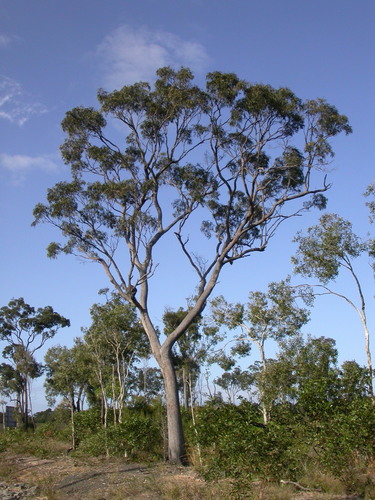
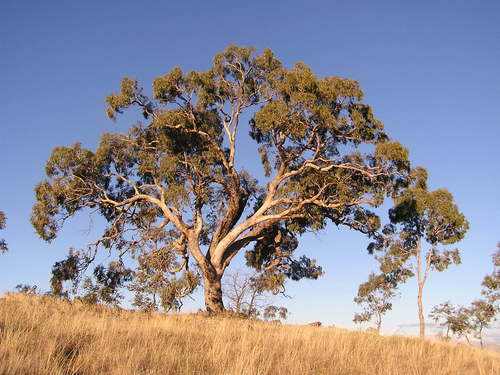
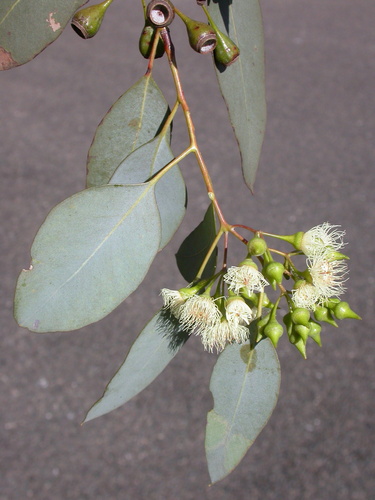
Eucalyptus caleyi Maiden, commonly known as Caley's ironbark, is a tree that typically reaches 25–30 metres (82–98 feet) in height and forms a lignotuber. Its trunk and branches are covered in rough, grey, brown or black ironbark bark. Leaves on young plants and coppice regrowth are egg-shaped, triangular, or roughly round, bluish grey, 30–70 millimetres (1.2–2.8 inches) long, 17–70 millimetres (0.67–2.76 inches) wide, and borne on a petiole. Adult leaves are dull bluish grey on both surfaces, sometimes covered in a powdery bloom, range from egg-shaped to lance-shaped, and measure 45–110 millimetres (1.8–4.3 inches) long and 18–45 millimetres (0.71–1.77 inches) wide, on a petiole 10–20 millimetres (0.39–0.79 inches) long. Flower buds are arranged in groups of seven on a 9–20 millimetre (0.35–0.79 inch) long peduncle, with individual buds attached to 5–12 millimetre (0.20–0.47 inch) long pedicels. Mature buds are oval to diamond-shaped, 7–10 millimetres (0.28–0.39 inches) long and 4–5 millimetres (0.16–0.20 inches) wide, with a conical operculum that is 3–4 millimetres (0.12–0.16 inches) long and 4–5 millimetres (0.16–0.20 inches) wide, usually narrower than the floral cup. Flowering occurs mainly between September and November, and the flowers are white. The fruit is a woody barrel-shaped or conical capsule, 6–10 millimetres (0.24–0.39 inches) long and 4–8 millimetres (0.16–0.31 inches) wide, borne on a 5–14 millimetre (0.20–0.55 inch) long pedicel, with valves positioned below the rim of the capsule. Caley's ironbark grows on low hills, ridges, and broad undulating valleys in dry forest and woodland. Its range extends from near Denman and the Goulburn River through the Northern Tablelands of New South Wales to the Millmerran area in south-eastern Queensland. The subspecies Eucalyptus caleyi subsp. ovendenii, called Ovenden's ironbark, is restricted to higher elevation sites west of Tenterfield.