About Eucalyptus caesia Benth.
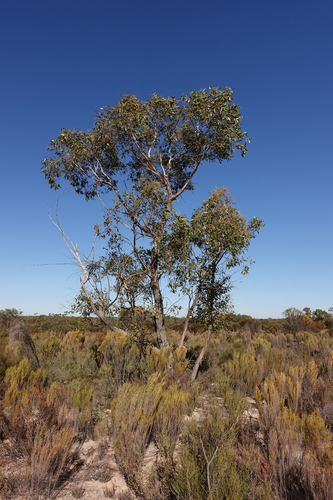
Eucalyptus caesia Benth. is a mallee that typically grows to a height of 2 to 14 metres (6.6 to 45.9 ft) and forms a lignotuber. Its bark is smooth reddish brown when new, and is shed in curling longitudinal flakes called "minnirichi". Young branches are shiny red, and covered with a waxy, bluish white bloom. Young plants and coppice regrowth have thick, glossy green, heart-shaped leaves that are 25–80 mm (0.98–3.1 in) long, 25–60 mm (1–2 in) wide, and borne on a petiole. Adult leaves are lance-shaped to curved, and are mostly 80–110 mm (3.1–4.3 in) long and 15–25 mm (0.6–1 in) wide, borne on a 10–35 mm (0.39–1.4 in) long petiole.
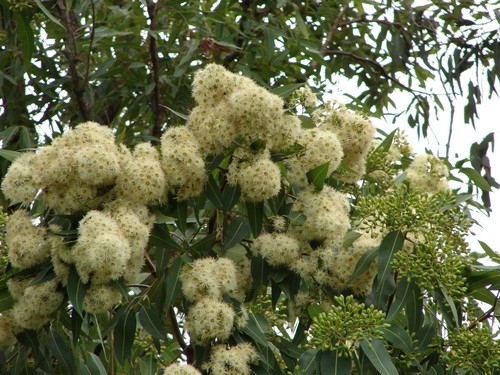
Flower buds are arranged in leaf axils in groups of three on an unbranched 15–35 mm (0.59–1.4 in) long peduncle, with individual flowers growing on 15–22 mm (0.59–0.87 in) long pedicels. Mature flower buds are oval or pear-shaped, covered with a whitish waxy bloom, and measure 17–30 mm (0.67–1.2 in) long and 10–13 mm (0.39–0.51 in) wide, with a conical operculum. Flowering mainly occurs between May and September, and the flowers have pink stamens with yellow anthers at the tip. The fruit is a woody bell-shaped or urn-shaped capsule that is 15–25 mm (0.59–0.98 in) long and 18–23 mm (0.71–0.91 in) wide, growing on a 13–33 mm (0.51–1.3 in) long peduncle.
In distribution and habitat, Eucalyptus caesia grows in crevices at the base of granite outcrops in scattered inland areas of the south-west, including the Avon Wheatbelt and Mallee biogeographic regions. This species is known to be drought tolerant.
In ecology, despite persisting as very small populations, this species does not appear to show effects of inbreeding depression. Its associated species include Eucalyptus crucis, Eucalyptus loxophleba, Allocasuarina huegeliana and Acacia lasiocalyx.
For use in horticulture, a cultivated form known as 'Silver Princess' is described as a "graceful weeping tree" with an irregular and weeping growth form. The species can be propagated from seed, which germinates readily.