About Eucalyptus bridgesiana F.Muell. ex R.T.Baker
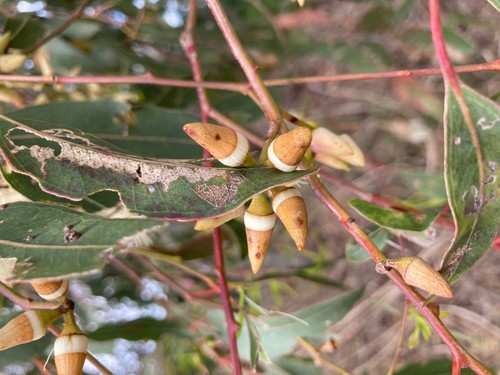
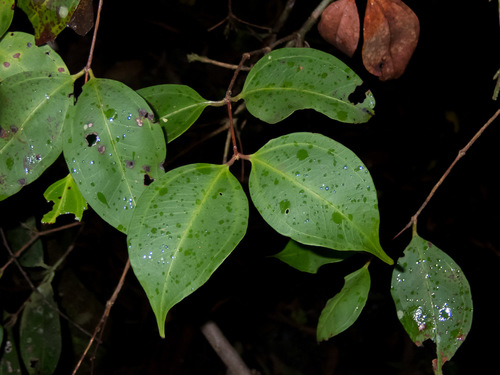
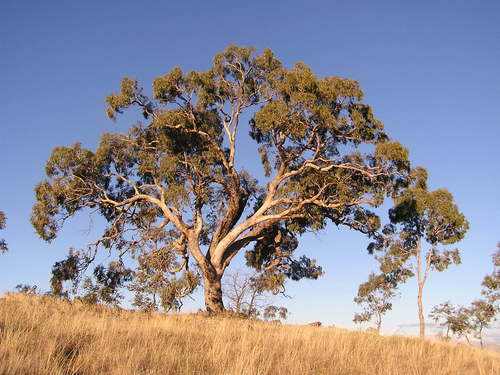
Eucalyptus bridgesiana, commonly known as apple box, is a tree that typically reaches a height of 20 to 25 metres (66 to 82 ft), and forms a lignotuber. It has rough, fibrous, mottled grey and white, sometimes tessellated bark on the trunk and larger branches. Thinner branches have smooth grey bark with whitish patches, which is shed in short ribbons. Young plants and coppice regrowth have sessile, egg-shaped, heart-shaped or almost round leaves arranged in opposite pairs. These leaves measure 25–100 mm (0.98–3.9 in) long and 20–80 mm (0.8–3 in) wide, have wavy edges, and are covered with a powdery white bloom. Adult leaves are lance-shaped, the same glossy green on both sides, 120–200 mm (4.7–7.9 in) long and 15–25 mm (0.6–1 in) wide, borne on a petiole 12–35 mm (0.47–1.4 in) long. Flower buds are arranged in groups of seven on a peduncle up to 15 mm (0.6 in) long, with individual buds attached to a pedicel 1–5 mm (0.04–0.2 in) long. Mature buds are normally oval, 5–8 mm (0.20–0.31 in) long and 3–5 mm (0.1–0.2 in) wide, with a conical to beaked operculum. Flowering occurs from February to March, and the flowers are white. The fruit is a woody, hemispherical capsule 3–7 mm (0.12–0.28 in) long and 4–8 mm (0.16–0.31 in) wide, with three valves extending above the capsule rim. Apple box grows in open woodland and forest, and is widespread from near Stanthorpe in Queensland and south through the slopes and ranges of New South Wales and eastern Victoria. The Sydney suburb of Tallawong, New South Wales is named after the Dharug word for apple box. The wood of apple box is softer than that of other eucalypts, and is considered poor for firewood or building timber. However, honey produced by bees that feed on this tree's small white flowers is of high quality.