About Eucalyptus botryoides Sm.
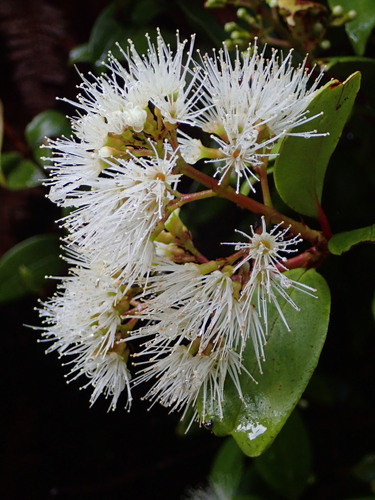
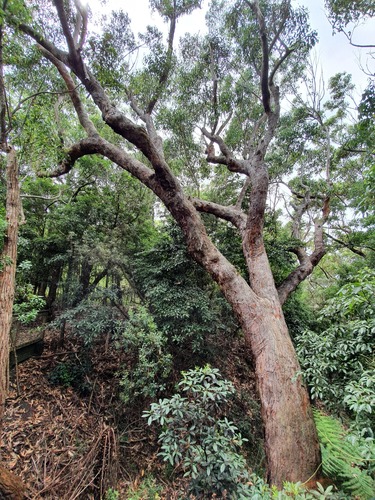
Under favorable growing conditions, Eucalyptus botryoides Sm. grows as a straight-trunked tree reaching up to 40 m (130 ft) in height, with a diameter at breast height of 1 m (3.3 ft). In poorer growing conditions, it is typically shorter. In exposed sites behind sand dunes, it grows as a shorter, spreading tree reaching 6–12 m (20–39 ft) tall with a dense leafy crown; it may even grow as a multitrunked mallee form in poor sandy soils. This species has a swollen woody base called a lignotuber that can grow up to 6 m (20 ft) in diameter. The trunk and larger branches are covered in thick, fibrous, rough, flaky bark that is vertically furrowed. Trees from inland forest populations have more greyish brown bark, while trees from coastal populations have redder brown bark. The bark of smaller branches is smooth and pale grey. Adult leaves are stalked and broad-lanceolate, measuring 10 to 16 cm (3.9 to 6.3 in) long and 2–6 cm (0.79–2.36 in) wide. They are dark green on the upper surface and paler on the lower surface, with fine venation that angles 40° to 60° to the leaf midline. White flowers develop from small cylindrical or club-shaped (clavate) buds, blooming between January and April. Flowers are arranged in groups of six to eleven held in umbellasters. The woody fruits (called gumnuts) are ovoid or cylindrical, measuring 7–12 mm long and 4–6 mm wide, with the fruit valve positioned near the rim or enclosed inside the fruit. Seedlings and young plants have more ovate leaves, which are arranged oppositely along the stems for the first three to six pairs, before shifting to the alternately arranged leaf arrangement found in adult plants. Young leaves are also paler on the undersurface, and measure 4.5 to 11 cm long and 1.3 to 5.5 cm wide. This species is native to coastal southeastern Australia, ranging from near Newcastle on the central coast of New South Wales to eastern Victoria in the Lakes Entrance area, specifically Loch Sport south of Bairnsdale. It has been introduced to Western Australia, where it is classified as an alien species. It grows primarily on low nutrient sandstone-derived or sandy soils, most often either behind coastal sand dunes, or further inland in alluvial valley soils, where it acts as a dominant tree. It typically grows not far from salt water, and is only found in lowlands between sea level and 300 m (980 ft) altitude, in regions that receive 700 to 1,300 mm (28 to 51 in) of annual rainfall. In mixed open forest, it grows alongside other tree species including turpentine (Syncarpia glomulifera), spotted gum (Corymbia maculata), red bloodwood (Corymbia gummifera), blackbutt (Eucalyptus pilularis), Sydney blue gum, red mahogany (Eucalyptus resinifera), and smooth-barked apple (Angophora costata). In wetter forests that transition toward rainforest, associated understory plants include lillypilly (Syzygium smithii) and wattles. In coastal sand dune plant communities, it grows with stunted forms of white stringybark (Eucalyptus globoidea) and silvertop ash (Eucalyptus sieberi), plus banksia, with understory plants including burrawang (Macrozamia communis). It is a component of wetland forest in Booderee National Park, growing alongside blackbutt, red bloodwood, grey ironbark (Eucalyptus paniculata), scribbly gum (Eucalyptus sclerophylla), old man banksia (Banksia serrata), coast banksia (Banksia integrifolia) and snow-in-summer (Melaleuca linariifolia), with understory plants including jointed twig-rush (Baumea articulata), tall spike-rush (Eleocharis sphacelata), prickly tea-tree (Leptospermum juniperinum), and zig-zag bog-rush (Schoenus brevifolius). After bushfire, Eucalyptus botryoides regenerates by resprouting from epicormic buds and its woody lignotuber. Individual plants have been recorded to reach 600 years of age. This species also drops living branches, which can grow roots to establish new plants; the wet environment and water-absorbing properties of its thick, fibrous bark help this process. Koalas (Phascolarctos cinereus) feed on its leaves, and ants consume its nectar. The species is highly susceptible to infestation by psyllids. The heartwood of Eucalyptus botryoides is durable and heavy, with a density of approximately 765–985 kg/m³, and it resembles the heartwood of Eucalyptus saligna and Eucalyptus grandis. It is used to make flooring and panelling.