About Eucalyptus bosistoana F.Muell.
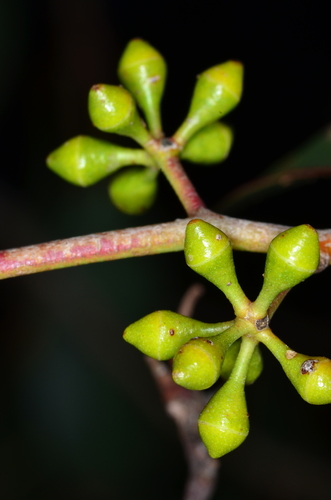
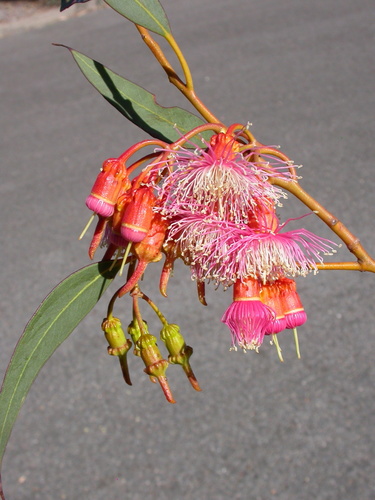
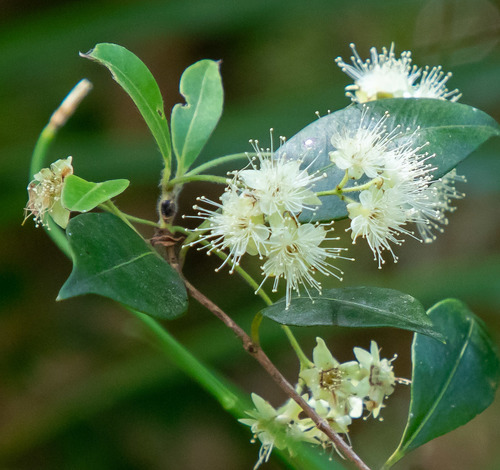
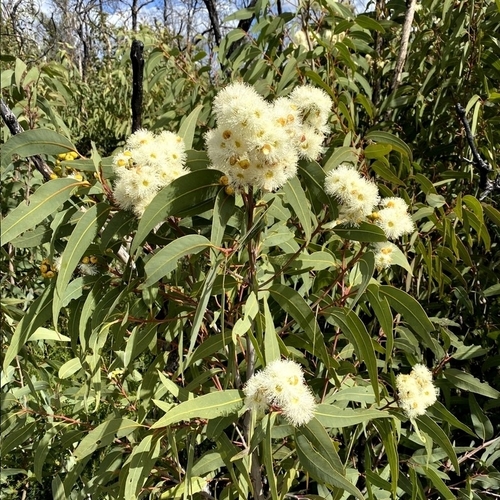
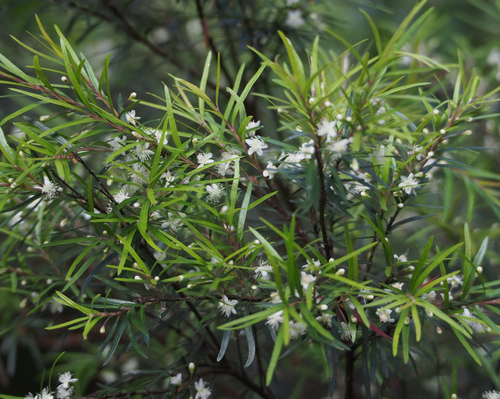
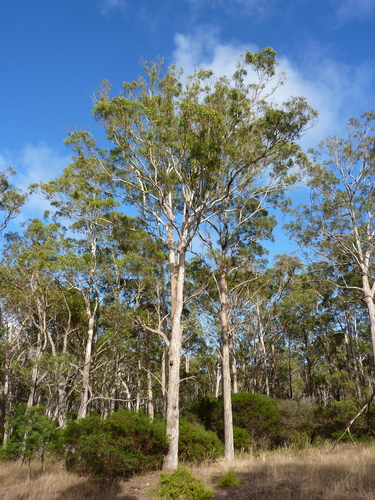
Eucalyptus bosistoana F.Muell. is the largest species in the "box" group of eucalypts. It grows up to 60 meters (200 feet) tall, with a stem diameter of at least 1.5 meters (4 feet 11 inches), and forms a lignotuber. The bark on the lower trunk is thin, greyish brown, rough, and flaky. The bark on the upper trunk and branches is smooth, white, cream-coloured, or grey, and it sheds in ribbons. Occasionally, all of the tree's bark is smooth. Young plants and coppice regrowth have rounded stems and oblong to elliptic or egg-shaped pale green leaves. These leaves are 30–70 mm (1.2–2.8 in) long and 18–33 mm (0.71–1.3 in) wide, and each is borne on a petiole. Adult leaves are lance-shaped to curved, and the same colour on both sides. They measure 58–200 mm (2.3–7.9 in) long and 7–27 mm (0.3–1 in) wide, and grow on a petiole 10–18 mm (0.4–0.7 in) long. Flower buds are usually arranged in groups of seven in leaf axils, on a peduncle 7–10 mm (0.3–0.4 in) long, with individual buds borne on a pedicel 3–8 mm (0.1–0.3 in) long. Mature buds are oval, 6–8 mm (0.24–0.31 in) long and 3–5 mm (0.12–0.20 in) wide, with a conical to rounded operculum. Flowering occurs mainly from January to April, and the flowers are white. The fruit are cup-shaped, barrel-shaped, or hemispherical, 4–8 mm (0.2–0.3 in) long and wide. The fruit grows on a pedicel 4–7 mm (0.2–0.3 in) long, with valves level with the fruit rim or enclosed.
This species, commonly known as coast grey box, is distributed in New South Wales and Victoria, Australia, ranging as far north as the Wolgan Valley west of Sydney, and as far south as eastern Gippsland. It grows near streams in lowland areas on higher quality soils, particularly over limestone. It may also occur on tablelands up to 500 m (1,600 ft) above sea level, near Goulburn and Bungonia. It is commonly found growing alongside Eucalyptus cypellocarpa, Eucalyptus longifolia, Eucalyptus paniculata, Eucalyptus sideroxylon, Corymbia maculata, Eucalyptus angophoroides, Eucalyptus elata, Eucalyptus muelleriana, Eucalyptus globoidea, and Casuarina cunninghamiana.
Eucalyptus bosistoana is a significant timber species. Its timber is resistant to termites but susceptible to lyctus borers. The timber has interlocked grain, and is highly valued for heavy engineering. Additional uses include construction, and manufacturing of piles, poles, and sleepers. It is a durable timber of considerable weight, with a density of 1100 kilograms per cubic metre.