About Eucalyptus baxteri (Benth.) Maiden & Blakely
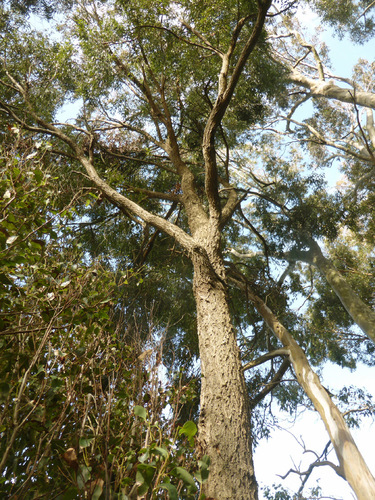
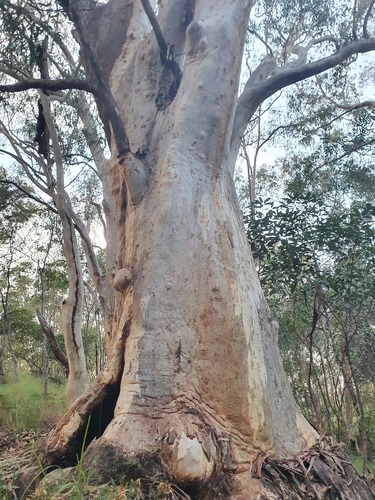
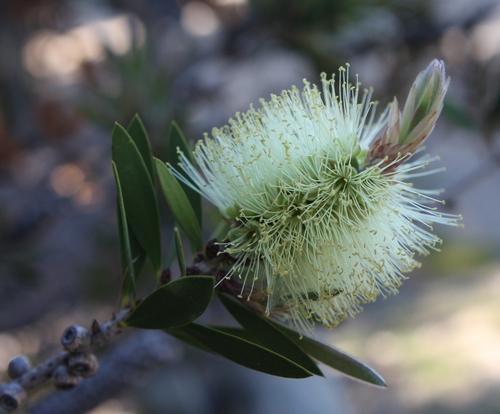
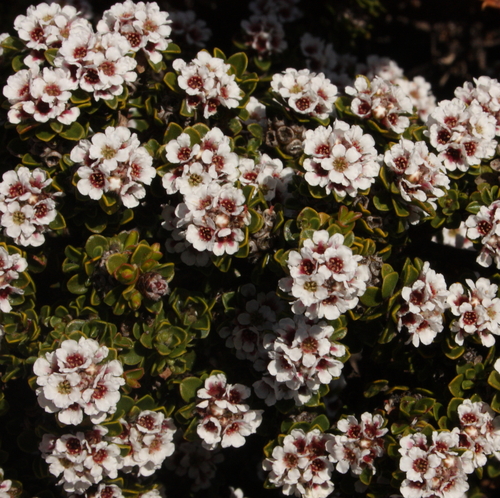
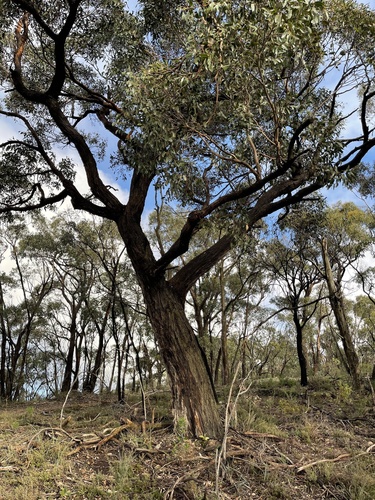
Eucalyptus baxteri (Benth.) Maiden & Blakely, commonly called brown stringybark, is a tree that reaches up to 40 metres (131 ft) in height and forms a woody lignotuber. It has grey to brownish, stringy or fibrous bark that covers the trunk all the way to its thinnest branches. Young plants and coppice regrowth have glossy green, egg-shaped leaves that are 25–105 mm (0.98–4.1 in) long and 13–75 mm (0.5–3 in) wide. Adult leaves are lance-shaped, curved, or egg-shaped, with the same glossy green color on both sides; they measure 60–150 mm (2.4–5.9 in) long, 15–55 mm (0.6–2 in) wide, and grow on a petiole 10–29 mm (0.39–1.1 in) long. Flowers grow in groups of 9 to 15 in leaf axils, on an unbranched peduncle 2–14 mm (0.079–0.55 in) long. Individual flower buds sit on a pedicel that is up to 2 mm (0.079 in) long, rarely reaching 5 mm (0.20 in). Mature buds are green to yellow, oval to oblong, 5–10 mm (0.20–0.39 in) long and 3–6 mm (0.1–0.2 in) wide, with a rounded, conical, or flattened, warty operculum that is roughly the same length as the floral cup. Flowering occurs mainly from June to January, and the flowers are white. The fruit is a woody capsule, shaped like a cup, hemisphere, or shortened sphere, 4–12 mm (0.16–0.47 in) long and 6–18 mm (0.2–0.7 in) wide, with valves that sit level with or slightly above the capsule rim. This species grows in wet forest, woodland, heath, and on coastal dunes and headlands across New South Wales, Victoria, and South Australia. In New South Wales, it is only found south of Nadgee Nature Reserve. In Victoria, it occurs in coastal and near-coastal areas, and extends inland as far as Casterton, Clunes, and the Grampians. In South Australia, it grows only in the far south-east, including Fleurieu Peninsula and Kangaroo Island. Ecologically, seeds from Eucalyptus baxteri trees over 100 years old are an important food source for the endangered south-eastern subspecies of the red-tailed black cockatoo.