About Eucalyptus baileyana F.Muell.
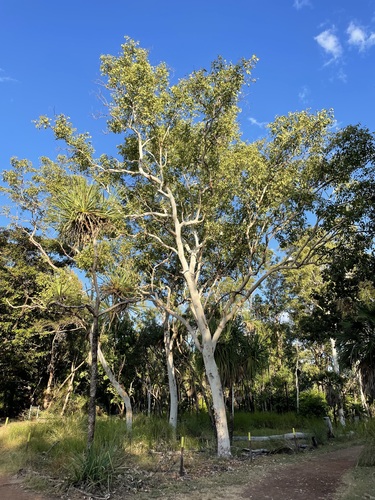
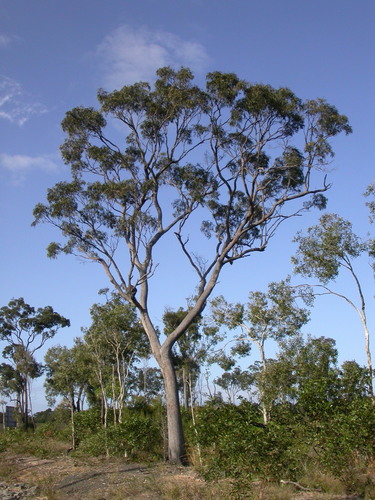
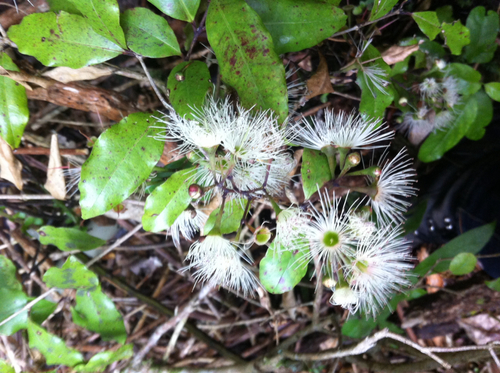
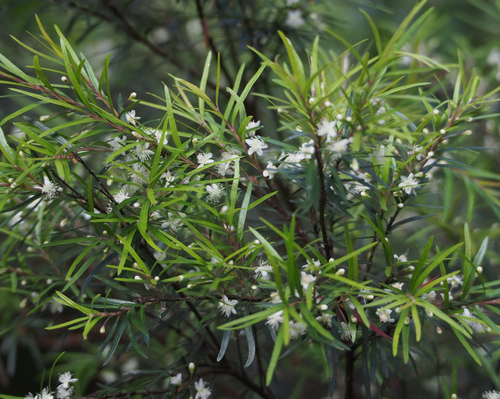
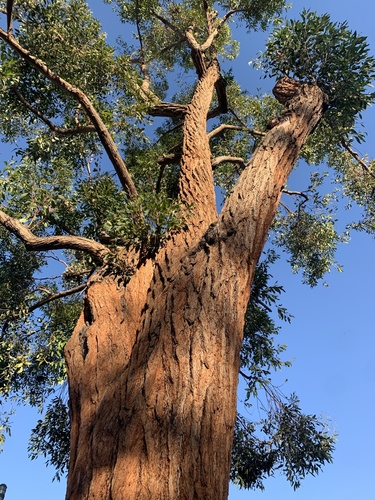
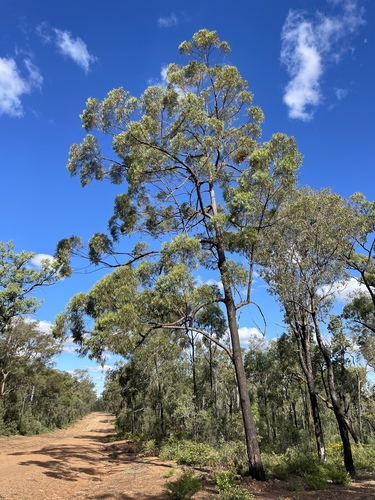
Eucalyptus baileyana F.Muell., commonly called Bailey's stringybark, is a tree that reaches 25 to 40 metres (82 to 131 ft) in height and forms a lignotuber. It has persistent, red-brown to brown-black, stringy or fibrous bark. Young plants and coppice regrowth have hairy, often bright pink growing tips, and lance-shaped leaves that are 60–150 mm (2.4–5.9 in) long and 25–75 mm (1–3 in) wide. Adult leaves are lance-shaped or curved, 90–165 mm (3.5–6.5 in) long and 10–25 mm (0.4–1 in) wide, borne on a 12–20 mm (0.47–0.79 in) long petiole. Each adult leaf is dark green on one surface and lighter green on the other. Flowers grow in groups of seven in leaf axils, attached to an unbranched peduncle 15–25 mm (0.59–0.98 in) long, with individual buds carried on a 3–9 mm (0.12–0.35 in) long pedicel. Mature buds are club-shaped to spindle-shaped, 5–8 mm (0.20–0.31 in) long and 3–5 mm (0.1–0.2 in) wide, with a rounded or conical operculum that ends in a small point. Flowering occurs mainly between October and January, producing white flowers with stamens arranged in four bundles. The fruit is a woody urn-shaped or shortened spherical capsule, 9–15 mm (0.35–0.59 in) long and 8–17 mm (0.3–0.7 in) wide, with valves that are level with the capsule rim or extend slightly above it. Bailey's stringybark most often occurs on hills, ridges, and coastal lowlands as a component of dry sclerophyll forest or woodland communities. It grows in nutrient-poor, shallow sandy soils that overlie sandstone. In New South Wales, it occurs along the coast north of Coffs Harbour, extending across the state border into Queensland in a narrow coastal belt usually no more than 80 kilometres (50 mi) from the coast. It ranges as far north as Brisbane, with a sporadic distribution extending further north to around the Blackdown Tableland. Common species associated with Eucalyptus baileyana include Eucalyptus planchoniana, Eucalyptus cloeziana, Eucalyptus citriodora, Eucalyptus gummifera, and Eucalyptus intermedia.