About Eucalyptus arenacea Marginson & Ladiges
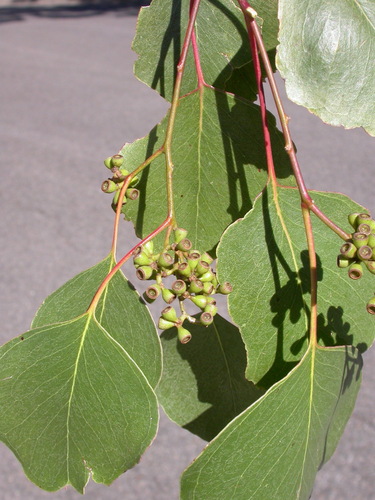
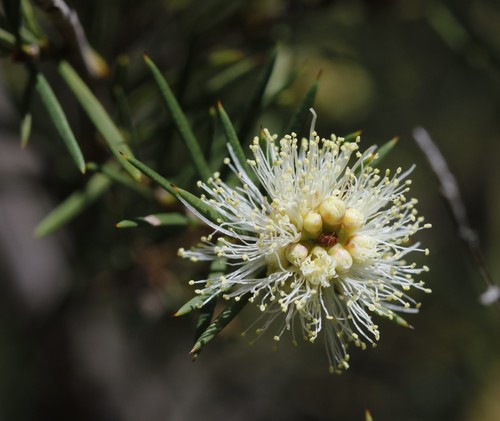
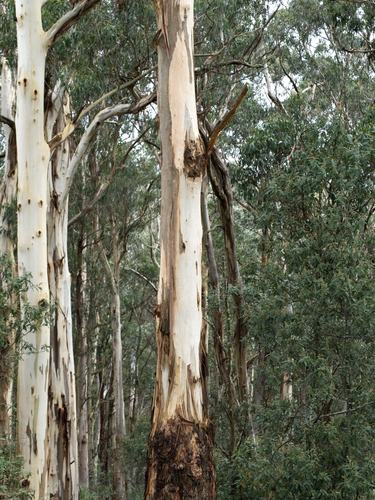
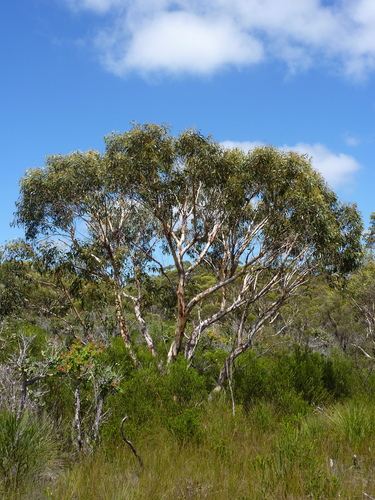
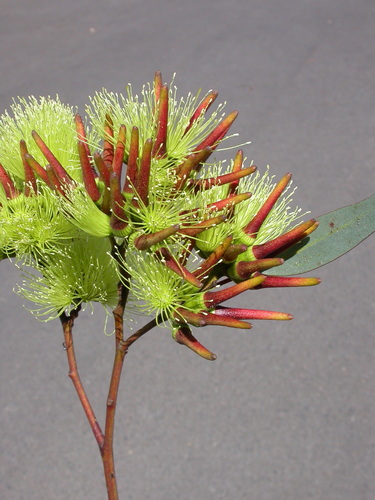
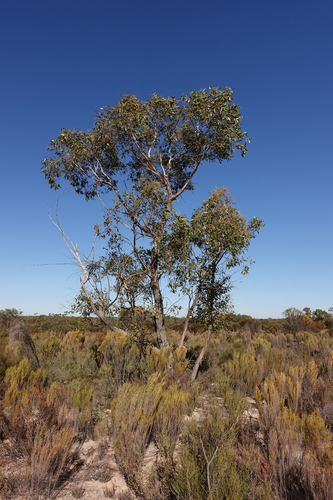
Eucalyptus arenacea, commonly called desert stringybark, can grow as a multi-stemmed tree or a robust mallee, reaching 3 to 10 metres (10 to 30 feet) in height and forming a lignotuber. It has rough, fibrous, stringy bark that covers its trunk all the way to its thinnest branches. Leaves on young plants and coppice regrowth are arranged in opposite pairs, are egg-shaped, and measure 35 to 85 millimetres (1 to 3 inches) long by 30 to 40 millimetres (1 to 2 inches) wide. Mature adult leaves are shiny green, arranged alternately, and are either lance-shaped or curved. They are 70 to 120 millimetres (3 to 5 inches) long, 15 to 40 millimetres (0.6 to 2 inches) wide, and grow on a petiole 10 to 25 millimetres (0.4 to 1 inch) long. The species produces flowers in groups of 7 to 15, borne in leaf axils on a peduncle 5 to 18 millimetres (0.20 to 0.71 inches) long, with individual buds attached to a 2 to 5 millimetre (0.079 to 0.20 inch) pedicel. Mature buds are oval to club-shaped, 5 to 6 millimetres (0.20 to 0.24 inches) long and 3 to 5 millimetres (0.1 to 0.2 inches) wide, with a rounded or conical operculum. Flowering occurs mainly between December and January, and the flowers are white. The resulting fruit is hemispherical to truncated sphere-shaped, 4 to 9 millimetres (0.16 to 0.35 inches) long and 7 to 12 millimetres (0.3 to 0.5 inches) wide, attached to a pedicel up to 3 millimetres (0.1 inch) long. This eucalyptus grows on pale sandhills and sandplains. Its distribution is limited to the area between Keith, Pinaroo and Bordertown in South Australia's Ninety Mile Desert, and the Little Desert and Big Desert regions of Victoria, Australia.