About Eucalyptus angulosa Schauer
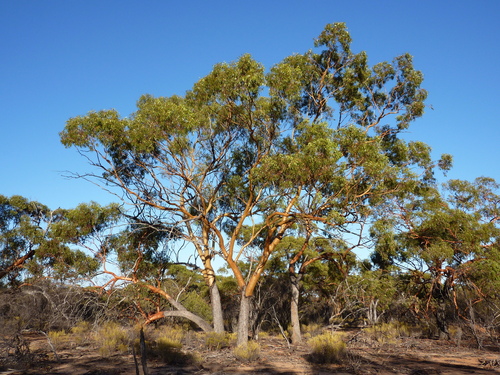
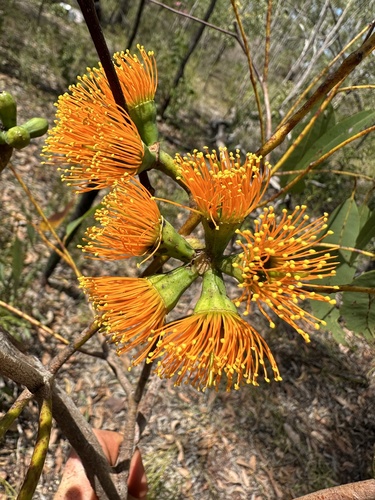
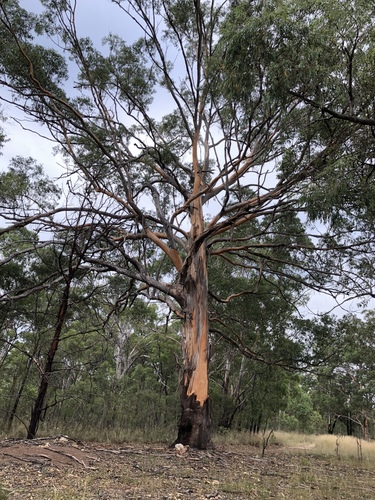
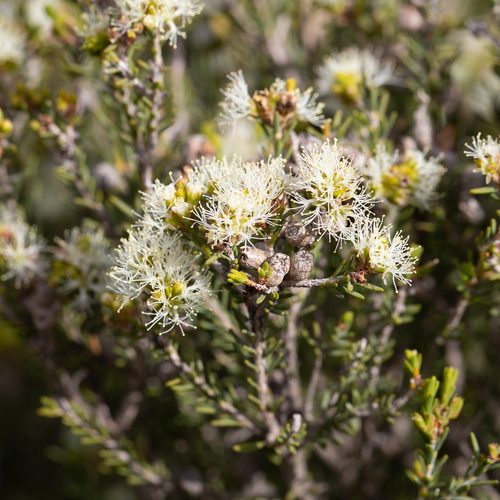
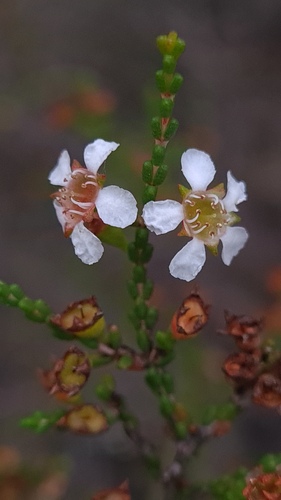
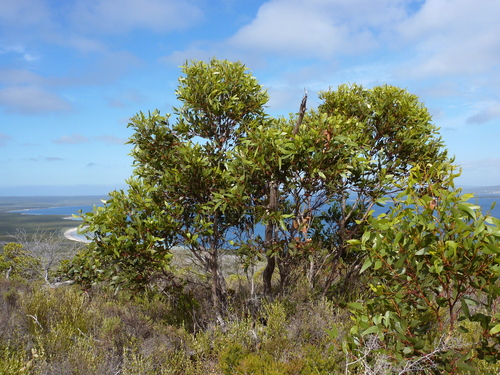
Eucalyptus angulosa Schauer is a mallee eucalyptus that typically grows to a height of 1.5 to 7 metres (5 to 23 ft). It has a lignotuber and usually forms multiple stems. Its bark is mostly smooth and grey, with loose strips of rough bark accumulating toward the base. On the upper branches, the smooth bark can become pale grey, grey-brown, white, or pinkish to coppery in color, and hangs as loose ribbons. Adult leaves are thick, glossy green, concolorous, and arranged alternately along the stems. Leaf blades are lanceolate to broadly lanceolate to ovate-elliptic in shape, measuring 5 to 14 centimetres (2.0 to 5.5 in) long and 1.7 to 5 cm (0.67 to 1.97 in) wide, with a base that tapers evenly to the petiole. Petioles are 1 to 3 cm (0.39 to 1.18 in) long. Flowering occurs between August and March, and produces white to creamy yellow flowers. Each axillary inflorescence is unbranched and has flattened peduncles. The fruit is pedicellate, with a cylindrical, hemispherical, or urceolate shape. It is 1 to 2.5 cm (0.39 to 0.98 in) wide, marked with coarse longitudinal ribbing, and has a descending disc along with three to four enclosed valves. The fruit contains blackish grey seeds that are 2 to 4.5 mm (0.08 to 0.18 in) long, with a flattened-pyramidal or cuboid shape. This species is native to southern Australia. In Western Australia, it is found on coastal headlands and dunes as part of mallee communities along the south coast, in the Great Southern and Goldfields-Esperance regions, where it grows in white-grey sandy soils, often overlying limestone. In South Australia, it occurs on the southern Eyre Peninsula and southern Fleurieu Peninsula, and is much less common in the Murray-Darling depression. It is common across Western Australia, but rare in South Australia. In horticulture, Eucalyptus angulosa is sold commercially as tube stock or seeds. It germinates readily, and is used as an ornamental plant and for land restoration projects. It is a slow-growing species that tolerates salt and drought. It grows best in a full sun position and has low maintenance requirements.