About Eucalyptus amygdalina Labill.
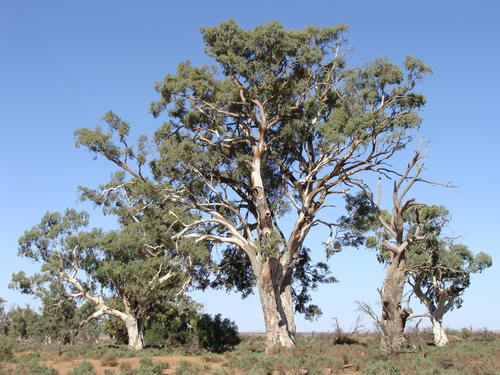
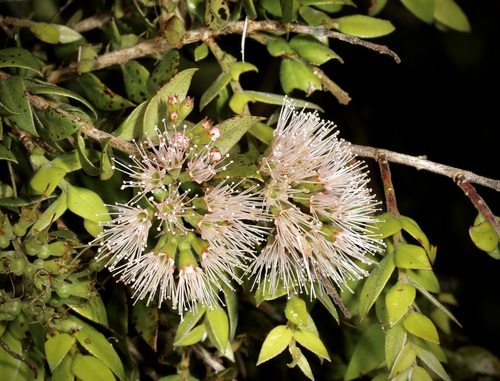
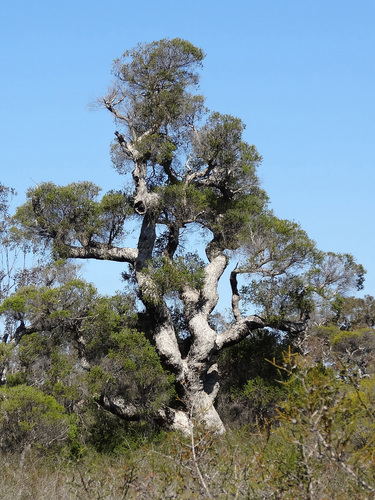
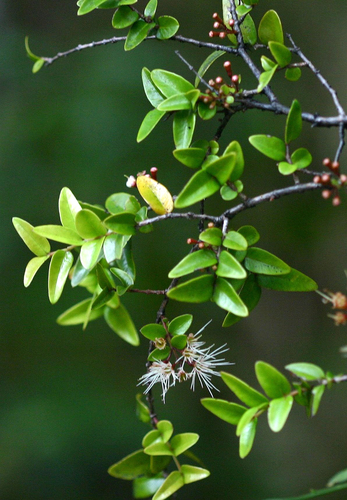
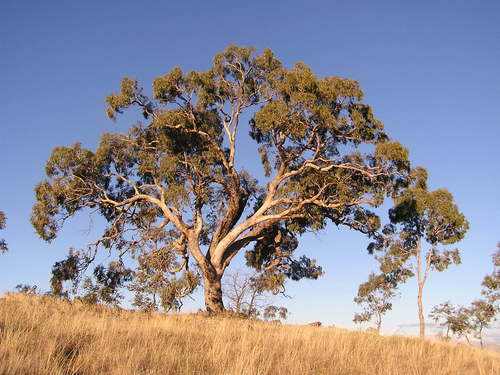
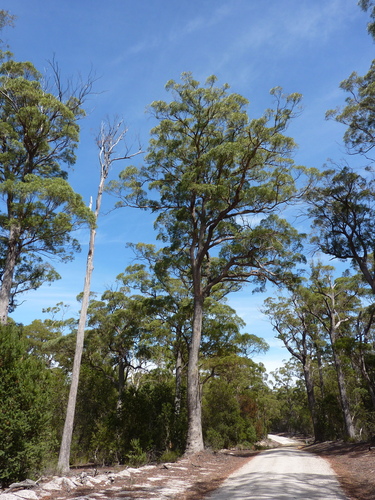
Eucalyptus amygdalina Labill., commonly known as black peppermint, is a tree that typically reaches 30 meters (98 feet) in height and forms a lignotuber. Most or all of its trunk and the bases of its larger branches have rough, finely fibrous bark, while the bark on upper sections is smooth and greyish. Leaves on young plants and coppice regrowth are arranged in opposite pairs, are lance-shaped or curved, measure 28–55 mm (1.1–2.2 in) long and 2–11 mm (0.079–0.433 in) wide, and are sessile. Adult leaves are arranged alternately along stems, are the same shade of bluish green on both sides, are lance-shaped to linear, measure 55–120 mm (2.2–4.7 in) long and 4–12 mm (0.16–0.47 in) wide, and grow on a 4–20 mm (0.16–0.79 in) long petiole. Flowers grow in groups of eleven to fifteen or more in leaf axils, on a 4–10 mm (0.16–0.39 in) long peduncle, with individual flowers attached to a 1–5 mm (0.039–0.20 in) long pedicel. The buds are oval to club-shaped, 3–5 mm (0.12–0.20 in) long and 2–3 mm (0.079–0.118 in) wide, and the stamens are white. Flowering occurs mainly from November to January. The resulting fruit are cup-shaped to hemispherical, 4–7 mm (0.16–0.28 in) long and wide. This species is endemic to Tasmania, where it is widespread across the drier northeastern side of the island, ranging from coastal areas well inland to the edges of plateaux, where it grows as part of dry eucalypt forest communities.