About Eucalyptus amplifolia Naudin
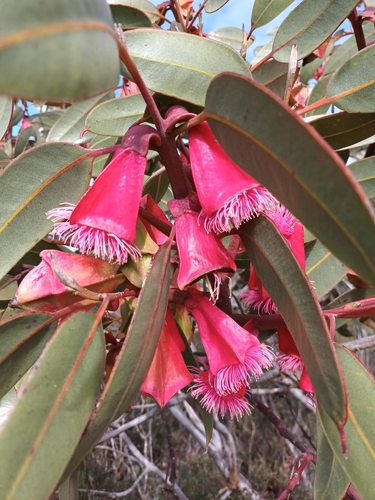
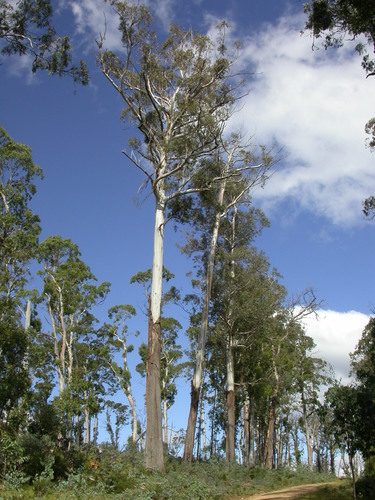
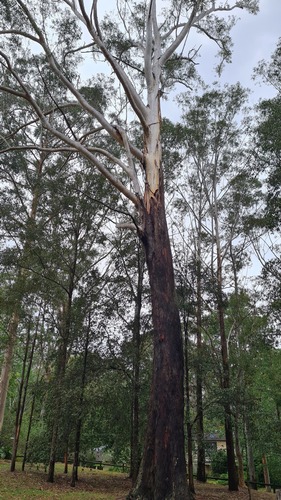
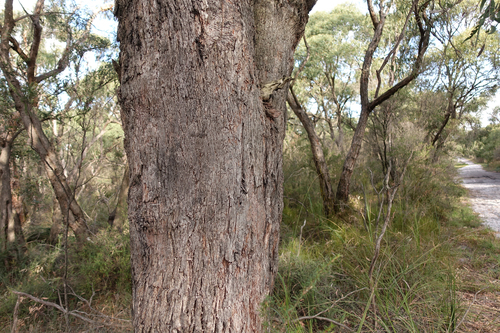
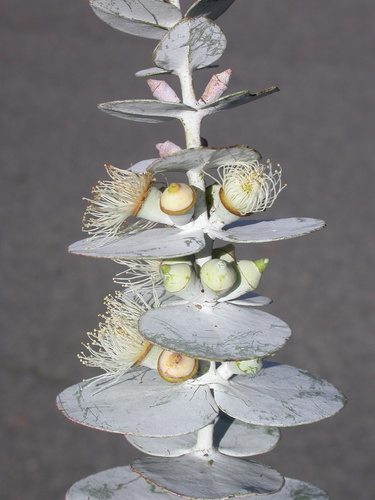
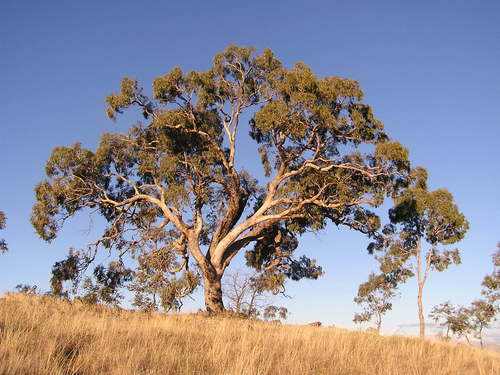
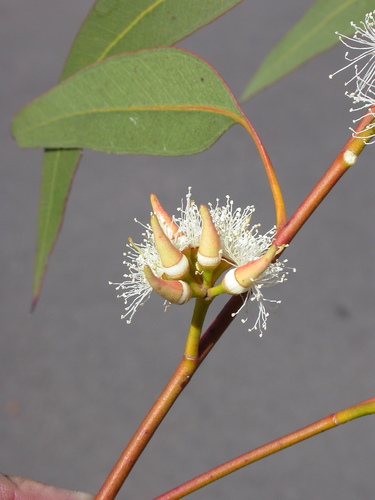
Eucalyptus amplifolia, commonly called cabbage gum, is a tree species. In forested settings, it can reach up to 30 m (100 ft) tall, but it is typically shorter when growing in open, sparser woodland. Its trunk and branches are covered in smooth bark that is often blotchy, with colors ranging from white, cream, yellow, and grey to pink or blue-grey. Loose, flaking grey bark slabs usually remain on the base and lower portion of the trunk. Leaves on young Eucalyptus amplifolia plants are rounded, egg-shaped, or triangular, green, and measure 50–220 mm (2–9 in) long by 35–180 mm (1–7 in) wide. These young leaves are mostly held horizontally to the ground. Adult leaves are arranged alternately along stems, are broadly lance-shaped, and measure 75–250 mm (3–10 in) long and 16–70 mm (0.6–3 in) wide, growing from a 10–30 mm (0.4–1 in) long petiole. The side-veins of the leaves angle at 45° or more relative to the central midrib, and both sides of adult leaves are the same dull or glossy green shade. Flower clusters of Eucalyptus amplifolia hold seven to fifteen or more individual flowers. The clusters grow from a flattened or angular peduncle 7–15 mm (0.3–0.6 in) long, and individual flowers are either attached by a pedicel up to 8 mm (0.3 in) long, or are sessile (lacking a pedicel). The flower buds are cone-shaped. The floral cup is hemispherical and 2–3 mm (0.08–0.1 in) long, while the conical operculum is 7–9 mm (0.3–0.4 in) long and around 4 mm (0.2 in) wide at the point where it connects to the floral cup. Flowering takes place between November and January. After flowering, the plant produces a woody, hemispherical capsule fruit that is 2–5 mm (0.08–0.2 in) long and 4–6 mm (0.16–0.24 in) wide, borne on a 1–5 mm (0.04–0.2 in) long pedicel. Three or four upward-pointing valves are present at the top of the fruit. Cabbage gum grows in grassy woodland and forest habitats, often occurring in depressions and on river flats. Subspecies amplifolia occurs on the coastal plains of New South Wales from Taree to Batemans Bay, with isolated populations as far north as Coffs Harbour. It is also found in the Megalong Valley and on the Southern Tablelands near Goulburn. Subspecies sessiliflora grows in northern New South Wales, specifically in the Tenterfield, Armidale, and Casino districts, and also occurs in adjacent areas of Queensland.