About Eucalyptus accedens Fitzg.
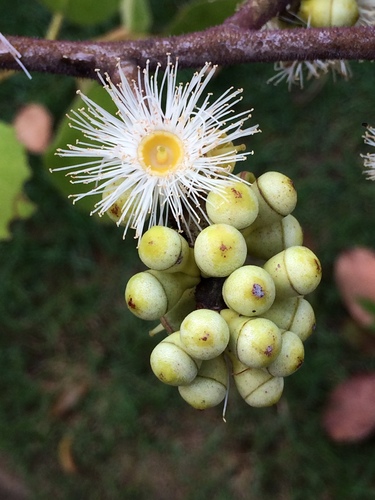
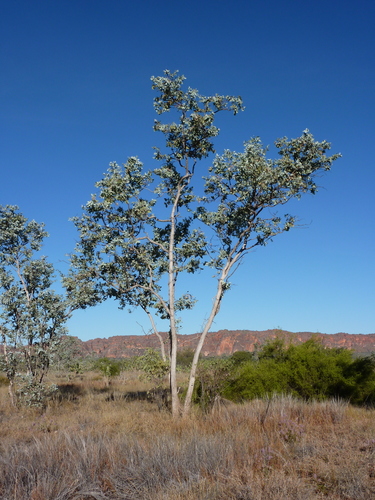
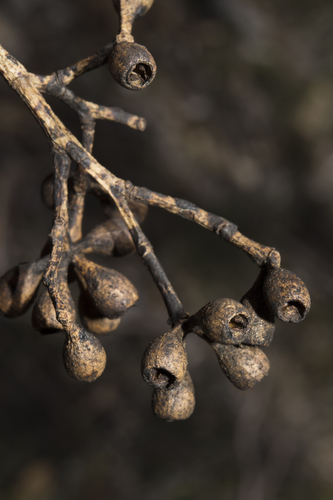
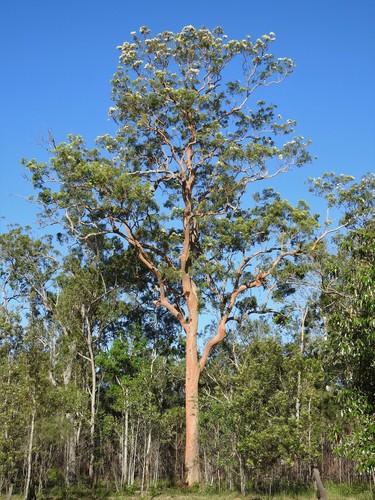
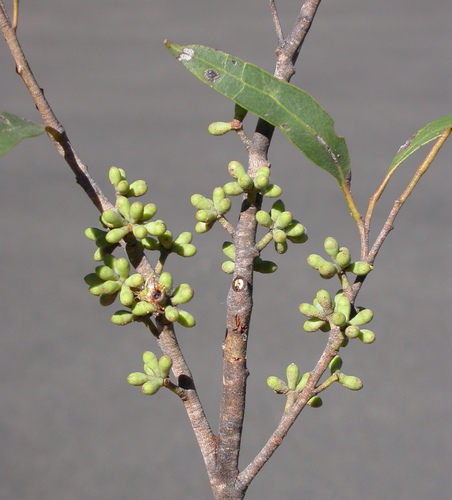
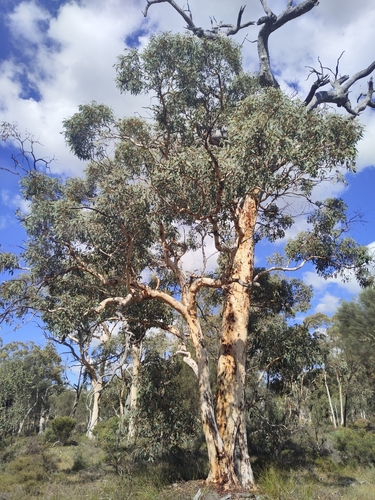
Eucalyptus accedens Fitzg. is a tree that typically reaches 15 to 25 metres (49 to 82 ft) in height. It has branches high on its trunk, forms a lignotuber, and can reach a trunk diameter of up to 1.5 metres (5 ft). Hollows form easily in its dead branches or at sites where limbs have fallen. This species has smooth bark, which is distinctively covered in a talc-like powder; when fresh, the bark is pale-white, and it turns orange before shedding. Its adult leaves are arranged alternately, are the same dull blue-green color on both surfaces, and have lanceolate blades that taper to a pointed tip. Leaf blades measure 8 to 18 centimetres (3.1 to 7.1 in) long and 1.2 to 3 cm (0.47 to 1.18 in) wide, and leaf petioles are 1.3 to 3.2 cm (0.51 to 1.26 in) long. White flowers grow between December and April. The inflorescence is single and axillary, with a peduncle 0.7 to 1.7 cm (0.28 to 0.67 in) long. Pedicellate buds form in clusters of 7, 9 or 11, and are cylindrical, obovoid or ovoid in shape. The fruit is pedicellate and cylindrical to barrel-shaped, measuring 0.5 to 0.9 cm (0.20 to 0.35 in) wide. The fruit holds brown, ovoid or flattened-ovoid seeds that are 1.5 to 2.5 mm (0.06 to 0.10 in) long. Eucalyptus accedens looks very similar to Eucalyptus wandoo, but can be distinguished by its seasonally present orange-hued powdery bark coating. It also has larger, more rounded buds and more rounded juvenile foliage than E. wandoo. This species, commonly called powderbark wandoo, grows in gravelly or clay-loam soils over laterite. It is most often found on stony ridges or lateritic breakaways, and often grows above stands of Eucalyptus wandoo. Its native range in Western Australia extends from south-east of Geraldton in the Mid West region, south through the Darling Range to Williams in the Wheatbelt region. It occurs in woodland areas. In the overstorey, Eucalyptus wandoo often grows below Eucalyptus accedens; Eucalyptus accedens may also associate occasionally with Eucalyptus astringens, and sometimes with Eucalyptus marginata on the western fringe of its range. Common understorey associated species include the shrubs Hypocalymma angustifolia, Hibbertia hypericoides, Hakea lissocarpha, Acacia pulchella, Hovea chorizemifolia, Gastrolobium microcarpum, Lepidosperma leptostachyum and Bossiaea eriocarpa. In horticulture, Eucalyptus accedens is commonly sold as an ornamental shade or shelter tree. Its bark is often used to deter ants. This tree tolerates a wide range of soil types, except lime, is reasonably drought tolerant, and is available commercially as seed or seedlings. In 2004, the powder that accumulates on its trunk was tested as an arthropod deterrent; results showed ant mortality was much higher on powder-coated paper discs than on untreated control discs.