About Estigmene acrea Drury, 1773
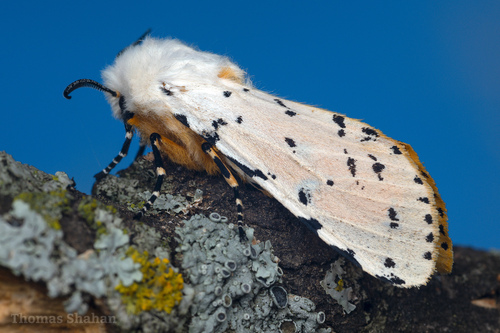
This species is scientifically named Estigmene acrea Drury, 1773. Its head and thorax are white, while the abdomen is yellow orange with a row of black spots. The forewing is white with a variable pattern of black spots, and some individuals have no spots at all. Males have yellow orange hindwings, and females have white hindwings. Both sexes have three or four black spots or blotches on their hindwings. The wingspan ranges from 4.5 to 6.8 cm (1.8 to 2.7 in). Yellowish eggs are laid in clusters on the leaves of host plants. The larva of this species is called the salt marsh caterpillar, and it grows to about 5 cm (2 in) in length. Larval body color is highly variable, ranging from pale yellow to rusty orange brown to dark brownish black. The larva is hairy, covered in numerous soft setae that grow in tufts, with several tufts present on each body segment. A few individual longer hairs grow toward the posterior end of the body. The thoracic and abdominal segments have a few rows of orange or black warts, and each segment bears one tiny white dot on both sides of the larva's body. The species pupates inside a cocoon partially constructed from the larva's own hair, usually formed by wrapping the larva's body in a leaf or other debris. The insect remains in the larval stage inside the cocoon through winter, pupates in spring, and emerges as an adult in late spring. In the southern parts of the species' range, there may be several generations per year.