About Eschscholzia californica Cham.
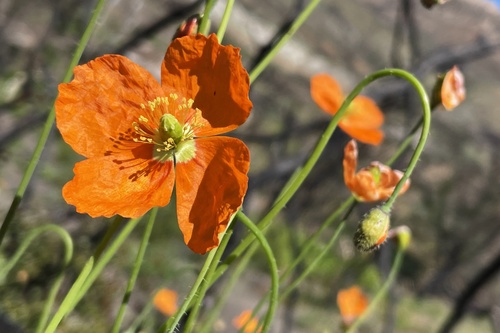
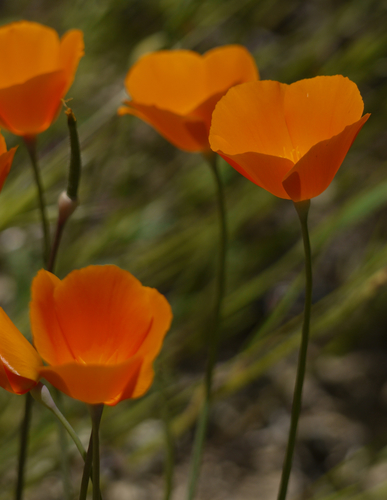
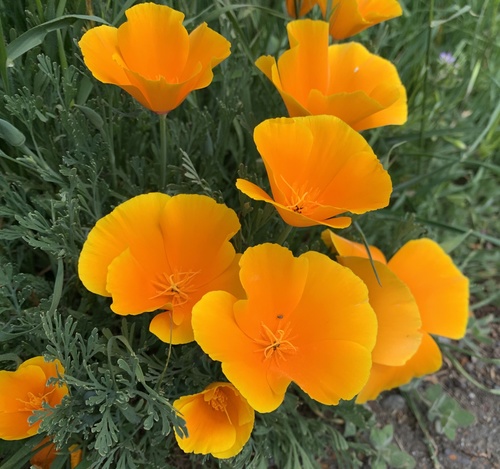
Eschscholzia californica Cham., commonly known as California poppy, is a perennial or annual plant that grows 5–12 inches (13–30 cm) tall. It has alternately branching glaucous blue-green foliage, with leaves alternately divided into round, lobed segments. Its flowers are solitary on long stems, have a silky texture, and feature four petals that are each 2 to 6 cm (0.79 to 2.36 in) long and broad; flower colors range across yellow, orange, and red. In the northern hemisphere, flowering occurs from February to September. The petals close at night or during cold, windy weather, and reopen the next morning, though they may stay closed on cloudy days. The fruit is a slender, dehiscent capsule that is 3 to 9 cm (1.2 to 3.5 in) long. It splits in two to release seeds, and sometimes splits explosively with an audible snap; the numerous small seeds are 1.5–1.8 mm (0.059–0.071 in) wide and are black or dark brown. This plant will reseed itself under ideal conditions, or when winters are cold. Anecdotally, it can be an aggressive reseeder in home gardens, and will eventually form a groundcover. In its native range, it survives mild winters and dies back completely in colder climates. Its native habitat spans California, extending to Oregon, Washington, Nevada, Arizona, New Mexico, Sonora, and northwest Baja California. The Antelope Valley California Poppy Reserve is located in northern Los Angeles County; at peak bloom, orange flowers appear to cover the reserve’s entire 1,745 acres (706 ha). Other well-known California poppy meadow sites include Bear Valley in Colusa County and Point Buchon in San Luis Obispo County. E. californica is drought-tolerant, self-seeding, and easy to cultivate. It is best grown as an annual in full sun, in well-draining sandy or loam soil. Horticulturalists have developed many cultivars with a wide range of colors, and different blossom and stem forms. These cultivars typically do not breed true when they reseed, and their seeds are often sold as mixtures. Three cultivars have earned the Royal Horticultural Society's Award of Garden Merit: 'Apricot chiffon', with yellow petals flushed pink and orange; 'Dali', which has red flowers; and 'Rose chiffon', with pink and white flowers. In cooking and food preparation, California poppy leaves are used as food or a garnish, while the seeds are used in cooking. No clinical trials have been conducted to demonstrate that California poppy effectively treats psychiatric disorders in humans.