About Erythropygia leucophrys (Vieillot, 1817)
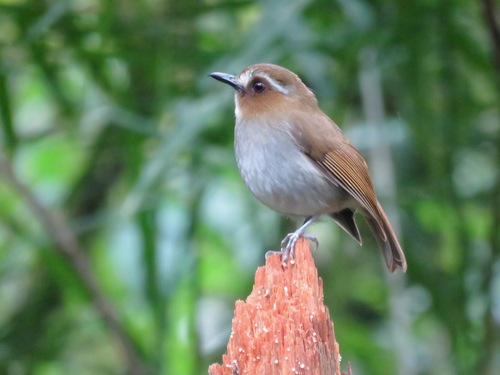
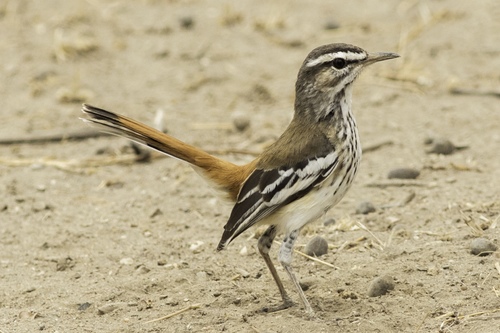
Description: The white-browed scrub robin (Erythropygia leucophrys) measures 14.0–16.5 cm from bill tip to tail tip, and males and females are alike in appearance. It has a distinct pale superciliary stripe, and its crown can be warm brown, olive brown, or greyish brown. Its wings are dusky but clearly marked: the greater and lesser wing coverts always have white tips, while the secondaries may or may not have white edging. The amount of streaking on the breast varies widely; in the subspecies ovamboensis, streaking is reduced to fine streaking that encircles the throat. The breast and flanks have a variable wash of tawny buff. The mantle and back range from brownish to hazel or rufous, depending on the subspecies. The tail is greyish brown to rufous, with a black subterminal band and white feather tips and corners. Juveniles have mottled plumage but retain the same tail pattern seen in adults. Distribution and habitat: The white-browed scrub robin occurs in Angola, Botswana, Burundi, the Republic of the Congo, the Democratic Republic of the Congo, Djibouti, Eswatini, Ethiopia, Gabon, Kenya, Malawi, Mozambique, Namibia, Rwanda, Somalia, South Africa, South Sudan, Tanzania, Uganda, Zambia, and Zimbabwe. Its range covers tropical, subtropical, and temperate latitudes. It is present, and usually common, in any mesic to arid woodland or savanna that provides cover, open scrub, or thickets. In the Eastern Highlands, it only occurs up to 1,400 metres, and in East Africa it occurs up to 1,500 metres. It is replaced on Kalahari sands by the Kalahari scrub robin, while in the Horn of Africa it lives in sympatry with the rufous bush chat, a species that has no white markings on its wings. Suitable habitat for this species is usually grassy, a condition that facilitates nesting.