About Erythropygia galactotes (Temminck, 1820)
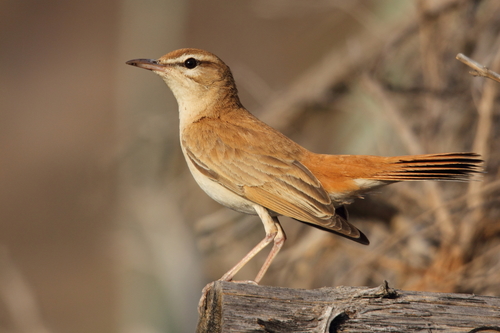
Erythropygia galactotes, commonly known as the rufous-tailed scrub robin, has adult males and females that are similar in appearance. Adults measure approximately 6 inches (150 mm) in length, with relatively long legs and a large rounded tail. Their upper parts are a rich brownish chestnut, while the rump and uppertail coverts are more distinctly rufous. A distinct, broad, curved creamy-white streak runs from the nostrils to behind the eye, and a dark brown line passes through the eye. The area under the eye is whitish, and the ear coverts are pale brown. Both the eye and beak are brown, but the lower mandible of the beak has a greyish base. The underparts are buffish white, with the chin, central belly and undertail coverts paler than other underpart areas. The wing feathers are dark brown, fringed with buff on the leading edge and pale chestnut-brown on the trailing edge; secondary feathers have white tips. The central pair of tail feathers are bright rufous-chestnut with narrow black tips, and the remaining tail feathers share a similar base colour, with white tips and adjacent broad black bands. The legs and feet are pale brown. Juveniles have a similar overall appearance, but are generally a paler sandy-brown colour. This species moults its plumage in autumn; before moulting, the white tips of the tail feathers may be reduced in size or worn away. The song is a somewhat lark-like, often disjointed sequence of notes, which can be clear and loud or soft. Males sing from an elevated position near the top of a tree, on a pole, or on a wire, and the song is often described as having a sad tone. The rufous-tailed scrub robin is a partial migrant. Its breeding range stretches from Portugal, southern Spain and the Balkan Peninsula, through the Middle East to Iraq, Kazakhstan and Pakistan. In Africa, it breeds from Morocco to Egypt, and south of the Sahara as far east as Somalia. It is an uncommon vagrant in northern Europe. It winters in North Africa and eastwards as far as India. Its preferred habitat is dry, scrubby open country with patches of dense bushes, located in lowlands or foothills. In areas where it is abundant, it can also be found in parks, vineyards and large gardens. This species has an extensive range, estimated at 4.3 million square kilometres (1,700,000 sq mi), and a large global population. Europe holds an estimated 96,000 to 288,000 individuals, and the European range makes up between one quarter and one half of the species' full global range, putting the global population estimate between 196,000 and 1,150,000 individuals. As of 2013, the population size appeared to be stable. The species was not considered to meet the IUCN Red List thresholds for threatened status (which require a population decline of more than 30% over ten years or three generations), so it was evaluated as Least Concern. In ecology, the rufous-tailed scrub robin sometimes associates with the woodchat shrike (Lanius senator), and may nest in a neighbouring tree. The woodchat shrike perches near the top of a tree to stay alert for aerial predators such as sparrowhawks and buzzards, while the scrub robin perches on a bush or lower branch to scan the ground for ground predators including snakes, cats, weasels, foxes, genets and ocellated lizards. Both species are skilled at luring predators away from the nest: they fly toward the predator to get its attention, then flit away from the nest site through undergrowth. The rufous-tailed scrub robin can also recognise the warning calls of other bird species and respond accordingly.