About Erythronium japonicum Decne.
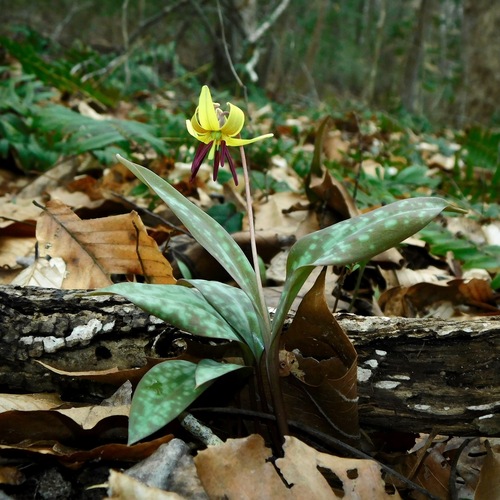
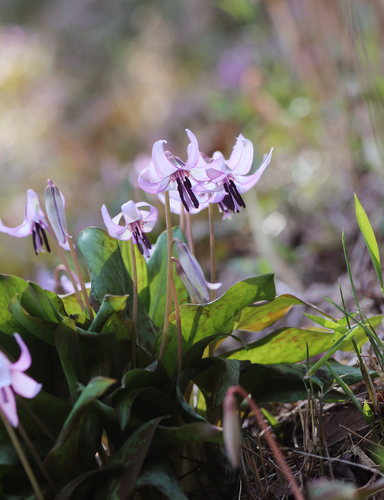
Erythronium japonicum Decne., commonly called Asian fawn lily, Oriental fawn lily, or Japanese fawn lily, is a pink-flowered trout lily species in the lily family. It is native to Japan, Korea, the Russian Far East (Sakhalin Island and Kuril Islands), and northeastern China (Jilin and Liaoning). A spring ephemeral, it blooms from April to June in woodland habitats. It is called zhūyáhuā (猪牙花) in Chinese, eolleji (얼레지) in Korean, and katakuri (片栗) in Japanese. Its stem can grow up to 20 centimeters (7.9 inches) long, with up to 30% of the stem growing underground. The plant produces an elongated bulb that reaches up to 6 centimeters (2.4 inches) long, and rarely exceeds 1 centimeter (0.39 inches) in width. Its leaves range from broadly elliptical to lanceolate, with leaf blades growing up to 12 centimeters (4.7 inches) long and 7 centimeters (2.8 inches) wide. It bears solitary, rose-colored flowers. Applying the general common name trout lily to this species is somewhat of a misnomer, because individual E. japonicum plants may or may not have the flecked dark leaf markings that the trout lily common name is associated with. Katakuriko (片栗粉, "katakuri powder") is a starch that takes its name from this plant; originally, the name referred specifically to starch obtained from the bulbs of E. japonicum. Due to the small amount of starch this plant can produce, the original starch is no longer common, and potato starch now fills both its production role and its name. This species is not known to be farmed. Wild populations have been harvested by poachers, who are typically not seeking starch, but are instead wildflower enthusiasts or plant traffickers. Powder from this plant has also been used as an ingredient in ointment to treat rashes. The claim that it is used in wagashi, specifically in the confection called katakuri-rakugan, is apocryphal. Historian Kahei Mori notes that this traditional confection, once presented to the Morioka Domain, was actually made using starch from lily bulbs.