About Erythrolamprus miliaris (Linnaeus, 1758)
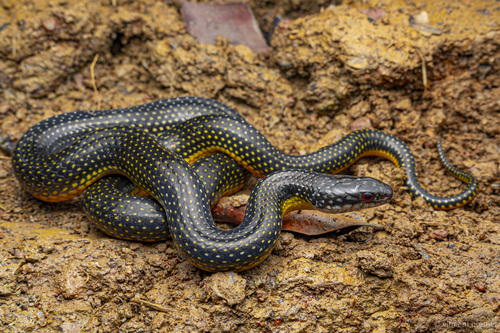
Erythrolamprus miliaris, first described by Linnaeus in 1758, has a stout, muscular build and a relatively short tail. The ratio of tail length to total body length ranges from 15.0% to 19.8%, with an average of 18.6%. Fully grown adults can reach a total length of around 50 cm, equal to about 20 inches, including the tail. On its dorsal side, this species is pale olive-brown or yellowish, and every smooth dorsal scale has black edges. On its ventral side, it is a solid, uniform yellow. Erythrolamprus miliaris is distributed in South America east of the Andes Mountains, ranging from the Guyanas in the north south to Paraguay. A subspecies that was previously classified under this species and found further south, in southeastern Brazil, Paraguay, Uruguay and northeastern Argentina, is now recognized as its own separate full species, Erythrolamprus semiaureus. This snake species lives in aquatic and riparian habitats. It can be found in both lowland tropical rainforest and Atlantic forest, at elevations between 0 and 100–700 m (330–2,300 ft).