About Erythrina edulis Triana ex Micheli
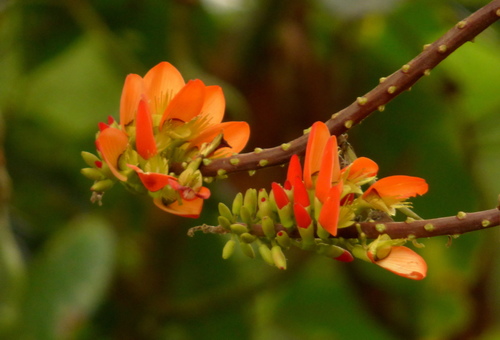
Erythrina edulis Triana ex Micheli, commonly called basul, is a nitrogen-fixing tree native to the Andean region, ranging from western Venezuela to southern Bolivia. It has different regional common names across its native range: it is known as "frijol mompás" in Venezuela; "psonay", "pajuro", "sachaporoto del basul", or "poroto del sacha" in Bolivia, Peru, and northwest Argentina; "chachafruto", "balú", "baluy", or "sachaporoto" in Colombia; and "guato" in Ecuador. While widely recognized by local people, it is not commonly cultivated, and future research focused on its use in agroforestry is needed. As a legume, it produces protein-rich beans contained in pods that can be used for human or animal nutrition, its leaves and branches can be used as fodder, and it can also be planted as a living fence. Erythrina edulis is a vigorous, fast-growing, early-maturing legume tree, and is considered one of the easiest tree species to grow. It is sensitive to cold, so it only grows in the tropics and is not suited to temperate regions. Its optimal growth temperature falls between 15 and 22 °C (59 and 72 °F), and it grows across a broad range of altitudes from 900 to 3200 meters above sea level. In its native habitat, average annual precipitation ranges between 450 and 1,800 mm (18 and 71 in). It grows best in well-drained soils with a sandy or clay texture, and a soil pH between 5.5 and 7. As a totipotent plant, Erythrina edulis propagates easily. Cut stems can be planted directly into soil and will sprout. It can also be propagated by planting mature seeds, which germinate easily in most cases. Grafting is another propagation method, and its main advantage is that it leads to earlier seed production. Seeds must be planted very soon after harvesting, because they lose viability just 8 days after harvest. A thin paraffin coating can extend seed viability to 20 days. Erythrina edulis produces red flowers arranged in racemes, which are pollinated by bees, wasps, and birds. Seed ripening is not synchronized across the tree. These trees can live for decades, and grain production increases as the tree ages. A 3- to 4-year-old tree produces about 30 kg (66 lb) of grain per year, while a 20-year-old tree produces 120 to 210 kg (260 to 460 lb) of grain per year. Through its symbiotic relationship with Rhizobium bacteria, Erythrina edulis can fix atmospheric nitrogen, so it does not require additional nitrogen fertilizer. Basul can act as a food source for both humans and animals. It produces pods that hold grains, with pod lengths ranging from 15 to 65 cm (6 to 26 in), and an average length of around 32 cm (13 in). Green pods can be eaten, but mature grains are the more commonly consumed part. Each pod holds 6 grains, which measure 1.4–6.4 cm (0.6–2.5 in) long and weigh 15–30 g (0.5–1.1 oz). Fresh grains have a high water content of around 80%, which means they cannot be stored easily. On a dry matter basis, the grains have a protein content between 18 and 23%. This protein has a similar composition to protein in most legumes, with a high lysine content and lower concentrations of sulfur-containing amino acids (methionine and cysteine) and tryptophan. Grains also contain a high starch content, ranging from 26 to 40%. The amino acid profile of Erythrina edulis seeds complements the amino acid profiles of cereals and tubers well. To prepare grains for human consumption, they must be boiled or fried for at least 45 minutes. Frequent consumption of raw grains is toxic, as they contain alkaloids. All other Erythrina species contain much higher levels of alkaloids and are significantly more toxic, and some of these species resemble E. edulis. While the difference between the species is clear to a trained observer, less experienced people should take care when harvesting and eating the beans. Cooked E. edulis beans can be used in soups, cakes, salads, tortillas, and other dishes. After boiling, grains can be dried, ground into flour, and used for various purposes. E. edulis grains are not widely available for consumption, and their use is typically limited to periods when other food sources are scarce. However, South American governments in the Andean region are promoting E. edulis, for example by distributing recipes to raise awareness of this potential food source. The Colombian government is also developing canned preservation of these beans to extend storage life and open export markets. Leaves, seeds, and pods of Erythrina edulis can all be used as animal fodder. Leaves have a high protein content of around 24%, are rich in potassium, and low in calcium. When pods and grains are fed to chickens, fish, pigs, or rabbits, they must be boiled first to avoid toxicity from alkaloids. Boiling is not required when feeding pods and grains to goats and cattle.