About Erynnis tages (Linnaeus, 1758)
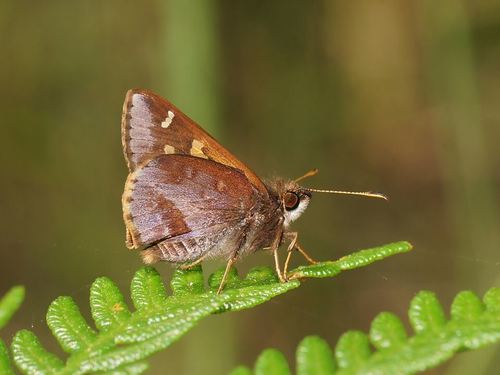
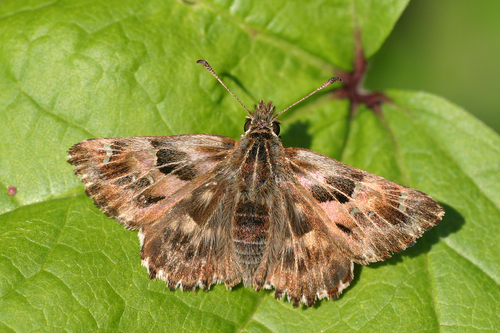
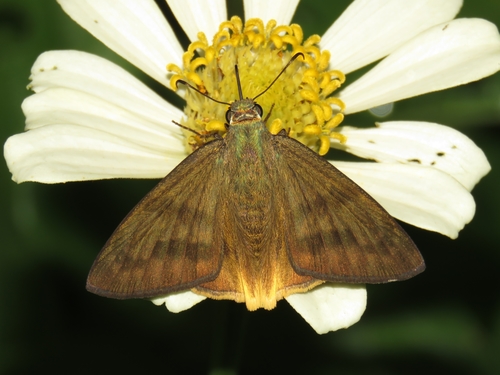
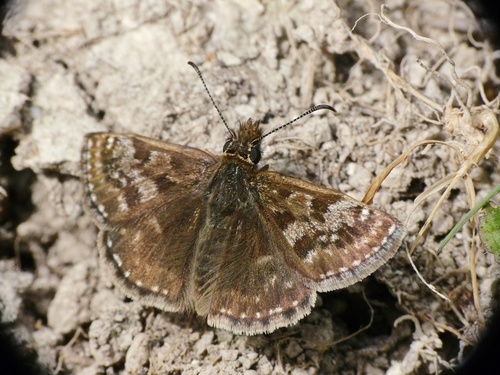
Erynnis tages, the dingy skipper, can be distinguished from other skippers by its predominantly monochrome gray-brown wing coloration, marbling that is only present on the upper side of the forewings, and a series of small white dots along the wing edge. It is probably the most moth-like British butterfly, and normally rests with its wings held in a moth-like fashion. This well-camouflaged brown and grey butterfly can be confused with the grizzled skipper, the Mother Shipton moth, or the burnet companion moth. Faded specimens of Carcharodus alceae are distinguished by glass spots in the forewing and a jagged rear wing edge. A key feature of adult Erynnis tages is their resting posture: their roof-shaped wings are held one on top of the other, which resembles the posture of deltoid moths. In Seitz's description: Th. tages L. (86 c) has grey-brown forewings with two oblique black bands, edged proximally with yellowish grey. It has a marginal row of small light dots and two apical dots, one of which is transparent. The hindwing is black, and unspotted in most typical specimens. The species ranges across all of Europe and Northern Asia to the Amur. The aberration ab. clarus [Caradja, 1895 ab.] consists of very pale specimens that can occur anywhere among typical Erynnis tages. The taxon popoviana Nordm. (= sinina Gr.-Grsh.), now recognized as the full species Erynnis popoviana (86 c), is hardly more than a former synonym; it is light grey, with a row of white marginal dots and a second similar row across the center, and the hindwing has a light discocellular spot, found in Dauria, Amur, and China. The taxon unicolor Frr., now a recognized subspecies (86 c), is uniformly brown grey without any markings, found in Greece and Asia Minor. The taxon cervantes Grasl., now classified as E. tages ssp. cervantes (Graslin, 1836) (86 d), is larger and much darker than typical E. tages; its dark bands are obsolete or only indicated by black streaks, and marginal dots are scarcely visible, found in southern Spain. The larva is green with a brown head and a yellow lateral stripe dotted with black; it feeds on Eryngium and Lotus, and occurs in July and late autumn. The pupa is green with a reddish abdomen. Adult butterflies emerge in April and May, and again from July onward, and are plentiful across their range. They fly low above the ground and prefer to settle on roads. The dingy skipper is widespread, ranging from the Iberian Peninsula and Ireland in the west to the Pacific coast of East Asia. In the north, its range boundary roughly follows the 62°N line of latitude. In Asia, the species extends south across the Caucasus to Pakistan, and its range reaches far southern China. In Bavaria, the species' distribution features noticeable gaps, moving from more or less densely populated areas to regions where the species is absent across large stretches. In southern Bavaria, the species is concentrated in the Alpine region, the valleys of Alpine rivers (particularly the Lech and Isar), and river-near areas of the Donaumoos. In Northern Bavaria, populations are concentrated on the Franconian Alb, parts of the Franconian Keuper-Lias-Land, and the Mainfränkische Platten. A secondary concentration in the Upper Main hill country leads to scattered records along the northeastern border, where the species occurs from the Vogtland over the Fichtelgebirge to the Upper Palatinate and Bavarian Forest. With the exception of the East Bavarian low mountain range, the occurrence of the dingy skipper coincides with the distribution of limestone areas (Jura and Muschelkalk) or specific geological features (basalt, gypsum, and basic sandstones such as dolomitic arkose). It is widely but patchily distributed across Britain. It occurs further north than any other skipper in Scotland, with some isolated colonies in the Inverness region. It is also one of two skipper species found in Ireland, where it has a patchy distribution with main strongholds along the western side. The species is declining in several European countries, including the UK and Armenia. Erynnis tages favors open grassy habitats up to 2,000 metres above sea level. It uses a variety of habitats, including chalk downland, woodland clearings, coastal dunes, railway lines, and waste ground. Its habitats are mainly dry, nutrient-poor grasslands. It also regularly inhabits extensive grassland with one or two-tier meadows and pastures, as well as sparsely vegetated habitats with raw soil and early successional plant communities. In forests, adult individuals fly in very sparsely wooded stands or on forest meadows, along path edges and forest edges. The species also occurs in fens. Disturbed sites such as paths with a dry, warm microclimate count as suitable habitat. Adult Erynnis tages fly in two generations, occurring from May to June and July to August, but only a single generation appears in northern regions and at high altitudes. The flight period in Bavaria extends from mid-April to early September, with peak activity from early May to late June and the highest abundance in the last third of May. The first and second generations overlap. The second generation, which only occurs irregularly or regionally, is always significantly smaller. Adults prefer low-growing or very patchy vegetation, and often stay on bare ground to sunbathe or absorb moisture and minerals. Males also move from perches on the ground or on low plants to track down females by intercepting approaching insects of the right size. Their flight is usually very fast and low; the site-faithful adults typically only cover short distances of a few meters before settling again. There is very little published information on flower visitation by this species. In Bavaria, out of 14 total listed plant species, only three are mentioned repeatedly. In addition to the most important egg-laying plants Hippocrepis comosa and Lotus corniculatus, Ajuga reptans is also commonly visited. Other nectar sources include yellow-flowered Fabaceae such as Anthyllis vulneraria, Chamaecytisus ratisbonensis, and Medicago falcata, as well as blue- and violet-flowered mint family plants such as Salvia pratensis and Thymus spp. Flower visits to taller perennials such as Cirsium arvense, Eupatorium cannabinum, or Echium vulgare are rare, as adults mostly stay close to the ground. Besides visiting flowers, adults regularly feed on moisture from moist soil, carrion, and excrement. Eggs are laid individually on the upper side of mostly terminal leaflets near the ground, with gaps or weak-growing, microclimatically favored locations preferred. Observations of egg laying, eggs, or caterpillars are only available in isolated cases. The following egg-laying and host plants have been recorded in Bavaria: Hippocrepis comosa, Lotus corniculatus, Securigera varia, Tetragonalobus maritimus. Almost all records relate to observations of oviposition or egg discoveries, only a single record of an adult caterpillar was found on Lotus corniculatus. In Great Britain, eggs were found on the tender young leaves of bird's-foot trefoil (Lotus corniculatus), the favoured larval food plant in the region, though horseshoe vetch (Hippocrepis comosa) and greater bird's-foot trefoil (Lotus pedunculatus) are sometimes used. Other larval host plants in Europe include Eryngium, Coronilla, Medicago, among others. The hemispherical egg has clear longitudinal ribs, is initially light yellow and later turns orange-red, and is easily recognizable on the green upper leaf surface with targeted searching. This combination of features provides an additional reliable detection method for the species. During the day, caterpillars hide in a shelter made of spun leaves and feed mainly at night. Caterpillars create a shelter by spinning leaves together and feed until they are fully grown in August. They then build a larger tent to form a hibernaculum, where they overwinter. Pupation occurs the following spring without any further feeding. The overwintering web is dense like parchment, so water cannot penetrate it. Summer-spun cocoons, which produce pupae that develop into second generation butterflies, have a loose texture.