About Eryngium yuccifolium Michx.
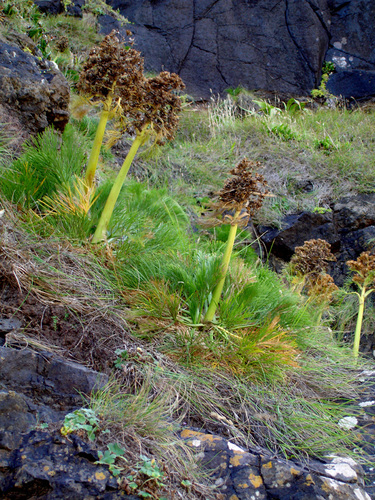
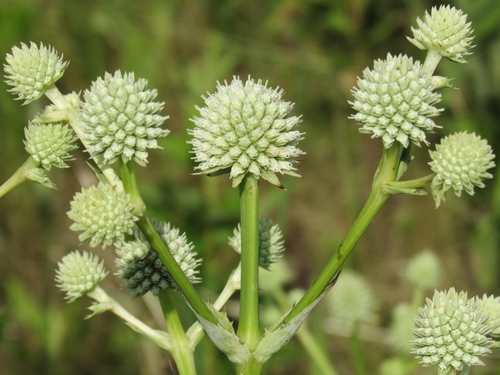
Eryngium yuccifolium Michx., commonly called rattlesnake master, has stiff, long, narrow leaves that end in a sharp tip. Each leaf measures 15–100 cm long and only 1–3 cm broad, is bluish-green, covered in a waxy coating, and lined with regularly spaced bristles or spines along its edges. Its root system is made up of a central taproot surrounded by thick, fleshy fibrous roots. The plant grows up to 1.8 m tall, and produces 10–40 dense, ball-shaped umbels of flowers at the top of each stem. Each condensed umbel is 1–3 cm in diameter and resembles a flowerhead. Individual flowers within the umbels are small, measuring 3–4 mm in diameter, with greenish-white or bluish-white petals and a faint honey-like scent. Every flower sits beneath a spiny green bract, and every flower cluster is underlaid by a small star-like rosette of spiny bracts. Flowers bloom in July and August. After flowerbuds open, pollen matures and is released two to three days before the stigmas become receptive, which encourages cross-pollination by making self-fertilization unlikely. Rattlesnake master has an unusually high seed set, close to 90%. There are two recognized varieties. Eryngium yuccifolium var. yuccifolium, the northern variety, is widely distributed across the eastern, midwestern, and southeastern United States. It grows in pine savannas, pine flatwoods over loamy or clay soils, wet to dry prairies, olivine barrens, diabase barrens and glades, and other open sites that receive at least periodic moisture. Eryngium yuccifolium var. synchaetum, the southern variety, is endemic to the southeastern Coastal Plain, ranging from southeast North Carolina to south Florida and extending west across the Gulf Coastal Plain. It occurs in wet savannas, particularly those growing over calcareous clay soils. In remnant natural areas, Eryngium yuccifolium is fairly intolerant of human-caused disturbance, but it establishes readily when planted in prairie restorations. Its flowers attract a wide variety of insects, including short-tongued and long-tongued bees, flies, beetles, and butterflies; wasps are the most numerous group of visiting insects. It is a larval host plant for the rare rattlesnake-master borer moth (Papaipema eryngii). While Eryngium yuccifolium is mostly self-pollinated, it is recognized as being of special value to native bees because it attracts large numbers of them for pollination. Fire facilitates the spread of Eryngium yuccifolium: fire increases seedling establishment, and the plant can grow more abundant overall in response to fire disturbance. This species is sold by native plant nurseries for prairie or native meadow restoration, and for use in gardens and landscapes. It grows best in full sun and well-drained soil, with a soil pH range of 5 to 7.5. It can develop root rot and die if soil stays wet or moist for too long. Once planted, it is best left undisturbed, and should not be dug up and replanted like many other perennials, because it develops a large taproot and other thick, fleshy roots. It often self-sows from a little to a good amount in garden settings. When propagated from seed, a period of cold-moist stratification is required. Fibers from rattlesnake master have been identified as one of the primary materials used in ancient shoe construction by midwestern Native Americans. Its roots were used medicinally to treat respiratory problems, rheumatism, and liver problems, to induce vomiting, and to treat rattlesnake bites. An infusion of the plant was drunk to relieve bladder problems and muscle pains.